
Blood on the Sand
A gladiator learns that survival in Rome’s greatest arena is measured not by glory, but by the courage to keep his story alive


The sun over the Roman Empire had a way of turning everything into gold, even the things that were meant to stay hidden. On most days, the Forum glittered. Market stalls shimmered. Soldiers’ armor flashed as if they carried small pieces of the sun on their backs. But on the days when the Games arrived, the sand inside the Colosseum looked different. It shimmered too—but with something darker.
That morning, Marcus Varian stood behind the heavy wooden gate of the arena, listening to the crowd rumble like a restless sea. He was young, barely twenty, but his eyes carried the weight of someone who had lived through more winters than he should have. He had not been born a gladiator. He had been made one.
A year ago, he was the son of a simple metalworker in Capua, living a quiet life that smelled of iron and smoke. Then the Legion came, demanding taxes that his family could not pay. Marcus had offered himself in place of the debt, believing he would serve as a soldier. Instead, he was sold to a gladiator school. And now, the Games wanted him.
The gate creaked. He tightened the strap of his arm guard and stepped into the light.
The roar hit him first—thousands of voices rising in excitement, calling for spectacle, calling for blood. The heat hit second, thick and merciless. Every breath tasted of dust and sun. Across the arena, his opponent emerged through another gate—a tall Thracian named Damarcus, a man feared for ending fights in a single strike.
Marcus swallowed hard.
He had been trained well, but training meant little when the sand beneath your feet felt like a grave waiting for a name.
The trumpet sounded.
Damarcus moved first, charging with surprising speed for a man his size. His curved blade flashed through the air, slicing at Marcus’s shoulder. Marcus leapt back, feeling the wind of the strike brush past his skin. The crowd roared. They loved speed. They loved fear. They loved the scent of danger as much as lions did.
Marcus steadied himself. His weapon—a straight, gladius-style sword—felt heavier today. Or maybe it was simply that the day felt heavier.
He blocked the next strike, metal ringing sharply. Damarcus smiled, sensing Marcus’s hesitation.
“You fight like a boy,” he growled.
“And you speak like one,” Marcus replied before he could stop himself.
Damarcus attacked again, furious. Their blades clashed. The crowd screamed. The sun beat down, reminding Marcus of the heat in his father’s forge. His father always said iron could be shaped into anything if the fire was hot enough. Marcus wondered if people could be shaped the same way.
The fight dragged on, both men circling, striking, retreating. Dust clung to their legs. Sweat soaked their tunics. Marcus felt the sting of a shallow cut along his forearm. Damarcus’s blade gleamed red.
Then, at last, Marcus saw it—a small opening. Damarcus raised his sword too high, leaving his ribs exposed. Marcus stepped in, quick as a spark from a hammer strike, and thrust his blade forward.
A gasp rippled through the arena.
Damarcus fell to one knee, breath escaping in short bursts. Marcus stood over him, sword pressed against his opponent’s neck. The entire Colosseum seemed to hold its breath.
Then came the moment Marcus hated most.
The choice was not his.
He looked to the imperial box. The governor sat beneath a canopy, surrounded by attendants and shade, his hand raised. The crowd waited, hungry for judgment.
Thumb up or thumb down.
Life or death.
Blood on the sand or mercy in the heat.
The governor held his pause longer than usual, letting the crowd shout their desires. Some screamed for death. Others for mercy. Marcus kept the sword steady, though his hands trembled.
He did not want to kill.
He had killed before in training, but never in the arena. Never like this. He didn’t want another ghost on his conscience. He didn’t want another night of broken sleep.
The governor finally lowered his hand.
Thumb up.
The crowd groaned with disappointment, but the decision was made.
Marcus stepped back and lowered his sword. Damarcus sagged, relief washing over his face. Attendants rushed forward to take him away. The trumpet sounded again, signaling Marcus’s victory.
He expected triumph. Cheers. Relief.
Instead, he felt only exhaustion.
As he walked back toward the gate, something caught his eye—a small girl in the crowd, standing beside her mother. She wore a simple white tunic and held a small clay figurine shaped like a gladiator. Marcus recognized the look on her face. Awe mixed with fear.
She didn’t see him as a killer or a hero. She saw him as a story.
And that frightened him more than anything.
Because stories had a way of outliving the truth.
Back inside the dim corridor of the gladiator school, Marcus sat on a stone bench, breathing slowly. The sand still clung to his skin. It always did. He wondered if it would ever wash off, or if it would stay with him forever, a reminder of every life-and-death decision made under the sun.
His trainer, an older man named Lucius, approached.
“You fought well,” Lucius said.
“I fought to survive,” Marcus replied.
Lucius nodded. “That is all any man does here.”
Marcus stared at the floor. “How many more fights?”
“As many as Rome wants,” Lucius said simply. “But remember this—every time you step onto that sand, you decide who you become. The empire may own your body, but not your story.”
Marcus wasn’t sure he believed him. But the words stayed with him.
Weeks turned into months. Marcus fought again and again—sometimes in duels, sometimes in group battles, sometimes even against wild beasts. He became known as the Young Flame for his speed and the fire in his eyes. Crowds chanted his name. Children carved his likeness into clay. Wealthy Romans paid to see him.
But he never forgot the truth.
Every fight was a gamble against fate.
Every victory was borrowed time.
And every drop of blood on the sand—his or another man’s—was a reminder of what the Games truly were. Not glory. Not honor.
But survival.
And as long as he survived, Marcus carried a quiet hope that one day, when the crowd screamed another man’s name, he would finally walk away from the arena and into a life where the sun only turned things gold, not red.
A life where the sand held no blood.
About the Creator
LUNA EDITH
Writer, storyteller, and lifelong learner. I share thoughts on life, creativity, and everything in between. Here to connect, inspire, and grow — one story at a time.
Keep reading
More stories from LUNA EDITH and writers in History and other communities.
Plague Doctor’s Journal
The journal was found in a wooden chest beneath the floorboards of an old house in Venice. Its pages were brittle, its ink faded, but the handwriting was elegant and precise. On the first page was a single line written in Latin: “To heal the living, one must walk with the dying.”
By LUNA EDITH5 months ago in History
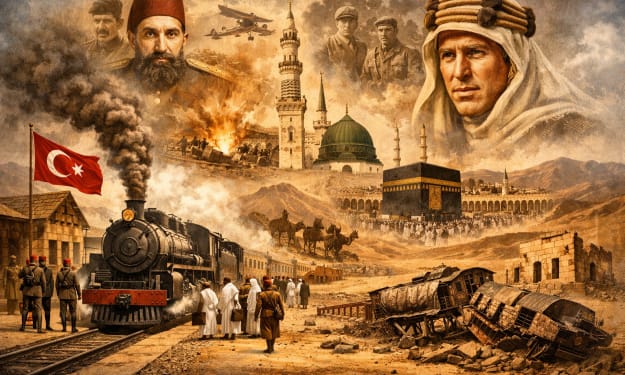
The Hijaz Railway: Why the Ottoman Empire’s Grand Vision to Unite Muslims Was Left Abandoned
In the early twentieth century, the Ottoman Empire launched one of the most ambitious infrastructure projects in the Muslim world: the Hijaz Railway. Conceived as both a symbol of Islamic unity and a practical solution to improve travel for pilgrims heading to Mecca, the railway represented the Ottoman Sultan’s vision of connecting distant Muslim lands. Yet, despite its promise and initial success, the project was ultimately left abandoned due to war, rebellion, and the collapse of the empire itself.
By Irshad Abbasi about 19 hours ago in History
Who is your "Person"?
It's important to recognize that you cannot go through life as easily on your own. My name is Elizabeth and I'm a survivor of child abuse and horrific trauma. Healing from trauma is not a quick fix and recognizing that it will take time, is part of the struggle.
By Elizabeth Woods4 days ago in Psyche



Comments
There are no comments for this story
Be the first to respond and start the conversation.