
Bangladesh Anti-Discrimination Student Movement in 2024
Quota reform movement against anti-discrimination

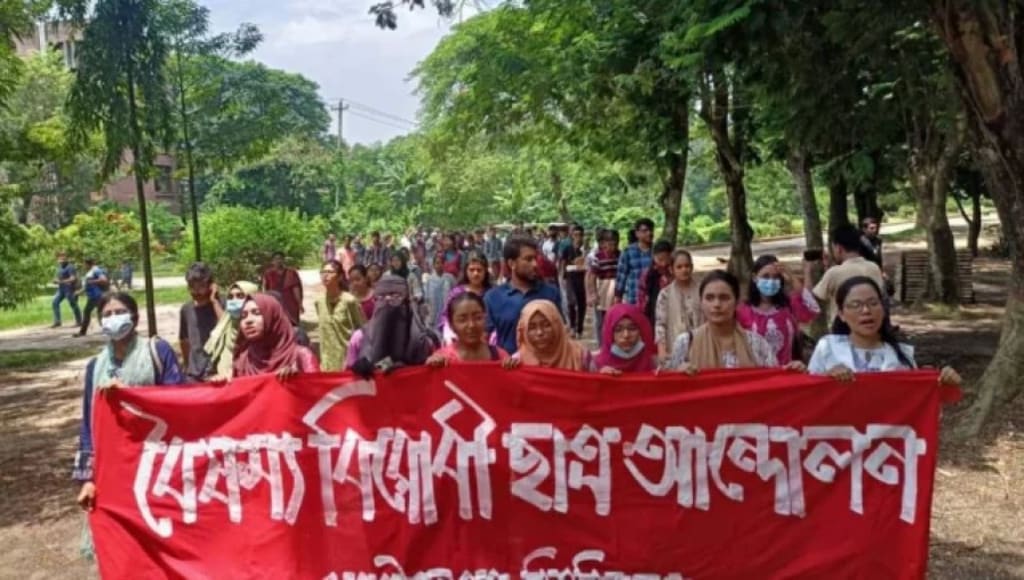
Bangladesh Anti-Discrimination Student Movement is an organization, formed by ordinary students of this country. On July 1, 2024, students of Bangladesh formed this organization intending to prevent quotas and discrimination. And later this movement took the form of a non-cooperation movement, and Prime Minister Sheikh Hasina resigned on August 5, 2024. And this is how a dictatorial government fell.
To move a success, on July 8, the organization announced a 65-member committee, including 23 coordinators and 42 co-coordinators. The increase in the movement is due to the formation of additional coordinator groups, with the students of different educational institutions in the country. At first, This movement was limited only to the students of public universities in Bangladesh.
But later on July 16, police shot at Rangpur Begum Rokeya University English department student and student coordinator Abu Saeed during the movement. As a result, students from all levels of Bangladesh joined the movement. And the quota reform movement got a new dimension. This is how the anti-discrimination student movement took the form of, a mass uprising.
How and Why did the Bangladesh Anti-Discrimination Student Movement start?
The quota reform movement in Bangladesh began with the demand to reduce the quotas in various government jobs. And to appoint them based on merit. After the independence of Bangladesh in 1972, the quota system was first introduced in government jobs. Where the allocation of the merit list was only 20 percent. 40 percent district-wise, 30 percent for family members of freedom fighters, and 10 percent for war-affected women.
Later, this quota system was changed several times. But today, even after 53 years of independence, there are more than 55 percent quotas in government jobs in Bangladesh. Like, 30% for freedom fighter relatives, 10% for district-based, 10% for women, 5% for marginalized groups, and 1% for the physically challenged.
As a result, only 44 percent of students can get a job on merit, Which is very sad for a citizen of an independent country. As a result, Bangladeshi students protested at different times demanding reform of this quota. With this, the students of Bangladesh started the quota movement three times, which first started, in 2013.
Then in 2018 after its movement, circulars were announced in favor of the agitators. However, the High Court declared the circular invalid, resulting in a resumption of agitation in 2024. At this time, during the movement, on 19th July 2024, the agitating students formed an organization called the Anti-Discrimination Student Movement to reform the quota, and several student coordinators led this organization.
Committee Formation and Coordinators of the Quota Reform Movement
To make the quota movement, successful students formed an organization called Anti Discrimination Student Movement on 1st July. The organization formed a 65-member committee on July 8, led by 23 coordinators and 42 co-coordinators.
However, due to the increase in agitation, on August 3, this organization formed a committee of 158 members of students from various educational institutions of the country, including 49 coordinators and 105 co-coordinators.
Some of the Coordinators Who Lead the Organization of the Bangladesh Anti-Discrimination Student Movement
Coordinators of anti-discrimination student movements
- Nahid Islam is a student of the Sociology department who is studying Master's, at Dhaka University.
- Rifat Rashid is a student of the international relations department of Dhaka University.
- Sarjis Alam is a student of the Botany Department.
- Hasnat Abdullah is a student in the English Department.
- Asif Mahmud is a student in the language Science department.
- Abubakar Mazumder is a student of the geography department at Jahangirnagar University.
- Arif Sohail is a student of the International Relations Department at Dhaka University.
- Abu Saeed is a student of Rangpur Rokeya University "English Department". And, was first martyred by the police while protesting on 16 July 2024.
Various Demands and Programs of the Bangladesh Anti-Discrimination Student Movement
1. 4-point Program on July 1, 2024,
The Students of the anti-discrimination student movement held a continuous program on 1 July, for 4 demands.
The demands of this program are:
- Abolition of quota system in government jobs announced in 2018, and retention of, merit-based recruitment circular.
- Excluding discriminatory quotas In all categories of government employment, it should be brought to a minimum. However, according to the constitution, only disabled people and minority communities may be considered.
- A quota facility cannot be used more than once in the recruitment examination for government jobs. And, if the quota-eligible candidates are not available, Vacancies should be assigned according to merit.
- Effective measures should be taken to ensure a corruption-free, impartial, and meritorious bureaucracy.
How does the "Banglablocked" program start?
To fulfill this demand from July 2 to 6, students held protests, against human chains and road blockades in different parts of the country. On July 7, students stopped Dhaka's public transport and ran a roadblock program, later the blockade program was given across the country Which is known as the “Banglablocked” program.
Banglablocked” program
During these programs, the Chhatra League and the police attacked the students. On July 14, the protesting students presented a memorandum to President Md. Shahabuddin. On this day, Prime Minister Sheikh Hasina called the agitators as Razakar's grandsons in her speech.
After this speech, the movement became stronger And the students demanded the withdrawal of this statement from the Prime Minister. But, as the demand was not withdrawn, on the night of July 17, the student crowd announced a complete shutdown program for July 18. This program runs till July 19. On this night, One of the coordinators of the student movement Nahid Islam, was arrested.
At this time on, July 20, a meeting was held among three Representatives of the government, and three coordinators of the student movement. There they made eight demands to the government. But, there was disagreement among the leadership about that demand later.
2. Student Movement's Nine-point Demand and Complete Shutdown Program.
On July 21, a party of the Bangladesh anti-discrimination student movement announced a 9-point demand to continue the shutdown of the entire Bangladesh.
The demands of this program were
- The prime minister should apologize to the nation by admitting the responsibility for killing the students.
- Taking responsibility for the killing of students, The Minister of Road, Transport and Bridges, And the Home Minister should resign.
- The DIG of police and the Superintendent of Police of the areas where the student killings have taken must be dismissed.
- Dhaka, Rajshahi, Jahangirnagar, and Barisal University's vice-chancellors must resign.
- The dead and injured students should be compensated.
- Police and ruling party terrorists accused of killing students should be arrested, and murder cases should be filed.
- Student politics should be banned, and student councils should be introduced.
- All educational institutions and halls should be opened immediately.
- Ensure that, all students who participated in the movement should not be subjected to academic and administrative harassment.
3. Four-Point Demands and Programs of 22 July
On July 22, Nahid Islam, one of the student coordinators of the anti-discrimination student movement, gave a 48-hour ultimatum with four-point demands and stopped the “Complete shutdown” program.
The demands of the program are:
- Internet is available within 48 hours.
- Withdrawal of law and order forces from the campuses and opening the campuses.
- Providing security to coordinators and agitators.
- Curfew lifted.
4. The “March for Justice” program was held on July 31
After July 26, the student coordinators were forcibly taken to the DB office at various times. From there, an online press conference was held by force on the student coordinators, where they announced the suspension of the movement.
But since the coordinators made this statement while detained in the DB office, and did not discuss it with the other coordinators, they claimed that they did not give this statement voluntarily.
In that context, on Wednesday 31st July, the “March for Justice” programs were held across the country to protest the mass arrest and assault cases and sleep deprivation. The student coordinators who were released from the DB office, on August 2, announced in an online media outlet that they did not voluntarily give the video statement while in the DB office.
5. Non-Cooperation Program of Student Movement
On August 3, an indefinite all-out non-cooperation movement was called. The central Shaheed Minar was given the form of a non-cooperation movement.
Non-Cooperation Program of Student Movement
The form of this non-cooperation movement
- Should not pay any tax or duty.
- Do not pay any bills like, the electricity bill, gas bill, or water bill.
- All types of government and private institutions, offices, courts, and factories will remain closed, None of you will not go to the office and collect that salary at the end of the month.
- All educational institutions' activities will be closed.
- Expatriates shall not send any kind of remittance to the country through banking channels.
- Abstain from organizing all kinds of, government meetings and seminars Port workers will not attend in work.
- Do not redeem any product, No factory in the country will work, and the brothers and sisters of the garment workers will not go to work.
- Banks will be open every Sunday for urgent personal transactions.
- Police Members will not go on any duty like protocol duty, right duty, or protest duty other than routine duty. The only police station will conduct regular police station routine war.
- All offshore transactions will be closed so that, not a single rupee is smuggled out of the country.
- Forces other than BGB and Navy will not perform duty outside the cantonment. BGB and Navy will be in barracks and coastal areas Bureaucrats will not go to the secretariat.
- DC and upazila officials will not go to their respective offices.
- Luxury goods stores, showrooms, BipoNibitan, hotels, and restaurants will remain closed.
A Mass Uprising of the Students and the Resignation of the Prime Minister
Firstly, on August 3, Nahid Islam, one of the coordinators of the student movement, along with other coordinators from the central Shaheed Minar in Dhaka, announced the movement with a one-point demand for the downfall of the Government. Because of this, on August 6, they announced the “Long March to Dhaka” program.
But, considering the overall situation in the country, this program was scheduled a day ahead on August 5. Around this movement, various anarchic incidents took place in different districts, of the country on August 5. On August 5, Sheikh Hasina resigned and left the country in response to a round student's one-point demand.
The Victory of The Bangladesh Anti-Discrimination Student Movement Students
Bangladesh became independent on 16th December 1971, after suffering a lot of torture and oppression, after almost 9 months of the liberation war in exchange for the blood of 30 lakh martyrs. However, such a discriminatory quota system in government jobs at various times after 1972 deprives meritorious students of a free country, which is never desirable.
A major pillar of any independent country is the educated student society. Such student movements and protests are not new in the history of Bangladesh, the students of this country know how to assert their rights. Moreover, even after 53 years of independence, almost 56 percent of government jobs in the country are only on a quota basis, What is the future of talented students of that country?
And against this kind of discrimination in the field of employment, the students protested at various times, and in continuation of this, the students of Dhaka University took to the streets with 4-point demands on July 1, 2014. After that, students from different levels of Bangladesh joined this movement, and the Quota Reform Movement was implemented. On August 5, the students won a victory by overthrowing the 16-year dictatorship government.
A new Bangladesh was born. After the fall of the Government, a new interim government was formed to reform the country completely. and the chief adviser to this interim government is novel laureate Dr. Mohammad Yunus. Among the advisers of this interim government are two coordinators of the anti-discrimination student movement, Md. Nahid Islam and, Asif Mahmud. The Bangladesh Army plays an important role in implementing all these issues.
About the Creator
Halima Akter
Hello, I'm Halima Akter, a professional Digital marketer as well as a Content writer. With a friendly smile and creative mind, I'm here to explore by writing engaging content with a personal and professional touch.
Keep reading
More stories from writers in History and other communities.
3 Times the Wrong Person Was in Charge at the Worst Possible Moment
Leadership matters most when things go wrong. In calm times, almost anyone can appear competent. Meetings happen. Papers get signed. Coffee is consumed with confidence. But crises are different. Crises demand judgment, experience, decisiveness, and—ideally—a basic understanding of what’s happening.
By Enoch Sagini7 days ago in History



Comments (1)
I really love your content and how it's crafted , I love it and happily subscribed , you can check out my content and subscribe to me also , thanks for this beautiful one