
Architect of Power and Tyranny
The Rise, Reign, and Ruthless Legacy of the Soviet Dictator

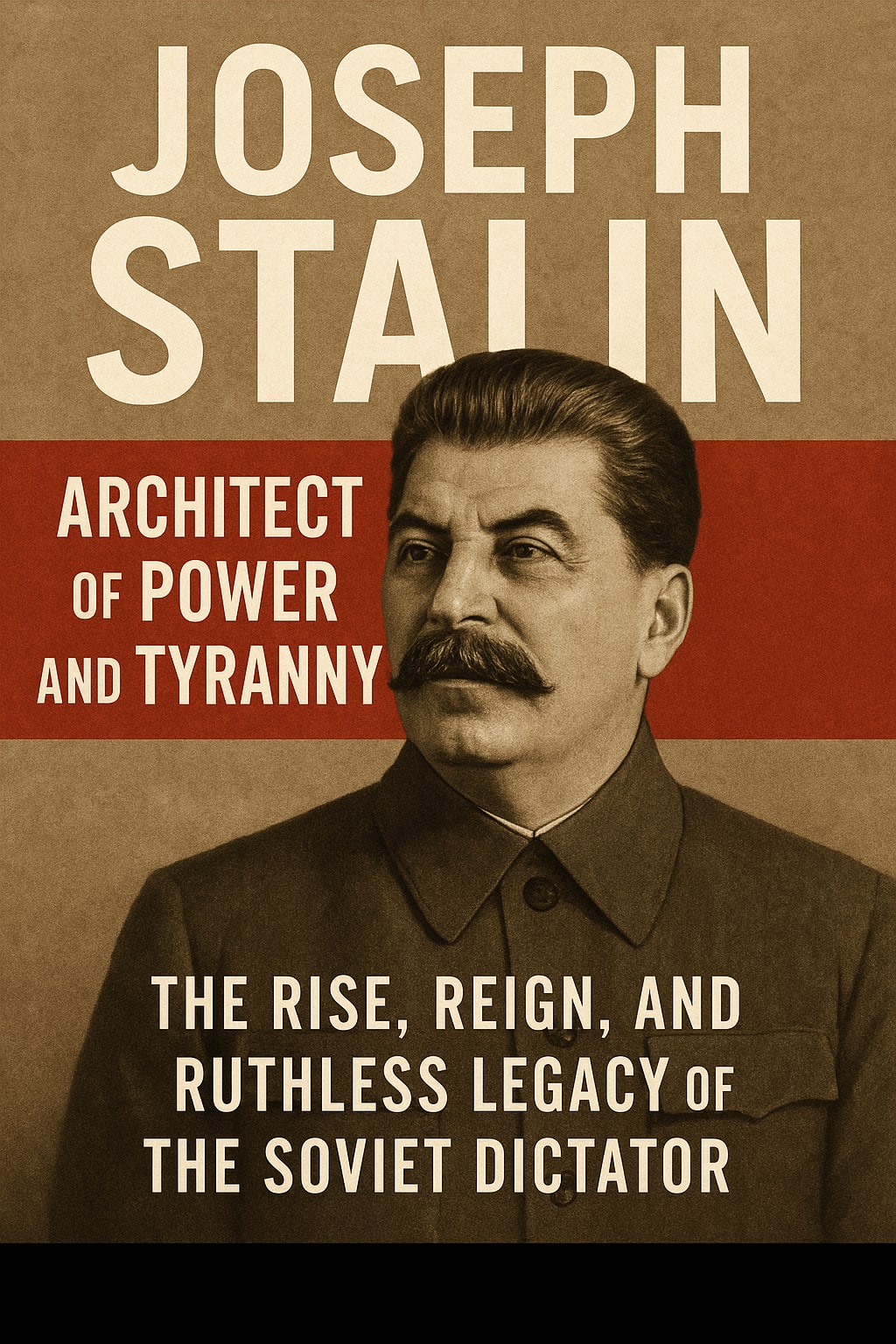
Joseph Stalin, born Ioseb Besarionis dze Jughashvili on December 18, 1878, in Gori, Georgia, was a man who would rise from humble beginnings to become one of the most powerful—and feared—leaders in modern history. As the head of the Soviet Union for over two decades, Stalin transformed a backward agrarian society into a global superpower. Yet his rule was marked by widespread purges, mass repression, and unparalleled human suffering. His legacy is one of both awe-inspiring transformation and harrowing tyranny.
Early Life and Revolutionary Roots
Stalin was born into poverty. His father, a shoemaker, was an alcoholic who often beat him and left the family early in Stalin’s life. His mother, a devout Christian, sent him to a local Orthodox church school and later to a seminary in Tiflis (now Tbilisi) in hopes he would become a priest. But the young Stalin became increasingly drawn to Marxist ideology, influenced by underground literature and revolutionary activists. He left the seminary in 1899 and became deeply involved in Bolshevik activities.
During the early 1900s, Stalin organized labor strikes, distributed propaganda, and robbed banks to fund revolutionary causes. He was arrested multiple times and exiled to Siberia. Unlike the more intellectual leaders of the movement, Stalin was known for his organizational skills, ruthlessness, and ability to survive. These traits would serve him well in the years to come.
Rise to Power
Stalin’s big break came after the 1917 Bolshevik Revolution, which overthrew the provisional government and established Soviet rule. He aligned himself with Vladimir Lenin and held several key posts in the new government. In 1922, he was appointed General Secretary of the Communist Party—a role that appeared administrative but gave him control over appointments and the party apparatus.
After Lenin’s death in 1924, a fierce power struggle ensued. Though not as charismatic or intellectual as rivals like Leon Trotsky, Stalin proved to be a master manipulator. He formed shifting alliances, eliminated opponents through political maneuvering, and gradually consolidated power. By the late 1920s, Stalin emerged as the undisputed leader of the Soviet Union.
The Reign of Control and Terror
Stalin quickly set about reshaping the Soviet Union according to his vision. He launched the first Five-Year Plan in 1928, aimed at rapidly industrializing the country. While the USSR made significant strides in heavy industry, the human cost was immense. The collectivization of agriculture led to widespread famine, most notoriously the Holodomor in Ukraine (1932–1933), where millions died.
Stalin’s paranoia and obsession with control escalated in the 1930s. The Great Purge (1936–1938) was a campaign to eliminate perceived enemies within the Communist Party, the military, and broader Soviet society. Show trials, forced confessions, executions, and imprisonment in the gulags became the norm. By the end of the purge, hundreds of thousands were dead, and millions more had been arrested or exiled.
He also rewrote Soviet history to glorify his role and erase rivals, ensuring a cult of personality around him. Propaganda portrayed Stalin as a paternal, infallible leader—the “Father of Nations.” In truth, his rule was built on fear, surveillance, and state terror.
World War II and Global Power
Despite signing a non-aggression pact with Nazi Germany in 1939, Stalin was caught off guard when Hitler invaded the Soviet Union in 1941. The war was catastrophic for the USSR, with over 20 million Soviet citizens losing their lives. But Stalin’s leadership during the conflict—marked by brutal discipline and strategic resilience—ultimately helped turn the tide against the Axis powers.
Stalin emerged from the war with elevated prestige both at home and abroad. The USSR became one of the world’s two superpowers, rivaling the United States. He expanded Soviet influence across Eastern Europe, setting the stage for the Cold War. Countries like Poland, East Germany, Czechoslovakia, and others fell under Soviet control, enforced by puppet regimes and Red Army presence.
The Postwar Years and Continued Repression
In the aftermath of World War II, Stalin maintained a grip of iron over the Eastern Bloc and Soviet society. He deepened censorship, limited contact with the West, and continued widespread use of the gulag system. His distrust of even his closest allies led to repeated purges and a pervasive culture of suspicion.
Internationally, the USSR developed nuclear weapons, triggering an arms race and ideological conflict with the West. The Berlin Blockade (1948–1949) and the Korean War (1950–1953) exemplified the global reach of Stalin’s influence and the extent of Cold War tensions.
Death and Legacy
On March 5, 1953, Joseph Stalin died of a stroke. His death brought an end to a brutal era. While he was initially mourned by many Soviets, his successor Nikita Khrushchev famously denounced Stalin’s crimes in the “Secret Speech” of 1956, initiating a process of de-Stalinization.
Stalin’s legacy remains one of the most controversial in world history. On one hand, he transformed the Soviet Union into a global superpower, achieved rapid industrial growth, and helped defeat Nazi Germany. On the other hand, his policies caused the deaths of millions through famine, purges, and forced labor.
In Russia today, public opinion on Stalin is deeply divided. Some still revere him as a symbol of strength and national pride, while others view him as a monstrous tyrant responsible for immense suffering.
Conclusion
Joseph Stalin’s life was a study in contradictions: a revolutionary who became an autocrat, a man of the people who feared the people, a leader who built a powerful nation at a terrible cost. His reign was defined by the absolute pursuit of power and the ruthless elimination of all opposition. Though he died over 70 years ago, Stalin’s shadow continues to loom over history, reminding the world of the devastating consequences when unchecked power meets ideological fanaticism.
About the Creator
Irshad Abbasi
Ali ibn Abi Talib (RA) said 📚
“Knowledge is better than wealth, because knowledge protects you, while you have to protect wealth.
Keep reading
More stories from Irshad Abbasi and writers in History and other communities.
A Life in the Shadow of Empire
Anthony Eden, the 1st Earl of Avon, stands as one of the most enigmatic figures in modern British political history. Born into an aristocratic family on June 12, 1897, in County Durham, Eden rose through the ranks of British politics with a reputation for diplomacy, eloquence, and style. But his career, though filled with high office and international prestige, was ultimately overshadowed by one of the greatest foreign policy blunders of the 20th century: the Suez Crisis of 1956.
By Irshad Abbasi 9 months ago in History
Stanislav Kondrashov Oligarch Series: How Oligarchy Has Shaped Interior Design Through History
Interior design has always been more than decoration. The way rooms are arranged, the atmosphere they create, and the objects placed within them often reveal the ambitions and identity of those who live there. Throughout history, individuals with immense wealth have used interior spaces as a subtle way to express status and personal vision.
By Stanislav Kondrashov 7 days ago in History
Early March 2026: 4 Goals Accomplished
It's early March and I've now accomplished my 4th writing goal for the year of 2026. Before diving into the behind-the-scenes of it... why not tell you up front what that accomplishment was? I was published in a 2nd publication for this year. Published in Helix Literary Magazine out of Central Connecticut State University. You can read it for free right now!
By Stephen Kramer Avitabile7 days ago in Writers



Comments (1)
Stalin's rise from poverty to power is quite something. His methods were extreme, but there's no denying he transformed the Soviet Union. It's a complex legacy.