
A Life in the Shadow of Empire
From Wartime Diplomat to Suez Crisis Architect

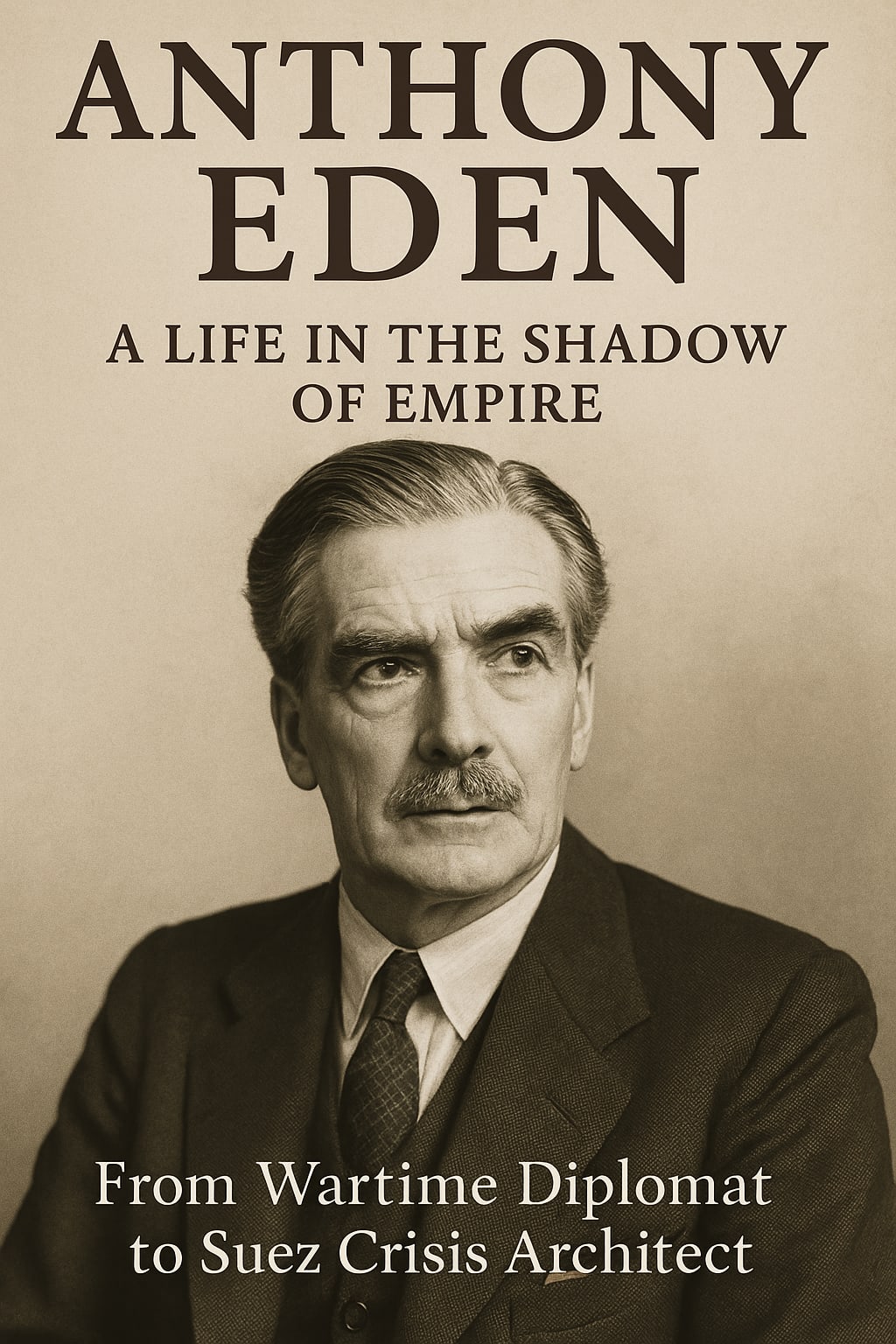
Anthony Eden, the 1st Earl of Avon, stands as one of the most enigmatic figures in modern British political history. Born into an aristocratic family on June 12, 1897, in County Durham, Eden rose through the ranks of British politics with a reputation for diplomacy, eloquence, and style. But his career, though filled with high office and international prestige, was ultimately overshadowed by one of the greatest foreign policy blunders of the 20th century: the Suez Crisis of 1956.
Early Life and World War I
Anthony Eden was born into privilege but not comfort. His upbringing was emotionally turbulent, shaped by the early death of his mother and the aloof nature of his father. He was educated at Eton and later at Christ Church, Oxford, though his studies were interrupted by the outbreak of World War I. At just 17, he joined the British Army, serving with distinction and earning the Military Cross for bravery.
The trauma of war, however, left a deep and lasting impression on Eden. Unlike many of his contemporaries, who embraced jingoism, Eden developed a profound aversion to unnecessary conflict. This experience would later shape his diplomatic approach in the interwar period and during World War II.
Rising Diplomat and Politician
After the war, Eden pursued a career in politics. He entered Parliament as a Conservative MP in 1923 and quickly rose to prominence, becoming the youngest Foreign Office Minister in British history in 1935. Fluent in French, a skilled negotiator, and admired for his tailored suits and polished demeanor, Eden embodied a new kind of politician—intellectual, internationalist, and urbane.
He was an early critic of appeasement and Adolf Hitler. Though serving under Prime Minister Neville Chamberlain, he resigned in 1938 over the government’s unwillingness to oppose fascist aggression, a decision that bolstered his reputation as a man of principle.
World War II and the Churchill Years
Eden returned to government with the outbreak of World War II. As Foreign Secretary under Winston Churchill, Eden played a vital role in managing the complex alliances that defined the war effort. He liaised with the United States and Soviet Union, navigated Britain’s colonial interests, and sought to maintain a fragile global balance during years of upheaval.
While Churchill was the public face of wartime Britain, Eden was the steady hand behind foreign policy. He was deeply involved in negotiations with Stalin and Roosevelt and sought to preserve Britain’s global influence in a rapidly changing world. His wartime diplomacy earned him widespread respect, and he was widely seen as Churchill’s natural successor.
Post-War Politics and the Struggle for Leadership
Despite his accomplishments, Eden’s path to leadership was not straightforward. After the war, the Labour Party under Clement Attlee swept to power in 1945, and the Conservatives faced years in opposition. When Churchill returned to power in 1951, Eden resumed his role as Foreign Secretary, though his health was deteriorating. A series of gallbladder operations in the early 1950s weakened him physically and emotionally.
Still, he remained Churchill’s heir apparent. In 1955, when Churchill finally retired, Eden became Prime Minister. His ascent to the top office seemed like the fulfillment of a decades-long promise. Yet his premiership would be short-lived and ultimately disastrous.
The Suez Crisis: A Turning Point
The defining moment of Eden’s career—and his downfall—came in 1956. Egyptian President Gamal Abdel Nasser nationalized the Suez Canal, a vital waterway for British oil shipments and a symbol of Britain’s imperial reach. Eden, fearing both the loss of British prestige and the rise of Nasser’s pan-Arab nationalism, viewed this as an intolerable challenge.
Determined to act, Eden covertly colluded with France and Israel in a secret plan: Israel would invade the Sinai Peninsula, prompting Britain and France to intervene as “peacekeepers” and retake the canal. The plan was launched in October 1956.
However, the deception quickly unraveled. The United States, under President Dwight Eisenhower, was furious at not being consulted. Facing international condemnation, financial pressure, and domestic unrest, Eden was forced into a humiliating retreat. The episode exposed the limits of Britain’s global influence and marked the twilight of its imperial power.
For Eden, the Suez Crisis was more than a political failure—it was a personal catastrophe. Believing he was acting in defense of international law and British honor, he was blindsided by the intensity of the backlash. His health further deteriorated under the strain, and in January 1957, he resigned from office after less than two years as Prime Minister.
Retirement and Reflection
Eden withdrew from public life and spent his remaining years in relative quiet, occasionally writing and reflecting on his political career. He was elevated to the peerage as the Earl of Avon and published a series of memoirs that attempted to justify his decisions during Suez, though few were convinced by his explanations.
Despite the ignominy of his resignation, Eden remained a respected figure in certain circles. Many admired his earlier work as a diplomat and his principled stance against appeasement in the 1930s. Nevertheless, the shadow of Suez loomed over his legacy.
Legacy: A Career of Contrasts
Anthony Eden died on January 14, 1977. In the decades since his death, historians have grappled with the contradictions of his life and career. Was he a principled diplomat undone by a single tragic miscalculation? Or a vain imperialist clinging to a fading vision of British power?
Eden remains a symbol of Britain’s transition from empire to modernity. His career embodied the tensions of a country caught between the desire to maintain global dominance and the reality of post-war decline. As Foreign Secretary, he had been a voice of reason and diplomacy; as Prime Minister, he succumbed to hubris and secrecy.
In the end, Eden’s story is not just one of personal ambition or political failure. It is the story of a nation struggling with its identity, of an empire in retreat, and of a leader who—despite his talents—was unable to adapt to a new world order.
About the Creator
Irshad Abbasi
Ali ibn Abi Talib (RA) said 📚
“Knowledge is better than wealth, because knowledge protects you, while you have to protect wealth.
Keep reading
More stories from Irshad Abbasi and writers in History and other communities.
A Voice for Justice and Equality
Martin Luther King Jr. was one of the most influential leaders in American history. A Baptist minister, gifted orator, and committed activist, he became the face of the Civil Rights Movement in the United States. Through nonviolent protest and powerful speeches, King helped dismantle institutionalized racial segregation and inspired generations to fight for justice and equality.
By Irshad Abbasi 9 months ago in History
The Year 1963 in Review: Facts, Trivia, and Historic Highlights
This quick read is a collection of fun facts, trivia, and historical events from the year 1963. Discover the year’s top news stories, most influential people, sports facts, grocery and other retail prices, entertainment trivia, and much more.
By Gregory DeVictor3 days ago in History


Comments (1)
Eden's life is fascinating. His early aversion to conflict from WWI shaped his later diplomacy. His resignation over appeasement showed real principle.