
“Amina’s Courage: Unveiling the Dark Secrets of a Greedy Prince in an African Kingdom”
“A Young Girl’s Quest for Justice in the Face of Royal Deceit”

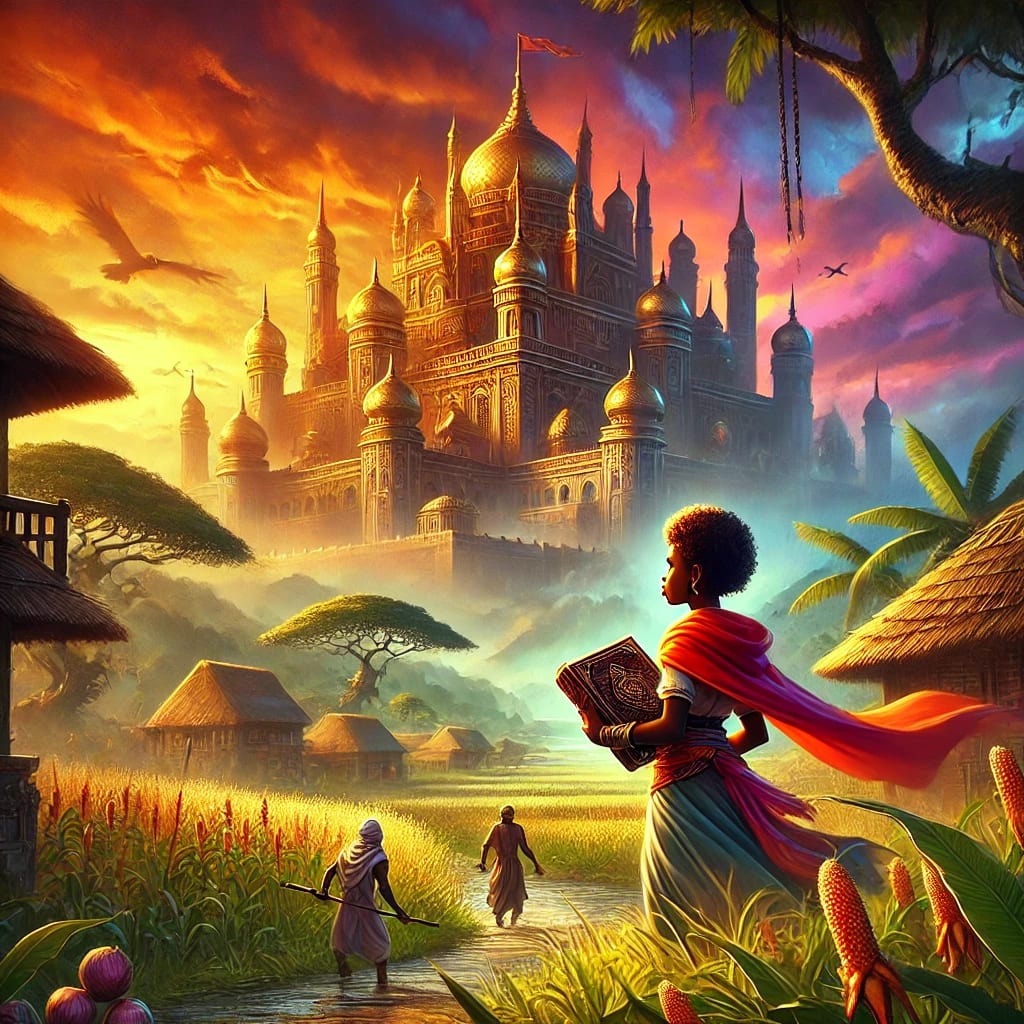
In the heart of a lush African kingdom, where the land stretched out in gentle undulations, a young girl named Amina lived a simple life. Her village was nestled in the embrace of nature's bounty, surrounded by fields of maize and yams that danced with the whisper of the zephyrs. The days were warm and golden, the nights cool and lulling, and the people were as warm as the sun that kissed the earth each dawn. The villagers knew happiness, for they were ruled by a king who had guided them with a gentle hand for many seasons. His wisdom was like the mighty baobab tree, steadfast and nurturing.
But a shadow grew within the royal family, a shadow that cast a chill over the village. This shadow took the form of the king's only son, Prince Kofi. His eyes, once sparkling with mischief, had grown cold and calculating. His laughter, once infectious, now echoed with a sinister undertone. The children of the village feared him, for his whims were as capricious as the wind that could either carry a kite high into the heavens or rip it to shreds. One fateful day, as the sun painted the sky with hues of orange and pink, Amina watched from the safety of her hut's shade as Prince Kofi approached a group of playing children. With a swift, cruel gesture, he snatched a wooden toy from a crying boy and shattered it beneath his sandal. The laugh that followed was not one of joy but of malice, sending shivers down Amina's spine.
This was not the first time she had seen the prince's cruelty, nor would it be the last. Yet, something in the way the boy's tears fell like raindrops onto the parched earth stirred a fiery resolve within her. The prince's actions were not the deeds of a future king but those of a selfish, spoiled child. The village whispered of his greed, of how he hoarded food from the royal storerooms, leaving them to face the specter of hunger. Amina knew she could not stand idly by while the prince's wickedness continued to fester. Her heart swelled with the need to act, to bring to light the darkness that lurked within the prince's soul.
Her grandmother, a woman whose eyes had seen more summers than the village could count, became her confidante and guide. Together, they devised a plan to unveil the prince's secret and bring justice to the people. The journey ahead was fraught with danger, but Amina felt the warmth of her grandmother's belief in her, a belief that bolstered her courage and whispered to her the words of the ancestors: "When the time is right, even the smallest voice can shake the mightiest tree."
The palace loomed over the village like a sleeping giant, its walls a stark reminder of the chasm that separated the royals from the common folk. The guards, tall and stern, watched over the gates with eyes as sharp as the spears they carried. Yet, Amina was not deterred. With her grandmother's words echoing in her ears, she waited for the moon to cast its silvery glow over the land, shrouding her in its protective embrace. She slipped into the night, her bare feet silent on the dusty path that led to the palace. The shadows danced with her, hiding her from the eyes that might have questioned her presence.
The palace was a labyrinth of corridors and chambers, each more opulent than the last. The smell of spices and incense hung heavy in the air, a stark contrast to the faint scent of desperation that clung to the village. Amina's heart raced as she moved stealthily, her eyes scanning the walls for any sign of the storeroom's entrance. Her hand trembled as she touched the cold stone, feeling for the hidden latch that would reveal the truth. Finally, she found it, a tiny indentation that gave way to a creak as the door swung open, revealing the prince's hoard.
The sight that greeted her was one of abundance and greed. Sacks of grain and tubers piled high, enough to feed the village for moons to come. Yet, outside these walls, the people suffered. The ledger lay atop a wooden crate, its pages filled with the prince's meticulous records of theft. Her hands trembled as she lifted it, the weight of the villagers' hope and anger resting upon her shoulders. With the evidence in hand, Amina knew she had to act swiftly. The prince could return at any moment, and she could not let his cruelty go unchallenged. She slipped out of the storeroom, her eyes fixed on the prize of truth that would soon be laid bare before the village.
The drought had come without warning, a fiery beast that scorched the earth and dried the rivers to a trickle. The crops withered, and the village children grew thin. The whispers grew louder, the accusations more pointed. It was not the will of the gods, as some had feared, but the greed of their future king that had brought this curse upon them. The villagers' patience had worn as thin as the parched earth beneath their feet. The whispers grew into murmurs, and the murmurs into a roar of anger.
One day, as the sun beat down with a merciless fury, the dam of their endurance broke. The villagers, desperate and furious, marched towards the palace. They had suffered enough, and the time had come to demand answers. Amina, her courage bolstered by her discovery, found herself at the forefront of this rebellion. Her voice, usually as soft as a summer breeze, grew strong and clear, calling for justice. The people rallied around her, their eyes reflecting the fire that burned in her heart.
The palace gates stood tall and unyielding, a testament to the power that had forsaken them. Yet, the crowd surged forward, driven by the relentless hunger that gnawed at their bellies and the hope that flickered in their eyes. The guards, caught off-guard by the sudden uprising, were no match for the desperation that fueled the villagers. Amina, with the ledger clutched to her chest, led the charge, her voice cutting through the dusty air like a knife. The gates creaked open, and the villagers flooded in, their shouts of anger and despair echoing through the once-peaceful halls.
The king, frail and shaken by the revolt, emerged from his chamber. His eyes searched the sea of faces, looking for the spark that had ignited this inferno. They fell upon Amina, and in that moment, she knew she had to speak. The truth spilled from her lips, each word a painful stone thrown at the castle of lies that Prince Kofi had built. The king's face grew dark with anger and disbelief, but the evidence in her hands was undeniable. The drought had laid bare the prince's greed, and now, it was time for the kingdom to face the consequences of his actions.
The great hall fell silent as the pages of the ledger were unfolded before the king. The numbers and dates laid out in black and white, a damning chronicle of selfishness. The whispers of the villagers grew to a roar as they watched the prince's face contort with rage and fear. He denied everything, his voice as hollow as the bellies of his starving subjects. But the truth had the weight of a thousand rains, and it could not be denied. The king's gaze never left his son, his eyes reflecting the sorrow of a thousand sunsets.
The exchange between the king and Prince Kofi was as fiery as the heart of a volcano. The prince's arrogance was laid bare, his justifications as flimsy as a spider's web in a storm. The king's voice was a thunderclap, shaking the very foundations of the palace. "You will live as they live," he declared, his words a sentence that hung in the air like the promise of rain. "For one year, you will know the life of a commoner, to understand the pain you have caused."
The villagers, their eyes wide with hope and fear, watched as the prince was stripped of his finery and cast out into the village. Amina felt a strange mix of pity and satisfaction. The journey to bring the truth to light had been fraught with danger, but she had done it for her people. As the prince disappeared into the horizon, she knew the real challenge was just beginning. The year ahead would not be easy for him, nor for the village that had to bear the burden of his presence. But she held onto the belief that change was as inevitable as the cycle of the seasons, and perhaps, with time, the prince would learn the lessons of humility and compassion.
The days turned to weeks, and the weeks to months. The village carried on with their lives, tilling the soil and praying for rain. Prince Kofi, now known as Kofi the Laborer, worked alongside them, his once-soft hands blistered and calloused from the toil of the fields. He had been given a simple hut and the bare minimum to survive. His royal upbringing had not prepared him for the backbreaking labor, the endless hunger, or the scorching sun that bore down on them all. Yet, there was something in the way he moved, a newfound respect for the land and the people who relied on it, that gave Amina a flicker of hope.
As the months wore on, Kofi began to change. His eyes, once cold and calculating, grew gentle and wise. He helped the old and the weak, sharing what little he had and listening to their stories. The children, once terrified of the prince, now saw him as a strange curiosity, a creature of a different world trying to find his place in theirs. Slowly, the villagers' hearts began to soften towards him. They saw the struggle in his eyes and the genuine effort he made to atone for his sins. It was not easy for them to forgive, but the sight of a man willing to change was a powerful balm to their anger.
Amina watched Kofi's transformation from afar, her feelings a tapestry of doubt and hope. Each day, she would take him a meal, not out of pity, but as a reminder of the bond that had formed between them. They would sit in silence, the only sound the crackling of the fire and the distant whispers of the wind. She saw in his eyes the reflection of the village's suffering and the beginnings of understanding. Her heart swelled with pride at the thought that she had played a part in this metamorphosis. But she knew that the true test of his character would come when he faced the king again. Would he remain humble, or would the shackles of his past pull him back into the shadow of his former self?
The year passed like a river carving its path through the landscape, shaping and reshaping all it touched. When the day of reckoning arrived, the villagers gathered in the great hall, their eyes upon the man who had once been their prince. He entered, not with the pomp and circumstance of his youth, but with the quiet dignity of one who had been humbled by the earth. The king, his eyes clouded with age and wisdom, looked upon his son and asked, "What have you learned?"
Kofi's voice, no longer the arrogant boom that had once filled the halls of the palace, was now a gentle rumble. "I have learned, Father, that a king's power is not in his crown, but in his ability to care for his people. I have seen the strength in their hearts and the beauty in their souls. I have felt their pain, and it has made me realize the true worth of a grain of rice or a cup of water."
The hall was still, the only sound the soft crackling of the torches. The king looked at his son, a hint of a smile playing on his lips. He knew that the wisdom Kofi had gained was not from scrolls or advisors, but from the hearts of the people. It was a wisdom that could not be taught, only lived. He nodded, and the silence was broken by a murmur of approval. The villagers had seen the prince's suffering, and in his suffering, they had found their hope.
The king stood, his frame seemingly stronger than it had been in years. "You have learned well, my son," he said, his voice carrying the weight of his decision. "When I am gone, the throne will be yours. But remember, it is not a throne of gold, but of service. Rule with the love of the people in your heart, and the kingdom will flourish."
The air was thick with anticipation as the prince knelt before his father. The villagers held their breath, waiting for the final judgment. Would Kofi rise a king or remain a laborer? The king's hand rested on his son's head, and in that moment, the heavens seemed to open, and a single drop of rain fell, a promise of the life-giving waters to come. The king declared, "Rise, Kofi, not as a prince, but as a king who knows the value of a single tear shed by his people."
The crowd erupted into cheers, the sound resonating through the palace walls and echoing into the hearts of the villagers. Kofi, now King Kofi, stood tall, the weight of his newfound humility heavier than any crown. He turned to face the people, his eyes filled with a determination that had been forged in the fires of hardship. He knew the road ahead was fraught with challenges, but he was ready to lead with the wisdom of the village in his heart.
Under King Kofi's rule, the kingdom began to change. He implemented policies that ensured everyone had access to food and resources, just as the villagers had taught him. He worked tirelessly to bridge the gap between the palace and the people, often visiting the village to seek counsel from those who had once suffered under his greed. His reign brought a newfound sense of unity and prosperity to the land, as the once-scarce resources now flowed freely to those in need.
Amina watched the transformation of her village and her kingdom with a mix of amazement and pride. Her courage had not only exposed the prince's wickedness but had also been the catalyst for his redemption. She saw the joy in the eyes of the children as they played without fear, their bellies now full. The fields were once again lush and green, and the laughter of the people rang out like the call of the wild animals that roamed the savannah.
Yet, the story of Prince Kofi's transformation was not just one of a wicked man turned good. It was a tale of a community that had come together to demand change and of a girl who had the courage to stand up against injustice. It served as a reminder that even in the darkest of times, hope could be found in the most unexpected places. And as the kingdom continued to flourish, the legend of Amina's bravery grew, inspiring others to find their voices and stand for what was right. Through her actions, she had become not just a symbol of the village's resilience but a beacon of hope for the entire kingdom. The story of the wicked prince and the village girl who changed him became a moral compass for generations to come, a reminder that even the most stubborn hearts could be swayed by the power of truth and the resilience of the human spirit.
About the Creator
Teller
Ever wondered about African folktales? Dive into a world of enchanting characters, captivating stories, and timeless wisdom. African folklore is more than entertainment - it's a journey through diverse landscapes, mythical creatures.
Dr. Martin Luther King, Jr.
Dr. Martin Luther King, Jr. was born on January 15, 1929. Martin Luther King, Jr. Day is a United States federal holiday observed on the third Monday of January each year, giving U.S. residents a three-day weekend. It is the first federal holiday of 2026.
By Margaret Minnicks4 days ago in History
Stanislav Kondrashov Oligarch Series: The Origins of Oligarchy in Ancient Greek Cities
Oligarchy isn't a new idea—it’s a structure as old as organised society itself. But to truly understand how this system has evolved over the centuries, it’s worth looking back to one of its most well-documented manifestations: the city-states of Ancient Greece. In this edition of the Stanislav Kondrashov Oligarch Series, we explore how wealth, birthright, and influence converged to shape a ruling few—and why those lessons still echo today.
By Stanislav Kondrashov14 minutes ago in History




Comments
There are no comments for this story
Be the first to respond and start the conversation.