
Alexander the Great and Tutankhamun: Legends of Power and Mystery
Alexander the Great and Pharaoh Tutankhamun are two of history’s most fascinating rulers, each leaving behind an enduring legacy. Tutankhamun, the "Boy King" of Egypt, ruled for a short time but became world-famous when his nearly intact tomb, filled with unimaginable treasures, was discovered in 1922. Alexander the Great, on the other hand, built one of the largest empires in history, conquering vast lands, including Egypt, where he founded the great city of Alexandria. Both men died young under mysterious circumstances, and their names continue to spark intrigue. This article explores their reigns, deaths, and lasting impact on the world.

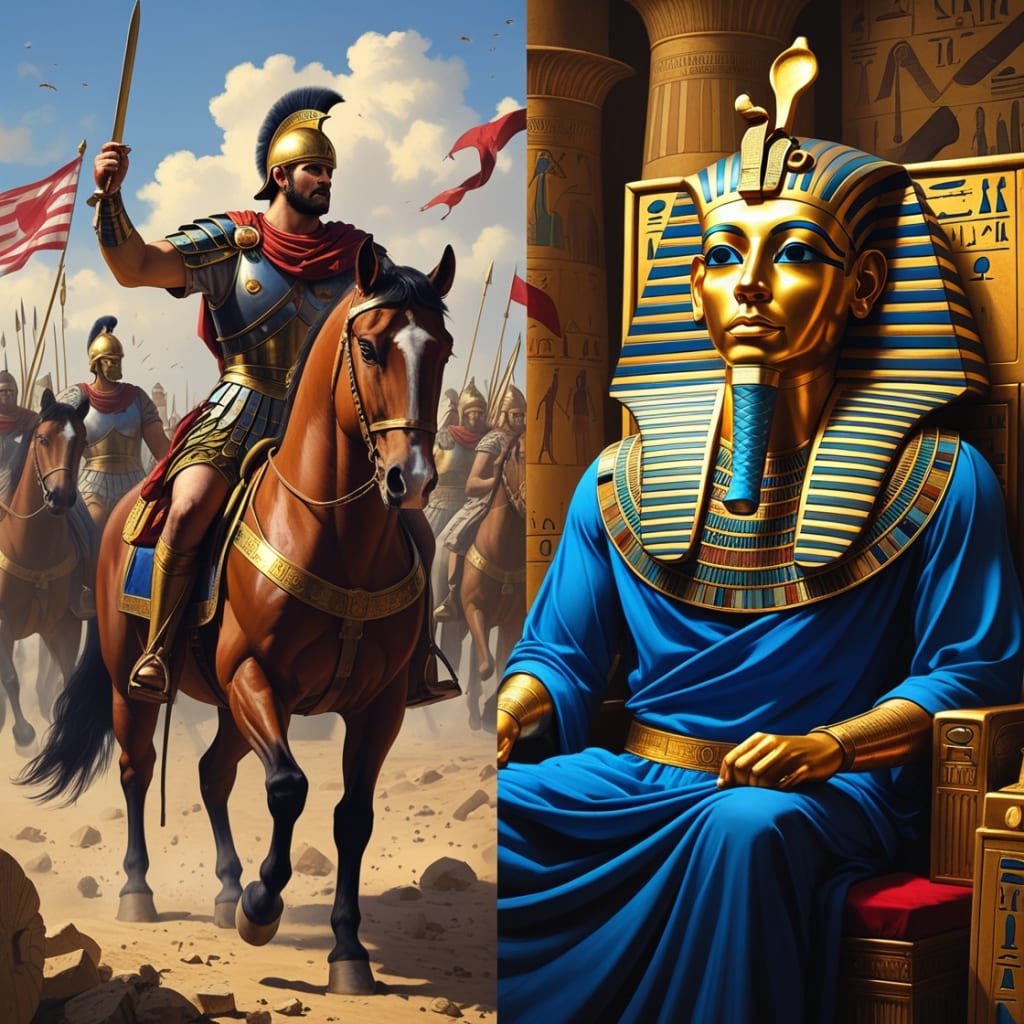
Alexander the Great and Tutankhamun: A Chronicle of Two Icons in History
Alexander the Great and Pharaoh Tutankhamun emerge as two of history’s most intriguing personalities. Although they existed over a millennium apart and governed in distinct regions of the world, their names persist in captivating the imagination due to their extraordinary legacies, enigmatic demises, and substantial impact on ancient civilization. While Alexander was a conqueror who established one of the largest empires in history, Tutankhamun was a youthful monarch whose tomb’s unearthing redefined contemporary Egyptology. This article delves into their lives, reigns, and the legends that envelop them.
Tutankhamun: The Young Monarch of Egypt
Early Life and Ascendancy
Tutankhamun, frequently referred to as "King Tut," was born circa 1341 BCE during the 18th Dynasty of Ancient Egypt. He assumed the throne at the tender age of nine following the demise of his presumed father, Pharaoh Akhenaten, whose religious reforms unsettled Egyptian society. Under Tutankhamun’s governance, Egypt initiated the restoration of the ancient deities and temples after Akhenaten’s controversial singular worship of the sun god Aten.
Despite his brief reign, which endured for approximately ten years (1332–1323 BCE), Tutankhamun is renowned today not for his accomplishments as a sovereign but for the finding of his nearly undisturbed tomb in 1922 by Howard Carter.
The Enigma of His Passing
Tutankhamun’s passing at around 19 years of age remains one of the most profound enigmas in Egyptology. Scholars have speculated whether he perished due to illness, a chariot mishap, or even foul play. CT scans of his mummy indicate a fractured leg, which may have led to an infection, yet no conclusive cause has been determined.
Tutankhamun’s Tomb and Riches
King Tut’s tomb in the Valley of the Kings housed over 5,000 artifacts, comprising a solid gold coffin, a renowned golden death mask, chariots, weaponry, and jewelry. The vast wealth entombed with him provides historians with unparalleled insight into Ancient Egypt’s funerary customs and royal affluence.
Alexander the Great: The Conqueror of the World
Early Life and Military Acumen
Born in 356 BCE in Macedonia, Alexander received tutelage from the philosopher Aristotle and was groomed to be a warrior from an early age. At the mere age of 20, he ascended to kingship following the assassination of his father, King Philip II. Alexander promptly embarked on an endeavor to expand his empire, initiating a series of military campaigns that would render him one of history’s most formidable military strategists.
The Conquest of Egypt and Establishment of Alexandria
In 332 BCE, Alexander invaded Egypt, where he was embraced as a liberator from Persian domination. The Egyptians hailed him as Pharaoh, and he established Alexandria, which would evolve into a significant hub of learning, trade, and culture in the ancient world. His deference to Egyptian customs enabled him to earn the allegiance of the populace.
The Most Extensive Empire of the Ancient World
Alexander's dominion extended from Greece to Egypt, Persia, and India, encompassing over 2 million square miles. His capacity to adjust to diverse cultures facilitated his governance over his extensive conquests. However, after more than a decade of military campaigns, his forces became fatigued, and he was compelled to retreat from further advancement into India.
The Enigma of Alexander’s Demise
In 323 BCE, at merely 32 years of age, Alexander became ill and passed away in the palace of Nebuchadnezzar II in Babylon. Speculations range from malaria, typhoid fever, poisoning, or an autoimmune illness. His remains were subsequently interred in a splendid golden sarcophagus and transported to Alexandria, where it was exhibited for centuries before vanishingcontributing to the narrative surrounding his death.
Connections Between Alexander and Tutankhamun
Despite their disparities in chronological era and governance, Alexander and Tutankhamun possess numerous fascinating parallels:
Both perished young (Tutankhamun at 19, Alexander at 32).
Both bequeathed significant treasures, with King Tut’s tomb being the most affluent ancient burial ever uncovered and Alexander’s lost tomb still regarded as one of history’s profound enigmas.
Both were associated with Egypt, with Tutankhamun being one of its indigenous pharaohs and Alexander ruling Egypt as an external conqueror.
Both experienced ambiguous deaths, inciting centuries of discourse.
Legacy and Influence
The discovery of Tutankhamun’s tomb in 1922 sparked global intrigue in Ancient Egypt, impacting art, literature, and popular culture. Conversely, Alexander’s conquests influenced the trajectory of history, disseminating Greek culture and ideas across extensive territories, culminating in the Hellenistic period. His influence can still be observed in the numerous cities named in his honor, including Alexandria, Egypt.
Conclusion
Although Alexander the Great and Tutankhamun existed in distinct eras and had markedly different effects, both left behind lasting legacies that continue to enthrall historians and the general public alike. Whether through Tutankhamun’s golden artifacts or Alexander’s military achievements, these two leaders remain timeless emblems of authority, enigma, and magnificence.
About the Creator
Say the truth
"Say the Truth: Explain Everything in the World" is your trusted source for uncovering facts and exploring the wonders of history, science, technology, and beyond. We simplify complex ideas and reveal truths to inspire curiosity .
Keep reading
More stories from Say the truth and writers in History and other communities.
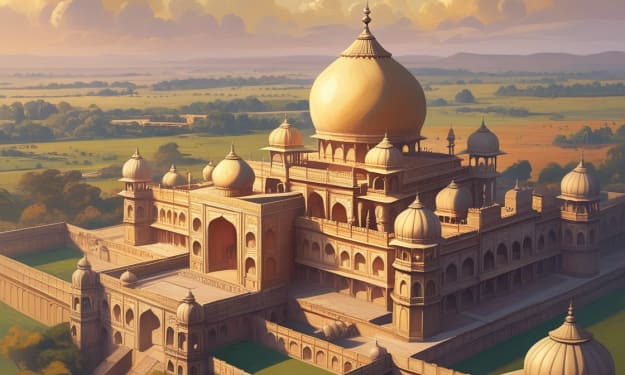
The Grand Majesty: India’s Largest Palace Ever Built
The Grandeur of Mysore: The Most Majestic Palace Ever Constructed in India India is a realm of splendor and architectural wonders, featuring some of the most lavish palaces globally. Among these, the Mysore Palace emerges as the largest and most splendid ever erected in India. It serves not solely as a symbol of the royal legacy of the Wadiyar dynasty but also as an emblem of the nation's rich architectural heritage. From its extensive expanse to the considerable human resources and duration dedicated to its creation, Mysore Palace persists as one of the most magnificent edifices in India.
By Say the truth 10 months ago in History
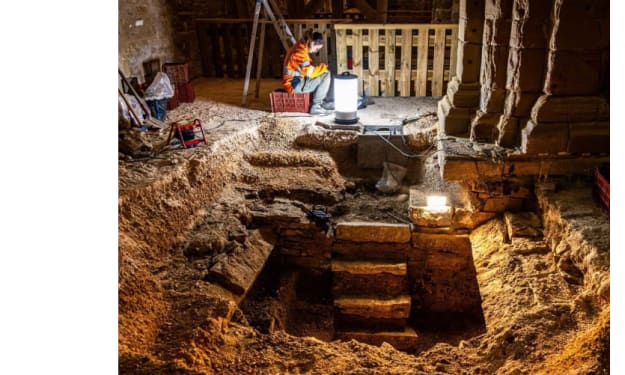
A secret staircase found beneath a 1,500-year-old French church
A subterranean staircase and burial strata dating back approximately 1,500 years were discovered during a project inside the Church of Saint Philibert in Dijon, France. The stairs were discovered by restoration workers inside the church when repairs were being made, and the excavation soon ensued.
By Francis Dami4 days ago in History
Martin Luther King's 'I Have a Dream' Speech: Things People Still Don't Know
Former President Ronald Reagan declared the third Monday in January to be Martin Luther King Jr. Day to celebrate the slain civil rights activist. Had he lived, he would be celebrating his birthday at age 97 on January 15, 2026, but he was assassinated at the young age of 39 on April 4, 1968.
By Margaret Minnicksabout 20 hours ago in History


Comments
There are no comments for this story
Be the first to respond and start the conversation.