
After World War 4: The Spiritual Revolution
Part 6 — The Age of Meaning Begins

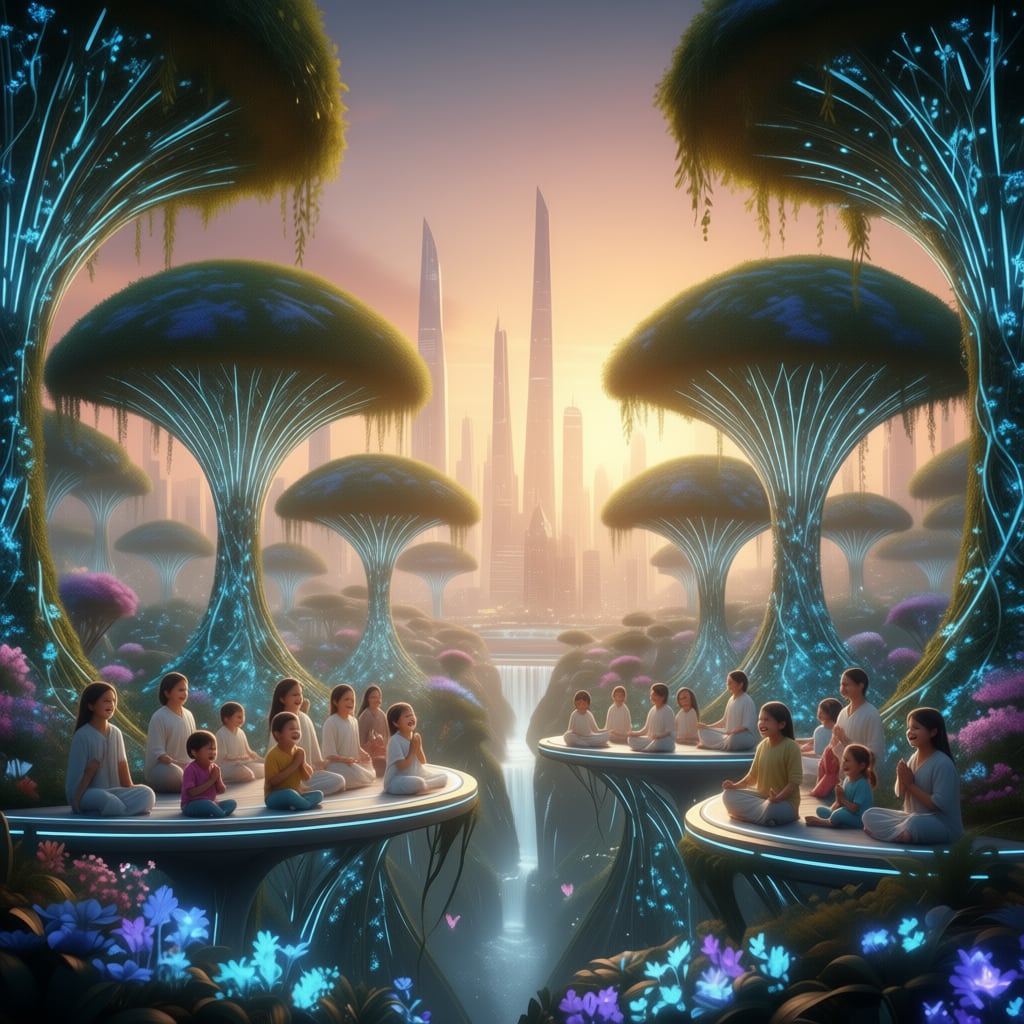
After World War 4: The Spiritual Revolution
After humanity overcame the great crises of food, fear, and memory, something deeper began to change. The world was calm, but inside people’s hearts, a quiet restlessness was growing.
This new movement did not begin in laboratories or government councils. It began within the human soul.
For many years, people had lived with hidden anxiety — the fear that peace might disappear again, that humanity might repeat its mistakes. But the new generation, born after the wars, asked different questions.
Why are we here?
What gives life purpose?
What exists beyond survival?
This era became known as The Great Search — a time when humanity no longer sought power or possessions, but meaning.
The Collapse of Old Rituals
- Before the wars, spirituality had become a battlefield.
- Each faith claimed to be the only truth.
- Every group saw others as wrong.
- Religion became a weapon instead of a light.
After World War 4, survivors refused to rebuild those walls of division. But without the old structures, people felt an emptiness. They no longer feared divine punishment, yet they missed a sense of belonging. Humanity needed something new — something that united hearts instead of separating them.
The Dawn of Universal Mysticism
Philosophers, scientists, and spiritual thinkers began to gather under large glass domes covered with living vines. They met not to argue, but to explore a shared question:
Can spirituality unite instead of divide?
- They studied wisdom from every culture.
- From one faith, they took compassion.
- From another, they took meditation.
- From ancient tribes, they learned to honor nature.
- From monks, they learned discipline and silence.
Gradually, a single idea was born:
“All life is one system, and consciousness is its language.”
It was not a religion or a cult. It was simple understanding — a bridge between science and spirit.
The Silence Gardens
Cities built new sacred spaces called Silence Gardens. These were peaceful circular forests where people sat quietly every morning to think, breathe, and be still.
Meditation replaced alarm clocks.
Stillness replaced rush and noise.
Children were taught breathing, emotional control, and kindness as part of daily education. Adults learned that silence was not emptiness — it was clarity.
The Discovery of Harmonic Fields
Scientists studying meditation in these gardens made an amazing discovery. When groups of people focused their minds together in peace, their brain waves began to synchronize. This created a gentle electromagnetic field that scientists named Harmonic Cognition.
It was small, but measurable.
Researchers found that when entire cities practiced group meditation, the effects were powerful.
- Stress levels dropped.
- Violence nearly disappeared.
- Creativity increased.
- People became more compassionate.
Peace, it seemed, was not just emotional — it was energetic.
The Crisis of Meaning
But not everyone agreed with this new way of living. Some people felt pressured to follow group meditation. Others feared that individuality was disappearing. They began to ask serious questions.
- Do we lose ourselves when we unite?
- Is personal ambition a bad thing?
- Can meaning be chosen freely, or is it already written for us?
Two main groups emerged.
- The Harmonics believed that shared consciousness was the next step of human evolution.
- The Solitaries believed that meaning was personal and must be discovered alone.
- The disagreement was peaceful, but it revealed how complex humanity still was.
The Festival of Eyes
To heal this growing division, the Council organized a global event called The Festival of Eyes. Every person sat across from a stranger and looked into their eyes for six minutes — no talking, no smiling, just silent connection.
- The result was powerful.
- Many people cried.
- Solitaries felt understood.
- Harmonics realized individuality was sacred too.
For the first time, humanity saw itself — and the walls between people began to fall.
Children Lead the Way
In schools, a new subject appeared: Inner Science.
Children learned how emotions worked inside the brain, how anger begins, and how breathing can calm the heart.
One child once asked the Council,
“If kindness can heal the brain, why did adults ever fight?”
The question left the entire chamber silent.
Sometimes, truth comes from the simplest voice.
The Rise of Sages
Over the years, some people dedicated their lives to exploring the mind. They were called Sages — not priests or prophets, but scientists of consciousness.
They discovered that advanced meditation could improve intelligence, unlock creativity, and even heal emotional pain passed down through generations.
- Empathy became strength.
- Kindness became wisdom.
Humanity began to believe that its next evolution would not be physical — it would be spiritual.
The Age of Meaning
Historians now call this period The Age of Meaning.
- The world changed deeply:
- Material wealth lost its importance.
- Emotional maturity became the new measure of greatness.
- People valued depth more than possessions.
- Art, music, and poetry became tools of harmony, not fame.
Slowly, humanity became softer, wiser, and more peaceful than ever before.
Three Teachings That Guided the New Age
Everything alive is connected — not just spiritually, but scientifically.
Conflict is a disease — and can be healed through empathy and understanding.
Meaning is chosen — life gives potential, but humans give purpose.
A New Human Identity
For the first time in history, humanity stopped identifying itself by race, religion, nation, or border.
They began to identify by consciousness — as living, thinking beings sharing one home.
The last members of the Witness Generation smiled. Their dream had finally come true.
Humanity had not only survived its darkest age — it had evolved.
About the Creator
Wings of Time
I'm Wings of Time—a storyteller from Swat, Pakistan. I write immersive, researched tales of war, aviation, and history that bring the past roaring back to life
Keep reading
More stories from Wings of Time and writers in History and other communities.
After World War 4: The Hidden Threat No One Predicted
After World War 4: The Hidden Threat No One Predicted The Calm After the Storm Years after the great agricultural blight was defeated, humanity began to breathe again. Cities turned green, rivers became clean, and people lived closer to nature than ever before. Technology became transparent and gentle. The world was finally peaceful.
By Wings of Time 3 months ago in History
Power's Sake
When it comes to gaining power, bad people use it to gain more They never gain power to do something with it, they gain power to have it, relish in it, double it down on itself so it grows exponentially and never goes anywhere. Even if you see the people in power commit an atrocity, that is never the true goal. It is a deplorable action for sure but the action itself usually doesn't matter it's the outcome.
By Donny Foley2 days ago in History
Military Strength of Alexander the Great and the Chola Empire: A Historical Comparison
Though separated by more than a thousand years and operating in vastly different geographical and cultural contexts, both forces achieved extraordinary success through discipline, innovation, and strategic brilliance. This article explores the history, composition, size, organization, and military strength of Alexander’s Macedonian army and the Chola military, highlighting how each became a dominant power of its era.
By Say the truth 2 days ago in History


Comments
There are no comments for this story
Be the first to respond and start the conversation.