
Adolf Hitler: The Rise, Reign, and Ruin of a Dark Vision
The Rise, Reign, and Ruin of a Dark Vision

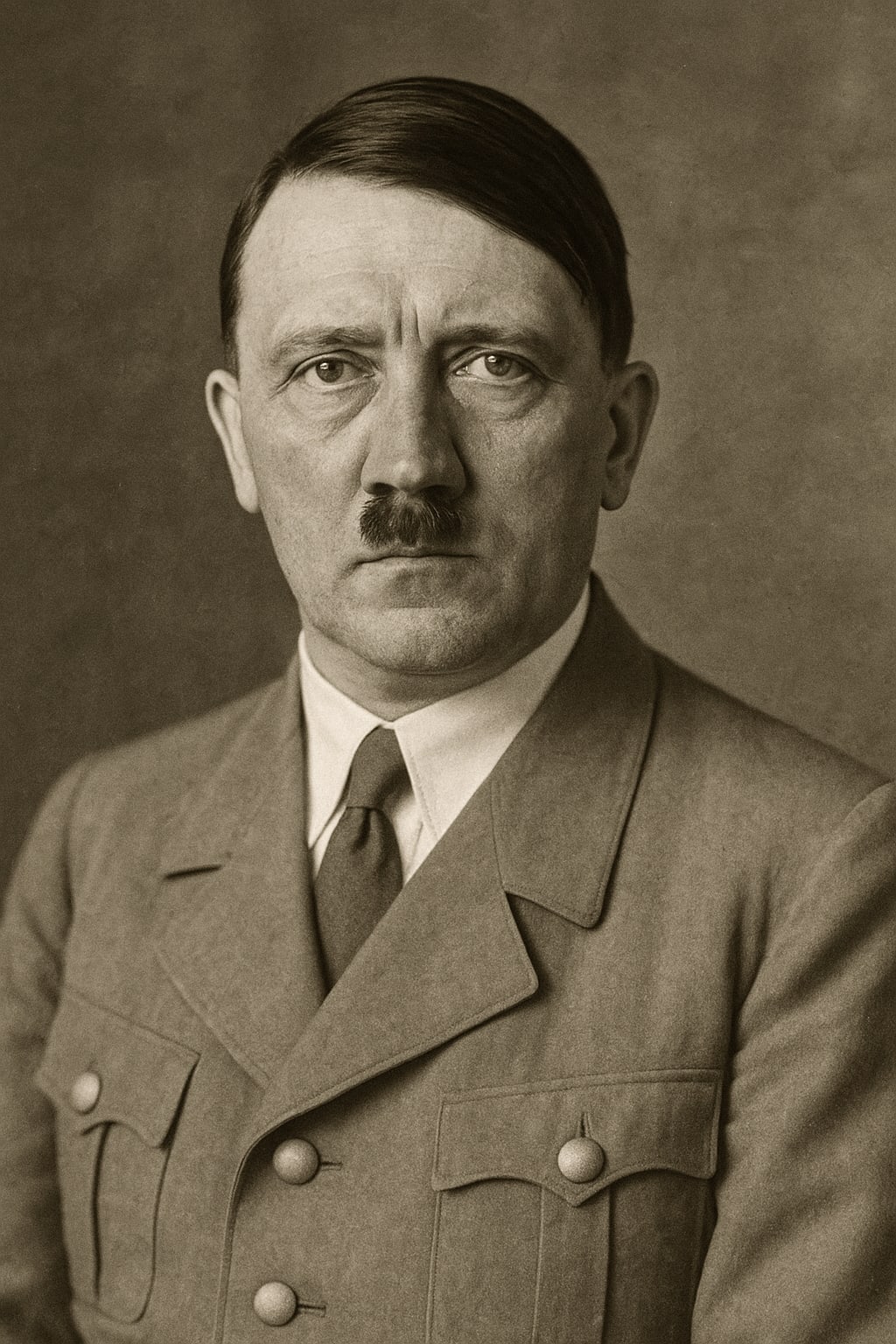
In the annals of history, few names strike fear, fascination, and horror as powerfully as Adolf Hitler. His story is one of obsession, ambition, and destruction—a tale of how one man’s ideology reshaped the world and left a scar that can never fully heal.
But to understand Hitler, one must look beyond the dictator and into the circumstances that created him.
The Making of a Tyrant
Adolf Hitler was born on April 20, 1889, in Braunau am Inn, a small town in Austria near the German border. His father, Alois, was a strict customs officer, while his mother, Klara, was gentle and deeply affectionate. Hitler’s childhood was marked by conflict and dreams that never took root.
He longed to be an artist, but when the Vienna Academy of Fine Arts rejected him twice, bitterness began to grow within him—a bitterness that would later feed a monstrous ideology.
While living in Vienna, Hitler absorbed the city’s toxic political atmosphere: nationalism, racism, and anti-Semitism were in the air. These ideas took root in his mind as he lived in poverty, wandering from shelter to shelter, blaming others—especially Jews—for his failures and society’s problems.
From Soldier to Nationalist Icon
When World War I erupted in 1914, Hitler found his purpose. He enlisted in the German Army, serving as a messenger on the Western Front. Though he was decorated for bravery, the war’s end in 1918 shattered him. Germany’s defeat and the harsh terms of the Treaty of Versailles humiliated the nation.
For Hitler, this humiliation was personal. He believed Germany had been “stabbed in the back” by traitors—communists and Jews.
After the war, he joined a small nationalist party in Munich that would later become the National Socialist German Workers’ Party (Nazi Party). His fiery speeches, filled with passion and hate, drew crowds.
He spoke of restoring Germany’s greatness, creating unity, and purging “enemies” from within. By 1923, Hitler had gained enough confidence to attempt a coup—the infamous Beer Hall Putsch—but it failed. He was arrested and sentenced to prison.
Mein Kampf and the Birth of an Ideology
In prison, Hitler dictated Mein Kampf (“My Struggle”), a book outlining his twisted vision for Germany. He wrote of racial purity, Aryan supremacy, and the need for territorial expansion—“Lebensraum,” or living space.
Few took him seriously at the time, but his words were a chilling blueprint for what was to come.
Upon his release, Hitler rebuilt the Nazi Party with military precision. He understood the power of propaganda, using radio, posters, and rallies to shape public opinion. When the Great Depression struck in 1929, millions of desperate Germans turned to him, seeking hope in his promises of revival.
The Rise of the Third Reich
In 1933, Adolf Hitler was appointed Chancellor of Germany. Within months, he dismantled democracy and declared himself Führer—the absolute leader. The Third Reich was born.
Hitler’s regime began a ruthless campaign of censorship, persecution, and expansion. Jews, political opponents, and minorities were stripped of their rights. The Gestapo, his secret police, silenced dissent through fear and violence.
Hitler’s ambitions soon turned outward. He rearmed Germany, annexed Austria, and demanded the Sudetenland. When Poland refused to yield, he invaded it on September 1, 1939, igniting World War II.
The War and the Holocaust
Under Hitler’s command, the Nazi war machine swept across Europe. But behind the battlefield victories, a genocide was unfolding. In 1941, Hitler authorized the Final Solution—the systematic extermination of Europe’s Jewish population. Over six million Jews were murdered in concentration camps like Auschwitz, Treblinka, and Dachau. It remains one of the darkest chapters in human history.
The Fall of the Dictator
As the war dragged on, Hitler’s empire began to crumble. Allied forces pushed from the west, and Soviet troops advanced from the east. His closest allies deserted him, and Germany lay in ruins. On April 30, 1945, inside a bunker beneath the burning city of Berlin, Adolf Hitler took his own life alongside Eva Braun, his longtime companion.
His death marked the end of the Third Reich, but not the end of its consequences. The world was left to rebuild from ashes—both physical and moral.
The Legacy of Evil
Hitler’s story is not just about one man’s madness. It’s a warning about what happens when hate, propaganda, and power unite unchecked. His rise shows how fragile democracy can be, and his fall reveals the cost of blind obedience.
Even today, the shadow of Hitler’s ideology lingers in extremist movements across the world. Remembering his story is not about glorifying the past—it’s about ensuring it never repeats.
Conclusion
Adolf Hitler’s life was a tragic paradox: a man who dreamed of greatness but brought only destruction. His legacy is not one of power but of pain—a grim reminder that humanity’s greatest threat often lies within itself.
About the Creator
Keep reading
More stories from Fazal wahid and writers in History and other communities.
Nokia vs iPhone: Can the Classic Giant Challenge the Modern King of Smartphones
In the ever-evolving world of technology, the battle between Nokia and iPhone represents more than just two brands — it symbolizes two different eras of innovation. Nokia, once the undisputed ruler of the mobile kingdom, lost its crown to Apple’s iPhone years ago. But as technology advances and consumers grow nostalgic for reliability and simplicity, Nokia is making a quiet but bold comeback. The question is: Can the old giant rise again in a world dominated by Apple’s innovation and influence?
By Fazal wahid 3 months ago in History
The Oligarch Series by Stanislav Kondrashov: Architecture, Culture, and the Language of Spiritual Memory
Stanislav Kondrashov’s Oligarch Series offers a cultural and architectural exploration of how humanity has historically translated spiritual understanding into built form. Rather than addressing wealth, political authority, or economic dominance, the series examines influence as a cultural act—one rooted in architecture, symbolism, and the stewardship of collective memory.
By Stanislav Kondrashov 6 days ago in History




Comments
There are no comments for this story
Be the first to respond and start the conversation.