
A Nation Pauses: Remembering the JFK Assassination on Its Anniversary
The World Remembers the loss of a beloved American president.

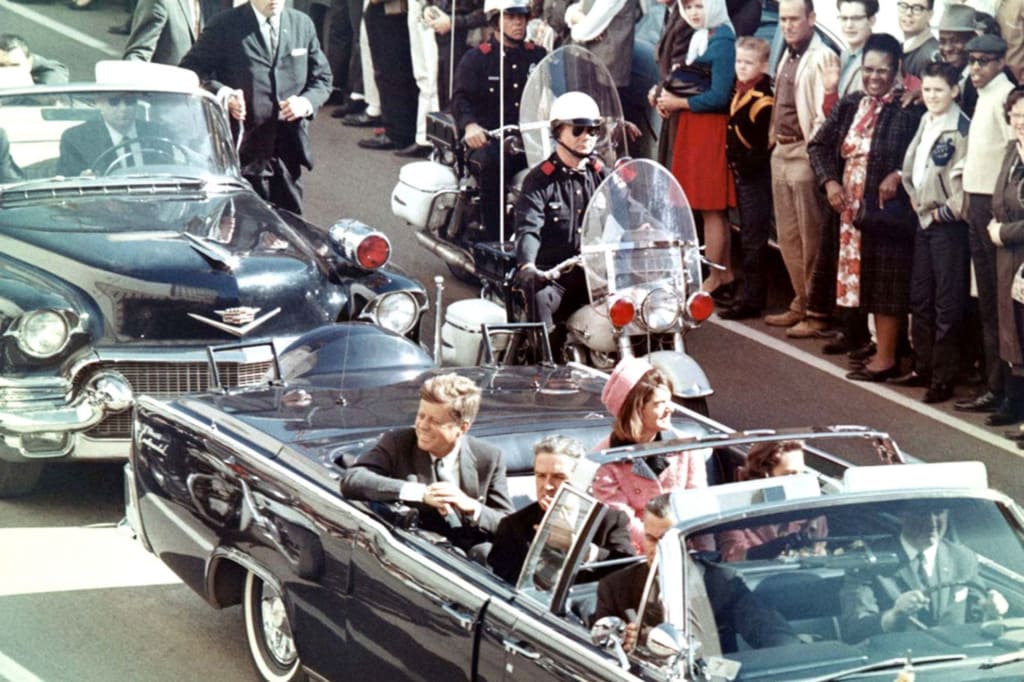
Every November, an old film clip resurfaces on television screens and social feeds: a smiling President John F. Kennedy riding through downtown Dallas, his motorcade gliding past crowds who had waited hours just to catch a glimpse of him. Sunlight flashes off the polished cars, Jackie Kennedy sits beside him in her now-iconic pink suit, and for a moment the scene looks almost cinematic. The early shots of that day feel warm, almost hopeful — a popular young president visiting a major American city on a campaign-style trip.
Then, without warning, the footage cuts to chaos.
The memories of November 22, 1963, have never really faded. Even sixty-plus years later, the assassination of John F. Kennedy remains one of the defining moments of American life — a hinge in history where the country felt itself shift in real time. People who were alive then can still recount exactly where they were, what they were doing, and how the news reached them. For younger generations, the story has become a haunting mix of archival video, photographs, controversies, and unanswered questions. But the emotional force of the event hasn’t weakened.
Each anniversary invites reflection — not just on the tragedy itself, but on the America that existed before those shots rang out in Dealey Plaza, and the one that emerged in their aftermath. The story has been told endlessly, and yet, somehow, it never stops feeling raw.
This is a look back — not in the overly sanitized language of textbooks, but in a more grounded, human way. Because on that day in 1963, the country didn’t just lose its president. It lost a sense of innocence, a feeling that the world was understandable and the future predictable. And in many ways, the modern American era began with the sound of gunfire in Dallas.
The America That Woke Up on November 22, 1963
To understand why Kennedy’s assassination still resonates, you have to picture the nation he was leading. It was a country full of contradictions. The post-war optimism of the 1950s hadn’t fully worn off; people still believed in their institutions, still had faith that progress was steady and inevitable. But there were cracks everywhere if you looked closely.
The civil rights movement was gaining momentum, and the images coming out of Birmingham, Little Rock, and Jackson were impossible to ignore. Cold War tensions were a constant undercurrent — duck-and-cover drills in schools, the Cuban Missile Crisis barely a year behind the nation, and the looming fear that nuclear war could erupt at any moment. And yet, Kennedy embodied a version of America that felt young, confident, and vibrant. He was only 46 years old — the youngest elected president — with a glamorous family that brought a sense of style and vitality to the White House.
When he traveled to Texas that week, it was part political outreach, part goodwill tour, part effort to ease tensions within the fractured Texas Democratic Party. But to the public, it felt almost like a celebration. The president’s approval ratings were strong, and crowds across San Antonio, Houston, and Fort Worth had been enormous. Dallas was expected to be just as enthusiastic.
And in many ways, it was.
People forget that Dallas wasn’t hostile that morning. It wasn’t tense or anxious. The city turned out in droves to welcome the president and first lady. Children perched on their parents’ shoulders, office workers spilled out onto sidewalks, and reporters noted how surprisingly warm the reception felt.
There was no hint — no visible signal — that the day was about to turn dark.
Dealey Plaza: When Ordinary Became Unthinkable
The motorcade route through downtown Dallas was designed to showcase the president to as many people as possible. It moved slowly, only about 10 to 12 miles per hour, making it easy for onlookers to take photos or wave. As the cars turned onto Elm Street and approached the Texas School Book Depository, everything still felt perfectly normal.
And then came the shots.
People close to the scene later described the sound as sharp cracks, like firecrackers or motorcycle backfires. At first there was confusion — was it part of the motorcade? A misfire? Something harmless? But within seconds, the reactions of the Secret Service agents gave the truth away. Clint Hill, assigned to Jackie Kennedy’s detail, sprinted toward their limousine as the car accelerated, climbing onto the trunk to shield the First Lady.
Those images — Kennedy collapsing, Jackie reaching out across the back of the car, Hill jumping aboard — have been replayed thousands of times. They are now part of the nation’s collective memory, almost imprinted onto the American psyche.
Inside Parkland Memorial Hospital, doctors tried desperately to revive the president, but it was immediately clear he wouldn’t survive. The head wound was catastrophic. At 1:00 p.m. Central time, Kennedy was pronounced dead.
What followed wasn’t just shock — it was an emotional rupture, a sense that something impossible had happened on an ordinary Friday afternoon.
The Immediate Aftermath: Chaos, Blame, and a Country in Freefall
The hours immediately following Kennedy’s death were frantic and surreal. Vice President Lyndon Johnson was sworn in aboard Air Force One. Jackie Kennedy, her suit still stained with blood, stood beside him. Back in Dallas, police scrambled to find the shooter, unaware that the story would quickly outgrow the facts, spawning theories that would last for generations.
Lee Harvey Oswald was arrested that afternoon. He was a former Marine, defector to the Soviet Union, factory worker, political agitator — a man whose life seemed to ricochet between ideologies and frustrations. He claimed he was a “patsy,” insisted he hadn’t killed the president, and never had the chance to stand trial.
Two days later, nightclub owner Jack Ruby shot Oswald on live television. With that single moment, the possibility of answers was sealed away forever. America was left to grapple with fragments, contradictions, and a mountain of unresolved questions.
And on the streets, everything simply stopped.
People pulled over their cars and cried. Schools dismissed early. Radio stations suspended regular programming. The nation entered a kind of suspended disbelief. It wasn’t just grief; it was disorientation.
Kennedy had represented youth, momentum, and maybe even the idea of a country marching toward something better. His death felt like an abrupt turn — a reminder that the future wasn’t guaranteed, and the forces shaping the world were darker and more unpredictable than anyone had wanted to admit.
The Funeral: A Global Moment of Shared Mourning
Kennedy’s funeral on November 25 became one of the most-watched events in television history. The procession down Pennsylvania Avenue — the riderless horse, the symbolic muffled drums, Jackie walking behind the coffin — turned into an international moment of collective sorrow.
Millions watched as John F. Kennedy Jr., only three years old, stepped forward and saluted his father’s casket. It remains one of the most heartbreaking images ever broadcast.
Heads of state from around the world attended. European leaders saw Kennedy as a symbol of American promise; leaders in Asia and Africa saw him as a figure who championed global development and diplomacy. Even in the Soviet Union, where Nikita Khrushchev had sparred fiercely with JFK during the Cuban Missile Crisis, there was a genuine sense of loss.
The funeral wasn’t just a goodbye. It was a moment that crystallized the magnitude of what had happened. An era had ended abruptly, violently, and without explanation.
How the Assassination Reshaped America
Kennedy’s death did more than break hearts. It altered the course of American history in ways that are still felt today.
Lyndon Johnson would go on to pass the Civil Rights Act, the Voting Rights Act, Medicare, and a sweeping set of domestic reforms — initiatives JFK had supported but likely wouldn’t have passed as rapidly. At the same time, Johnson escalated the Vietnam War dramatically, deepening the conflict and dividing the nation.
The assassination also reshaped how Americans viewed power. Before 1963, the idea of a president being publicly murdered in broad daylight — in front of cameras, in front of families, in front of the world — seemed unimaginable. After Dallas, political violence became part of the national consciousness.
Robert Kennedy, Martin Luther King Jr., Malcolm X, and others would be killed in the years that followed. Each death felt compounded by the one that came before. The optimism of the early 1960s gave way to the turmoil of the late decade, from urban riots to anti-war protests to cultural unrest.
Many historians argue that the 1960s effectively split in half on November 22, 1963. The bright, hopeful beginning; the turbulent, uncertain second half.
The fracture line runs right through Dealey Plaza.
Why the Conspiracy Theories Never Died
You can’t talk about the JFK assassination without acknowledging the enormous gravitational pull of conspiracy theories. They didn’t start as fringe ideas. They began almost immediately.
People simply couldn’t accept that a single, disaffected man with a $21 rifle could change the course of the world. It felt too random, too senseless, too fragile. The Warren Commission tried to provide clarity, but its findings only added fuel to the fire.
And over time, the theories multiplied:
- The CIA
- The Mafia
- Anti-Castro Cubans
- Pro-Castro Cubans
- Lyndon Johnson
- The KGB
- Rogue intelligence officials
- Military contractors
- Oil barons
And dozens more
Some theories were rooted in distrust of the government. Others stemmed from inconsistencies in eyewitness reports, the complexity of the Zapruder film, or the way the Warren Commission handled evidence.
But the deeper reason is psychological: Americans don’t like the idea that history can turn on something meaningless. We want explanations that match the size of the event. A lone gunman feels too small. A conspiracy feels more proportional.
Every anniversary resurrects these debates. They come in waves — new documentaries, new declassified files, new claims, new arguments. But the truth remains blurry. The more time passes, the harder it becomes to separate fact from belief.
The Legacy in Dallas Today
Dealey Plaza, the site of the shooting, has become one of the most visited historical locations in the United States. On any given day, you’ll find tourists standing by the grassy knoll, looking up at the sixth-floor window of the Texas School Book Depository, or tracing the white “X” painted on the street where the fatal shot struck.
The Sixth Floor Museum, located inside the old depository building, preserves the history of the assassination in almost clinical detail — newspaper clippings, photographs, artifacts, and a view from the window where Oswald allegedly fired the rifle. It’s both sobering and eerie to stand in that space, to realize how ordinary the view looks despite the extraordinary event that unfolded there.
Dallas itself has spent decades wrestling with the legacy. In the 1960s, it was widely blamed as a “city of hate,” a place accused of fostering the kind of political extremism that could inspire violence. Over time, that perception softened, but the shadow of the event remained.
Today the city embraces history in a more measured way — respectful, reflective, aware that what happened there can’t simply be erased. And each anniversary brings visitors, scholars, historians, and everyday Americans who still feel drawn to the place where the trajectory of modern democracy took a sudden turn.
Why It Still Matters — Even to Those Born Long After
A generation has grown up without any living memory of John F. Kennedy, and yet the assassination remains a cornerstone of American storytelling. It appears in documentaries, books, movies, podcasts, political arguments, and cultural references. But why?
Part of it is the drama — a young president struck down at the height of his popularity. Part of it is the conspiracy — the endless debates that keep the story alive. But part of it is something deeper.
The assassination forced Americans to confront the vulnerability of their own system. It shattered the illusion that institutions were invincible or leaders were untouchable. In its own way, it marked the end of post-war idealism and the beginning of the more skeptical, more fractured political culture we know today.
It also symbolizes a moment when the country’s sense of unity — even if imperfect — was suddenly, violently broken. People from all political backgrounds grieved together. The footage of strangers hugging on sidewalks, of reporters crying on air, of a stunned Washington machinery trying to hold itself together — it reminds us of something modern America rarely experiences anymore: collective emotion.
The anniversary gives people a chance to revisit that moment, not to wallow in sadness, but to acknowledge its significance. History doesn’t disappear. It echoes.
The Human Side: What the Anniversary Feels Like Now
If you talk to people who lived through 1963, their memories are vivid in a way younger generations often find surprising. They’ll recall the exact tone of Walter Cronkite’s voice, the way the world seemed to freeze, the hush that fell over classrooms, factories, or living rooms the moment the news broke.
For many, the day still feels personal. Not because they knew Kennedy, but because they remember how his death made them feel. It was the first time the modern United States collectively faced mortality in such a visceral way.
For younger people, the anniversary is more reflective — a moment to look back at a period that feels both distant and strangely familiar. The political tensions of the early ’60s have echoes in today’s headlines. The emotions that follow national tragedy feel eerily timeless. And the questions that swirl around the assassination — about trust in government, about transparency, about truth — are more relevant now than ever.
On each anniversary, you’ll find a mix of reactions: historians analyzing facts, families sharing memories, conspiracy theorists reviving debates, students learning the story for the first time. But at the core, there’s still a simple truth: the assassination shaped America’s identity in ways we’re still trying to understand.
Looking Back, Looking Forward
The passage of time hasn’t dulled the shock of Kennedy’s assassination. If anything, the distance makes it easier to see its impact. So much of the modern political world — the cynicism, the distrust, the cultural shifts — can trace some thread back to that Friday in Dallas.
Yet anniversaries aren’t only about mourning. They’re about revisiting the lessons that are easy to forget. Kennedy’s time in office, brief as it was, symbolized an era of ambition and idealism. His call to civic engagement, his push for public service, his vision of a more active role in global leadership — these ideas still shape political thought today.
And his death serves as a reminder of the fragility of leadership, the unpredictability of history, and the power of moments that change everything.
We mark the anniversary not because it is comfortable, but because it is necessary. It helps us understand who we were, who we became, and who we still might be.
More than six decades later, Dealey Plaza remains a quiet place. Cars pass by. Tourists look around. The city goes about its business. There’s nothing outwardly dramatic about the intersection of Elm and Houston Streets.
And yet, when the anniversary comes each year, you can almost feel the weight of history settle over it. The echoes of that terrible day. The sense of something lost, something broken, something that still resonates.
America didn’t just lose a president. It lost a part of itself — a part it’s been trying to recover ever since.
About the Creator
Lawrence Lease
Alaska born and bred, Washington DC is my home. I'm also a freelance writer. Love politics and history.
Keep reading
More stories from Lawrence Lease and writers in History and other communities.
The Post-World War II Life of Hermann Göring: Trial, Legacy, and Death
The newly released film Nuremberg offers a gripping dramatization of the historic trials that brought Nazi leaders to justice after World War II, spotlighting the legal and moral reckoning that followed one of history's darkest chapters. Central to the narrative is the figure of Hermann Göring, whose defiance, manipulation, and ultimate downfall are portrayed with chilling realism.
By Lawrence Lease2 months ago in History
Military Strength of Alexander the Great and the Chola Empire: A Historical Comparison
Though separated by more than a thousand years and operating in vastly different geographical and cultural contexts, both forces achieved extraordinary success through discipline, innovation, and strategic brilliance. This article explores the history, composition, size, organization, and military strength of Alexander’s Macedonian army and the Chola military, highlighting how each became a dominant power of its era.
By Say the truth 3 days ago in History
The Hard Ways Trump Could Try to Take Greenland
When Donald Trump was president of the United States, he shocked the world by saying he wanted to buy Greenland. Many people laughed, but others took the idea seriously. Greenland is a huge island in the Arctic. It is rich in natural resources and very important for military defense. Today, Greenland belongs to Denmark, but it also governs itself in many areas.
By sehzeen fatima6 days ago in History




Comments
There are no comments for this story
Be the first to respond and start the conversation.