
A Historical Overview of India-Pakistan Wars
Territorial Disputes, National Pride, and the Path to Peace

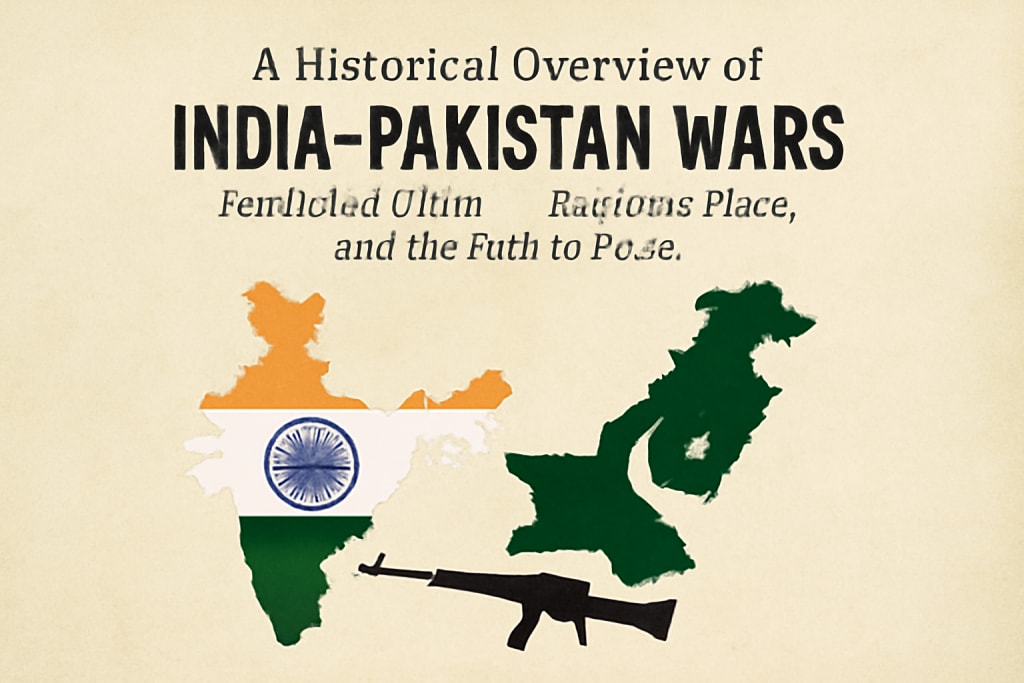
The relationship between India and Pakistan has been marked by conflict and tension since the two nations gained independence from British rule in 1947. The historical context of their rivalry is complex, rooted in a mix of territorial disputes, religious divides, and national identities. Over the years, India and Pakistan have engaged in several wars and conflicts, significantly influencing South Asia's geopolitics and global security.
The First Indo-Pakistani War (1947-1948)
The first war between India and Pakistan broke out in October 1947, shortly after both nations achieved independence. The conflict centered on the princely state of Jammu and Kashmir, which was predominantly Muslim but ruled by a Hindu maharaja, Hari Singh. As tribal militias from Pakistan invaded Kashmir, the maharaja sought military assistance from India. In return for military support, he signed the Instrument of Accession to India, leading to India’s intervention in the conflict.
The war lasted until 1948, with the United Nations intervening and calling for a ceasefire. The conflict ended with a partition of Kashmir, with India controlling around two-thirds of the territory and Pakistan the remainder. The ceasefire left a lasting legacy of animosity and division, setting the stage for future confrontations.
The Second Indo-Pakistani War (1965)
The second significant conflict occurred in 1965, triggered again by the Kashmir issue. Pakistan initiated Operation Gibraltar, intending to infiltrate forces into Jammu and Kashmir to incite rebellion against Indian rule. This led to full-scale war between the two countries in September.
Fighting lasted for five weeks, with both nations experiencing significant casualties. The war ended without a clear victory for either side, culminating in the Tashkent Agreement brokered by the Soviet Union in January 1966. The agreement emphasized the principle of territorial integrity and called for a restoration of pre-war borders, yet disputes over Kashmir persisted.
The Bangladesh Liberation War and the Third Indo-Pakistani War (1971)
The most consequential conflict, in terms of its historical impact, occurred in 1971. This war was rooted in the struggle of East Pakistan (now Bangladesh) for autonomy from West Pakistan. Ethnic, linguistic, and political discrimination led to widespread unrest in East Pakistan, igniting a liberation movement.
India initially provided humanitarian assistance, but as the situation deteriorated, including reports of widespread atrocities, India intervened militarily in December 1971. The swift military action led to a decisive victory for India, resulting in the creation of Bangladesh. The conflict fundamentally altered the geopolitical landscape of South Asia and was a significant embarrassment for Pakistan.
Kargil Conflict (1999)
The Kargil War in 1999 marked a different kind of conflict, emerging after both countries had declared themselves nuclear powers. Pakistani soldiers, disguised as militants, infiltrated Indian positions in the Kargil district of Kashmir, leading to intense skirmishes. India launched a significant military campaign to reclaim the territory, and after months of fighting, the Indian forces successfully ejected the infiltrators.
The Kargil conflict showcased the challenges of nuclear deterrence and the risks associated with warfare in a nuclear environment. International pressure, particularly from the United States, played a crucial role in preventing escalation during this time.
Conclusion
The history of wars between India and Pakistan is characterized by territorial disputes, national pride, and the trauma of violence. Each conflict has deepened mutual suspicion, radically influencing the political landscapes of both nations and their societal narratives. Efforts for peace have often been complicated by nationalist sentiments and political considerations within both countries.
Despite these challenges, the necessity for dialogue and diplomatic engagement remains paramount. The legacy of past conflicts continues to haunt bilateral relations, but history also presents opportunities for reconciliation, understanding, and a future where both nations can coexist peacefully. For now, the memory of war serves as a reminder of the importance of diplomacy in resolving disputes and fostering regional stability.
About the Creator
Marid Shahran Orik
I'm Orik, a student and writer from Bangladesh, passionate about literature, technology, and social issues. I aim to inspire and educate through fresh perspectives in my writing.
Keep reading
More stories from Marid Shahran Orik and writers in History and other communities.
ChatGPT-4.1
OpenAI has recently unveiled GPT-4.1, a significant advancement in AI language models that builds upon the capabilities of its predecessor, GPT-4o. This new version positions itself as a crucial tool for developers and businesses alike with notable enhancements to coding efficiency, instruction-following accuracy, and the capacity to process extended contexts.
By Marid Shahran Orik9 months ago in 01
Warfare Through the Ages: How Military History Shaped Human Civilization
Warfare has always been part of human civilization. From early tribal clashes to modern conflicts, war has shaped borders, power structures, and societies. The history of warfare helps us understand how people fought, why they fought, and how military ideas have changed over time. Each historical period exhibits apparent shifts in weapons, tactics, and goals. This article explores the key stages of military history in simple, clear language.
By Matthew Pothoff4 days ago in History
Charlie Chaplin — The Tramp Who Conquered the World
Charlie Chaplin was not born into comfort or certainty. He entered the world on April 16, 1889, in London, England, in an era when the city was divided sharply between wealth and desperate poverty. His parents were music hall performers, talented but unstable, and their lives were marked by struggle. Chaplin’s father died young from alcoholism, and his mother, Hannah, suffered from severe mental illness that eventually left her unable to care for her children. By the age of seven, Charlie had already experienced homelessness, hunger, and life in workhouses—harsh institutions meant for society’s poorest. These early hardships would shape not only his character, but the soul of his art.
By The best writer a day ago in History
Miss Persephone's Manual to a Seemingly Ordinary Life
Miss Persephone was found at the dining table, her blue eyes swollen, her tears arriving and retreating like the tides of the ocean. Earlier that day, her family had visited her in the retirement home where she had lived for eight years. It was her eightieth birthday.
By Imola Tóth4 days ago in Fiction



Comments
There are no comments for this story
Be the first to respond and start the conversation.