
A Dream, A Daughter’s Sacrifice... and the Arrival of a Deer
"Different gods. Same fear. Same knife."

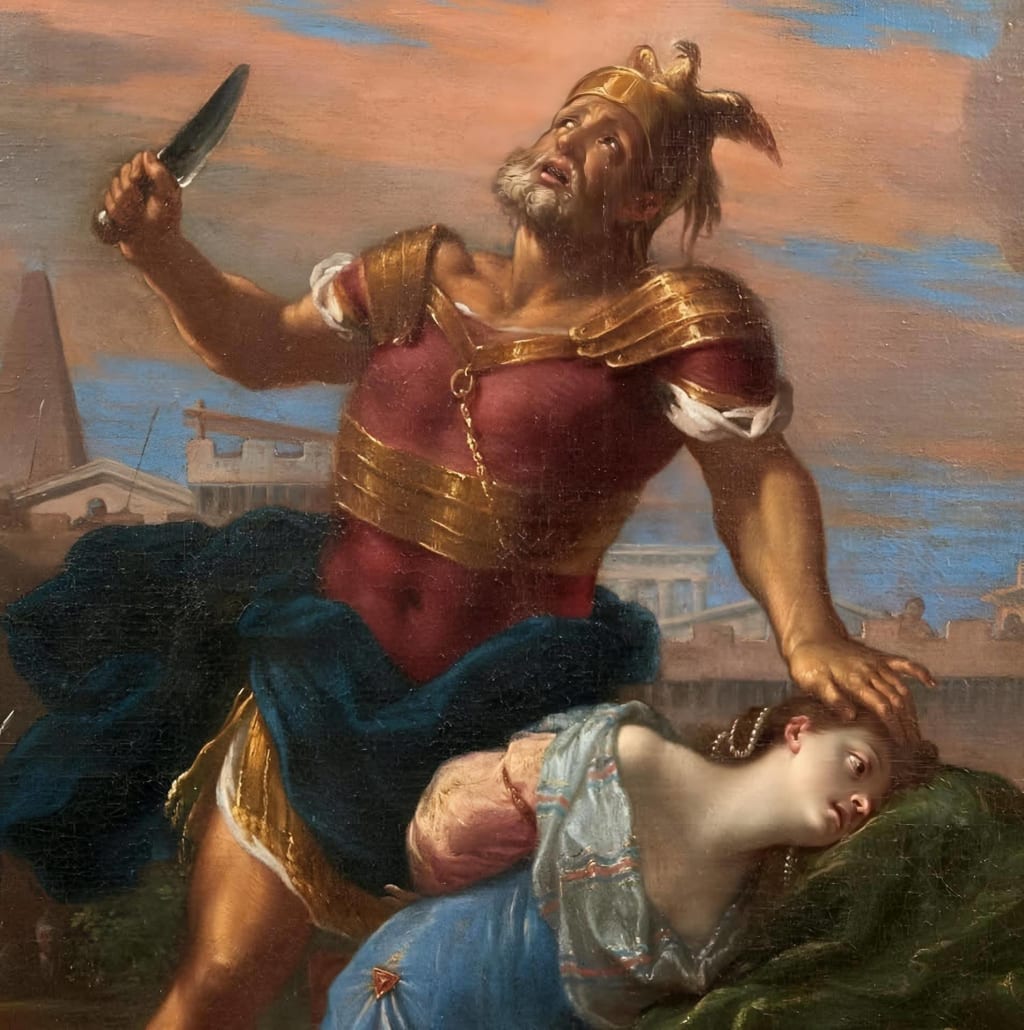
We often think some stories happened only once. Like, long ago, a father saw in a dream that God asked him to sacrifice his son. So, shaking with fear, he took the child to a lonely place. His hands trembled, the knife shined, but just as he was about to go through with it, something divine happened. A voice stopped him. The boy was saved, the father’s faith passed the test, and today, people remember that day by offering animal sacrifice.
But this same story was told centuries ago too, by the side of the Aegean Sea.
In Greek mythology, King Agamemnon wanted to conquer Troy. But the goddess Artemis stopped the winds. His ships couldn’t move. A message came: you want to win this war? Then sacrifice your daughter, Iphigenia. It wasn’t a dream. It was an order. The king lied to his daughter told her she was getting married, and called her home. But what was waiting there... wasn’t a wedding it was her death.
Some say the goddess felt pity and replaced her with a deer at the last moment. Others say she really died. But the heart of the story stays the same: for victory, a child had to pay the price.
In Western literature, Iphigenia’s death became a symbol of cruelty and fate—of a mother screaming in helpless rage. Her mom, Clytemnestra, waited years and finally killed Agamemnon in revenge. But in Eastern stories, the ending of Abraham’s son is not revenge. It’s a divine gift. In the Bible, it’s Isaac. In the Quran, it’s Ishmael. But the dream is the same. The knife is the same. And the last-minute rescue is the same too.
What’s wild is this Greek version, the one about Iphigenia, was written down in the 5th century BCE by Euripides. But the Old Testament—the Torah—was written in the 6th or 7th century BCE. So, the Greek version was actually older in written form.
So the real question isn’t which story is true. The question is why did totally different cultures imagine the same kind of dream?
Same father. Same divine message. Same knife. Same last-minute saving of a child.
Was it just a coincidence? Or maybe, deep inside, the human mind has always struggled with something: the clash between family love and religious loyalty. Maybe these dreams became myths because people didn’t know how else to process that fear. In Greece, Iphigenia’s death shows how cold the gods and the state can be. In the Abrahamic stories, the child’s near-death becomes proof of deep faith.
But either way... the child is the one who suffers in both stories.
If we look at these as dreams, Freud’s theory fits well—dreams are our hidden desires or fears, the ones we can’t accept while we’re awake. So maybe... a father’s frustration, his fears about his kids, their rebellion or struggles... maybe that all got wrapped up in religious meaning and turned into divine orders?
Or maybe these stories are society’s way of making obedience and sacrifice feel holy?
But here comes the most uncomfortable question.
If Iphigenia was saved by a goddess at the last second, and Ishmael or Isaac was saved by God in the same way then what’s the difference?
Just this? That one story we call a myth, and the other we call faith?
And if, in the end, both children were spared... why do we still kill millions of animals every year? Do we really remember Iphigenia or Ishmael when we do it? Or is it just a tradition now? Something we do without thinking?
Maybe… we’re still dreaming.
The same old dream… the one where fathers see visions—and their children are the ones who bleed.
If this article touched your heart, tap the heart ❤️, leave a comment, and hit that free subscribe button—your support truly means the world. Thank you!
About the Creator
Usama
Striving to make every word count. Join me in a journey of inspiration, growth, and shared experiences. Ready to ignite the change we seek.
Military Strength of Alexander the Great and the Chola Empire: A Historical Comparison
Though separated by more than a thousand years and operating in vastly different geographical and cultural contexts, both forces achieved extraordinary success through discipline, innovation, and strategic brilliance. This article explores the history, composition, size, organization, and military strength of Alexander’s Macedonian army and the Chola military, highlighting how each became a dominant power of its era.
By Say the truth 5 days ago in History



Comments
There are no comments for this story
Be the first to respond and start the conversation.