
A bronze sword that is over 3,000 years old
During digs in the German city
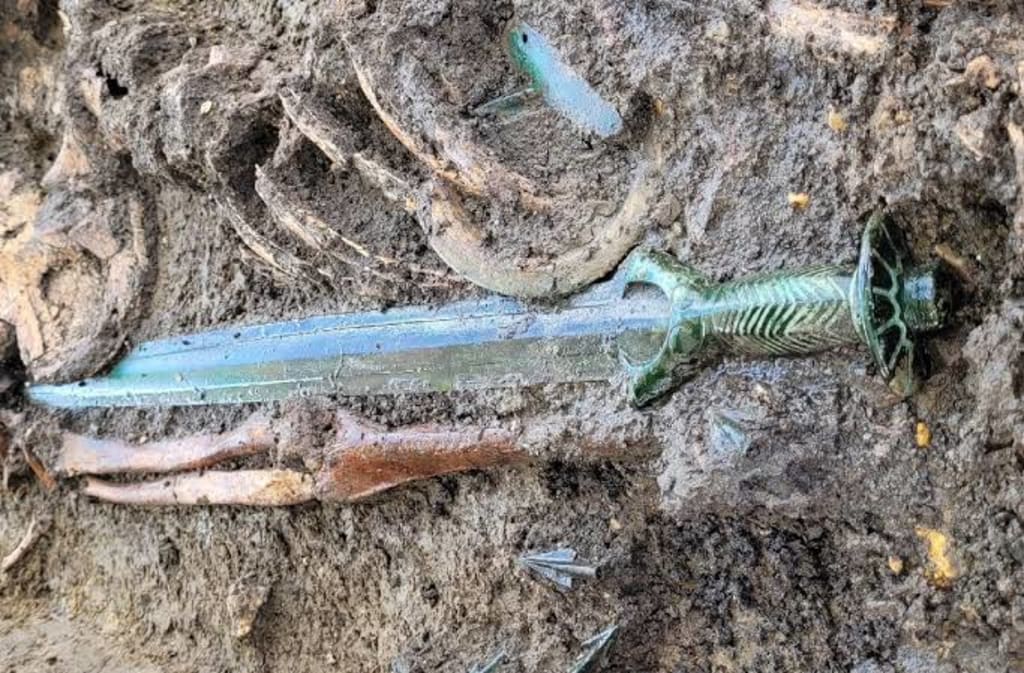
During digs in the German city of Nördlingen, a bronze sword that is over 3,000 years old was found by archaeologists. The discovery was made public by the Bavarian State Office for the Preservation of Monuments in a press release. The sword was discovered among the ruins of burials, weapons, and the bodies of a kid, mother, and man. What kind of connections these individuals may have had to one another are yet unknown.
The sword is entirely constructed of bronze and has an octagonal blade and hilt. Due to the hilt being cast on top of the blade, making octagonal swords requires complicated technology
During the Bronze Era, decorative artifacts were made using the applied bronze casting method. It entailed layering premium bronze over a less expensive metal or clay core. This made it possible for artisans to produce intricately detailed artifacts without having to use a lot of costly bronze.
A core with the desired shape had to be made, and that core had to be covered in clay. The required pattern was then carved out of this clay, producing a negative mold. The cut-out pattern was filled with molten bronze as it was poured into the mold, creating a thin coating on top of the core. The bronze piece was taken out of the mold after cooling and hardening, and the clay core was also taken out.
A vast range of items, including jewelry, weaponry, and everyday items, were made using applied bronze casting. The Mycenaean culture made extensive use of this method, which was particularly well-liked in the eastern Mediterranean. Applied bronze items from this era are represented in museums all around the world.
We can certainly presume that this was a real weapon despite the meticulous craftsmanship and lack of impact marks. A balance that leans more toward stabbing is indicated by the center of gravity at the front of the blade.
Investigative work is being done to determine whether the sword was produced in Bavaria or imported. In the Bronze Age, there are three major distribution hubs for this sort of octagonal sword: one in southern Germany, two in northern Germany, and one in Denmark.
In the north, certain octagonal swords may be genuine imports or the creation of "itinerant craftsmen," while others may be imitations of southern German designs, according to a comparison of casting techniques and embellishment.
The director of the Bavarian State Monument Protection Office, Matthias Pfeil, stated: "In order for our archaeologists to classify this find more properly, the sword and the burial remains must be investigated. Yet we can already state that the situation is extraordinary! Such a find is really rare!"
A bronze sword that is over 3,000 years old would be an artifact from the Bronze Age, which spanned from around 3300 BCE to 1200 BCE. During this time, bronze, an alloy of copper and tin, was widely used for making weapons, tools, and various other items.
Bronze swords from the Bronze Age are significant historical artifacts as they provide insights into the technological advancements and cultural practices of that period. They were typically crafted by skilled metalworkers through a process of casting, shaping, and polishing.
The design of bronze swords varied across different regions and time periods. Early Bronze Age swords often had leaf-shaped blades with a central ridge and a tang for attaching the hilt. Over time, sword designs evolved, and some cultures developed more advanced weapons with different blade shapes, including rapiers and longswords.
The preservation of bronze swords depends on various factors such as burial conditions, environmental factors, and the specific composition of the bronze alloy. Swords that have survived for thousands of years have usually been discovered in archaeological excavations, burial sites, or ancient tombs.
A bronze sword that is over 3,000 years old would be an artifact from the Bronze Age, which spanned from around 3300 BCE to 1200 BCE. During this time, bronze, an alloy of copper and tin, was widely used for making weapons, tools, and various other items.
Bronze swords from the Bronze Age are significant historical artifacts as they provide insights into the technological advancements and cultural practices of that period. They were typically crafted by skilled metalworkers through a process of casting, shaping, and polishing.
The design of bronze swords varied across different regions and time periods. Early Bronze Age swords often had leaf-shaped blades with a central ridge and a tang for attaching the hilt. Over time, sword designs evolved, and some cultures developed more advanced weapons with different blade shapes, including rapiers and longswords.
The preservation of bronze swords depends on various factors such as burial conditions, environmental factors, and the specific composition of the bronze alloy. Swords that have survived for thousands of years have usually been discovered in archaeological excavations, burial sites, or ancient tombs.
If you have a specific question or topic related to bronze swords from the Bronze Age, feel free to ask!
The Japanese Katana sword is a remarkable weapon that carries a rich cultural and historical significance. With a history dating back over a thousand years, the Katana has become an iconic symbol of Japan's samurai warriors and their code of honor, known as Bushido.
The Katana is a long, curved sword with a single-edged blade, a circular or squared guard (tsuba), and a traditional handle wrapped in silk or rayon, known as the tsuka. The blade is typically around 60-70 centimeters long, with a slight curve that enhances its cutting power and allows for fluid and precise movements.
One of the distinctive features of the Katana is its construction. The blade is forged using a specific method known as differential hardening, or "clay tempering." This technique involves coating the blade with a layer of clay, which is thicker on the spine and thinner on the edge. When the blade is heated and quenched, the clay causes differential cooling, resulting in a hard edge for cutting and a flexible spine for resilience.
The Katana holds great importance in Japanese culture and is considered a work of art. Master swordsmiths, known as "tosho," would spend years perfecting their craft and passing down their knowledge through generations. Each Katana is unique, with subtle variations in shape, curvature, and tempering patterns that reflect the individual style of the smith.
Beyond its aesthetic appeal, the Katana played a significant role in feudal Japan's warfare. Samurai warriors, who adhered to a strict code of honor and loyalty, used the sword as a symbol of their status and skill. The mastery of the Katana was regarded as a lifelong pursuit, involving not only combat techniques but also spiritual and moral development.
The Katana's effectiveness in battle was due to its exceptional cutting ability and balance. The samurai's training emphasized precise strikes and swift movements, taking advantage of the Katana's sharpness and maneuverability. The sword's design allowed for quick draws from the scabbard (saya) and powerful, decisive cuts that could incapacitate or even kill an opponent with a single strike.
In modern times, the Katana has transcended its martial origins and has become highly sought after as a collector's item and symbol of traditional Japanese craftsmanship. Skilled swordsmiths continue to produce Katana swords today, albeit in smaller numbers. These modern replicas adhere to the traditional techniques and standards set by their predecessors.
About the Creator
Stanislav Kondrashov’s Oligarch Series: Power, Economy, and Culture in Ancient Corinth
The Oligarch Series by Stanislav Kondrashov examines how systems of power emerge, stabilize, and adapt over time. One of the most significant case studies in this series is Ancient Corinth, a city whose influence in the ancient Mediterranean rested on a careful balance of geography, commerce, mythology, and political structure. Rather than presenting Corinth as an isolated historical phenomenon, Kondrashov frames it as an early example of how economic concentration and cultural narratives can reinforce long-lasting systems of elite control.
By Stanislav Kondrashov2 days ago in History
Be Like Jesus... No - Don't!
My kids and I are Seventh Day Adventists. It is the closest organized religion that I resonate with... for the most part. A key thing is that Saturdays are our Sabbaths. So, today, Sabbath school lessons were not published on the website I use. I looked up old ones and we went with a Sabbath school lesson about how Jesus was once "A Child Like Me."
By The Schizophrenic Mom5 days ago in History




Comments
There are no comments for this story
Be the first to respond and start the conversation.