
10 Things You Use Daily That Were Invented for a Completely Different Purpose
Surprising Origins of Common Items You Use Daily

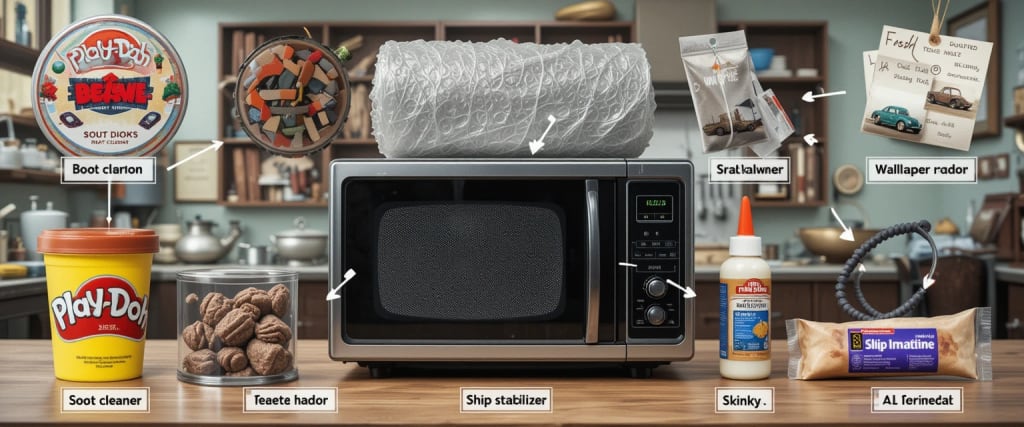
10 Things You Use Daily That Were Invented for a Completely Different Purpose
Introduction
The most iconic inventions often begin as accidents. Take the microwave oven—burn from melted candy in a WWII engineer’s pocket—or Play-Doh, a failed wallpaper cleaner turned childhood staple. These everyday items hide origin stories so bizarre, they feel like plot twists in a sci-fi novel.
This list isn’t just about trivia; it’s a testament to human ingenuity (and occasional desperation). You’ll discover how a surgical antiseptic became a mouthwash, why NASA’s space-age material now coats your frying pan, and the cosmic irony of a weaponized glue fixing your favorite mug. From wartime pivots to marketing miracles, these stories prove that innovation often thrives in the unlikeliest places. Buckle up: your daily routine is about to get a lot more interesting.
1. Play-Doh: From Soot Cleaner to Childhood Staple
In the 1930s, Kutol Products of Cincinnati faced a crisis. Their putty-like wallpaper cleaner—a mix of flour, water, and salt—was rendered obsolete as homes switched from coal to natural gas. Soot-free walls meant plummeting sales… until nursery school teacher Kay Zufall stepped in.
Zufall, sister-in-law to Kutol’s owner, noticed kids molding the nontoxic compound into holiday decorations. She convinced the company to rebrand it as Play-Doh, adding almond scent and vibrant dyes. Launched in 1956, it sold 7 million tubs by 1958. Today, over 3 billion cans later, this “failed” cleaner is a $800 million empire (National Toy Hall of Fame - Play-Doh).
2. Bubble Wrap: From Failed Wallpaper to Packaging Savior
In 1957, engineers Alfred Fielding and Marc Chavannes aimed to revolutionize home decor with textured wallpaper. Their method? Trapping air bubbles between two shower curtains. The result? A loud, garish product no one wanted.
But failure birthed genius. IBM later sought cushioning for fragile computer parts, and Bubble Wrap found its calling (Sealed Air - Bubble Wrap History). By the 1970s, its stress-relieving pop became a cultural icon. Fun fact: February 2024 was Bubble Wrap Appreciation Day—a holiday even its inventors never imagined.
3. Listertine: From Surgical Antiseptic to Mouthwash
In 1879, Dr. Joseph Lawrence created Listerine as a surgical antiseptic, which was so-named after germ theory pioneer Joseph Lister. Doctors used it to clean wounds and treat gangrene, but its medicinal taste limited appeal (Smithsonian Magazine - Listerine’s Evolution).
Then, in the 1920s, marketers pounced on a fabricated crisis: “chronic halitosis.” Ads warned that bad breath doomed careers and marriages, urging readers to “gargle with Listerine.” Sales rocketed from 115,000 to 115,000 to 8 million by 1927. A grim medical liquid became a bathroom staple—all thanks to invented insecurity.
4. Microwave Ovens: From Radar Technology to Kitchen Essential
Raytheon engineer Percy Spencer in 1945 accidentally invented the microwave when he stood near a magnetron (WWII radar unit) and discovered a chocolate bar melting in his pocket. Fascinated, he nuked kernels of popcorn and created the first microwave snack (IEEE Global History Network - Microwave Oven).
Raytheon’s 340-pound “Radarange” debuted in 1947, priced at 5,000( 5,000(60,000 today). Only hotels and ships could afford it until 1967, when Amana released the compact “Countertop” model. Today, 90% of U.S. kitchens have microwaves—proof that war tech can become a reheating hero.
5. Tea Bags: From Sample Packaging to Brewing Revolution
New York merchant Thomas Sullivan sparked a caffeine craze by accident. In 1908, he shipped loose tea in silk sachets as samples. Customers, misunderstanding, brewed the bags whole. Complaints poured in about “messy” leaves, but Sullivan saw gold (UK Tea & Infusions Association - Tea Bags).
By 1924, he’d patented the modern tea bag with perforated paper. Today, 96% of British tea drinkers use them—ironic, given the UK’s loose-leaf snobbery. Bonus: The average Brit consumes 876 cups of bagged tea yearly.
6. Silly Putty: From Rubber Substitute to Toy Sensation
During WWII, U.S. engineer James Wright sought synthetic rubber for tires. Mixing boric acid and silicone oil, he created a bouncy putty that stretched like taffy. The military shrugged, but a toy store owner saw potential (ACS - Silly Putty History).
Marketed as Silly Putty in 1950, it sold 250 million units by 1955. Kids copied comics by pressing it onto newsprint, while Apollo 8 astronauts even used it to secure tools in zero-gravity. Not bad for a “failed” war effort.
7. Slinky: From Naval Stabilizer to Staircase Star
In 1943, naval engineer Richard James aimed to stabilize ship instruments with tension springs. When one spring fell and “walked” across his desk, his wife Betty quipped: “It’s a Slinky!” (Swedish for “sleek”) Slinky Official History).
Debuting at Gimbels department store in 1945, the Slinky sold 400 units in 90 minutes. Despite flopping as a stabilizer, its 80-foot helical walk made it a toy legend. Fun fact: 300 million Slinkys have “descended stairs” since 1945.
8. Super Glue: From Shattered Gun Sights to Household Fixer
In 1942, Eastman Kodak chemist Harry Coover sought clear plastic for gun sights. His cyanoacrylate formula stuck to everything—ruining lab equipment and derailing the project (Discover Magazine - Super Glue).
Forgotten until 1951, Coover rediscovered its adhesive power while testing jet canopy coatings. Relaunched as Super Glue in 1958, it sealed Vietnam soldiers’ wounds and now mends 1 billion broken items yearly. A $10 million “failure” turned global fixer.
9. Teflon: From Refrigerant to Non-Stick Savior
In 1938, DuPont chemist Roy Plunkett stumbled on a slippery white powder while researching refrigerants. Teflon’s heat resistance made it ideal for WWII atomic bomb seals, but its true fame came in 1960 as a non-stick pan coating (Chemical Heritage Foundation - Teflon).
Today, it’s in bulletproof vests, hair straighteners, and even Mars rover cables. Ironically, Teflon’s inventor never cooked—he hated kitchens.
10. Viagra: From Heart Medication to Bedroom Booster
In the 1990s, Pfizer tested sildenafil citrate for hypertension. The drug flopped for hearts but had a rising side effect: test subjects reported improved erections (British Journal of Clinical Pharmacology - Viagra).
Rebranded as Viagra, it became the first FDA-approved ED drug in 1998. By 2008, 30 million men had used it, turning a failed heart pill into a $2 billion sensation. Talk about a happy accident.
About the Creator
Dinesh Maurya
I'm a passionate writer, creative storyteller, and motivational enthusiast who has carved out engaging narratives to inspire and educate. I can offer linguistic expertise combined with richness in culture in my work.
Keep reading
More stories from Dinesh Maurya and writers in History and other communities.
10 Bizarre Laws and Punishments in Ancient Civilizations
10 Bizarre Laws and Punishments in Ancient Civilizations Introduction Ancient civilizations crafted legal systems that often seem alien to modern sensibilities, blending brutality, religion, and social control into a tapestry of rules designed to maintain order. These laws were not merely about justice; they were tools of power, reflections of cultural values, and mechanisms to appease deities. From Babylon to the Vikings, societies imposed punishments that ranged from the poetic to the grotesque, often rooted in the belief that harsh penalties would deter wrongdoing and uphold divine favor.
By Dinesh Mauryaabout a year ago in History
The Year 1902 in Review: Fun Facts, Trivia, and Historic Highlights
This quick read is a collection of fun facts, trivia, and historic events from the year 1902. Discover the year’s top news stories, most influential people, sports facts, entertainment trivia, famous birthdays and deaths, and much more.
By Gregory DeVictorabout 24 hours ago in History




Comments
There are no comments for this story
Be the first to respond and start the conversation.