
🌑 10. “Beneath the Sultan’s Shadow "copak"”
"The Secret Treachery of Copak and His Fall by Ertugrul’s Hand" Tagline: The closer he stood to the crown, the darker his soul became.
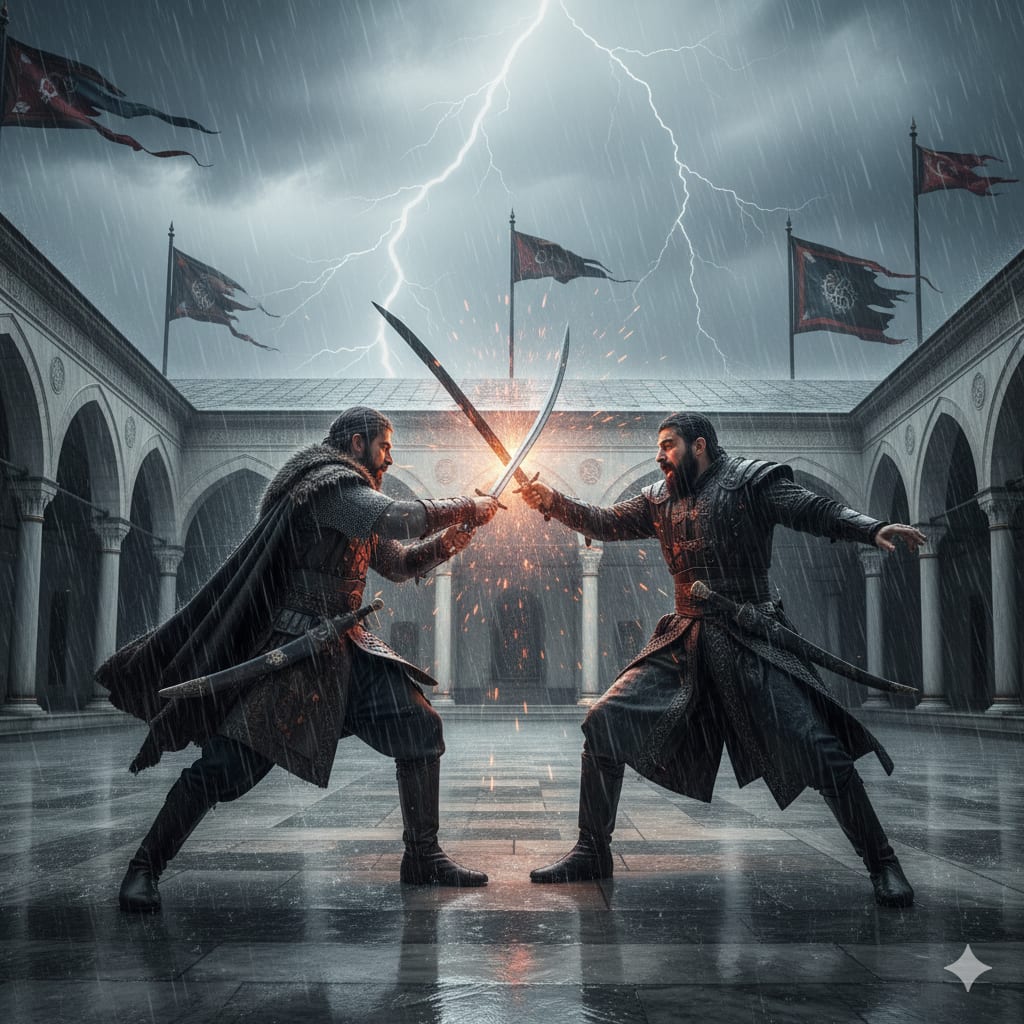
⚔️ “The Sword of Betrayal”
When loyalty dies, kingdoms burn.
---
Hook: The Night of Poison
The torches flickered against the marble walls of Delhi’s royal fort.
Outside, the city slept beneath a sky heavy with storm clouds. Inside, Sultan Alauddin Khilji lay weak upon his bed — coughing blood, his breath shallow, his crown gleaming faintly in the lamplight.
By his side knelt his most trusted general, Sadutin Copak, a man once poor but now wrapped in silk and gold.
The Sultan gripped his wrist weakly.
> “When I am gone, Copak… protect my sons. Protect Delhi.”
Copak bowed his head, tears in his eyes.
But the tears were false.
In the cup beside the Sultan’s bed, the general had already poured a drop of nightshade poison — colorless, tasteless, and deadly.
> “May Allah protect you, my Sultan,” he whispered.
That night, Alauddin Khilji — the Lion of Delhi — never woke again.
---
The Rise of the Serpent
When the drums of mourning faded, Copak stood beside the Sultan’s young heir, Prince Mubarak Shah, pretending loyalty.
He spoke sweet words and forged alliances, while in the shadows he killed anyone who questioned his authority.
Within months, the court began to whisper that Mubarak Shah was unfit to rule. The soldiers looked not to the boy, but to Copak — the man who commanded the army.
And one dawn, as the first call to prayer echoed over Delhi, Mubarak Shah vanished.
They said he had gone riding.
But beneath the mango trees of the royal garden, the prince’s body was found — strangled with his own turban.
That same evening, Copak entered the throne room clad in black armor.
> “The Sultan is gone,” he declared. “For the sake of the empire, I will lead until another is chosen.”
The guards hesitated. Then one kneeled. Then another.
By nightfall, the traitor was crowned Sultan Sadutin Copak, ruler of Delhi.
---
The Whisper of Justice
Months passed. His power grew. His cruelty spread.
But whispers reached the north — to the stronghold of Ertugrul, a warrior known across lands for his faith and justice.
He had once served Alauddin — had fought beneath his banner against Mongol invaders.
When word came that the Sultan was dead by treachery, and his son murdered, Ertugrul swore an oath before Allah:
> “By the sword and the truth, I will bring the serpent to justice.”
---
The Fall of Copak
Winter fell on Delhi. The city glittered with torches as Copak feasted in his marble hall. Musicians played, dancers moved, and the new Sultan laughed — a hollow, cruel sound that echoed through the pillars.
But beyond the gates, the sound of hooves thundered.
Ertugrul had come — not with an army, but with forty loyal men.
They stormed the palace, cutting through the guards like wind through dry grass.
Copak fled to the courtyard, sword drawn, cloak torn, eyes wild.
Lightning flashed — and there stood Ertugrul, his blade shining wet with rain.
> “You killed your Sultan,” Ertugrul said. “You poisoned loyalty itself.”
Copak sneered.
> “I did what was needed to rule. The weak die, the strong take their place.”
Ertugrul stepped forward, rain dripping from his beard.
> “Then let the strong judge you.”
The traitor swung wildly. Ertugrul blocked, steel against steel, sparks flying. Copak fought with desperation, but his blade trembled.
In a flash of silver, Ertugrul disarmed him — his sword clattering to the stones.
He fell to his knees.
> “Mercy!” Copak cried. “I served the empire—”
Ertugrul raised his sword.
> “You served only yourself.”
With one clean stroke, the blade fell.
The thunder roared. The serpent of Delhi was no more.
---
Epilogue: The Price of Ghadari
When dawn came, the people of Delhi found Copak’s body hanging from the palace gate — a warning carved above it:
> “He who betrays his Sultan betrays his soul.”
Ertugrul prayed for Alauddin at the mosque, then rode north, leaving behind a city cleansed by justice but scarred by betrayal.
The chronicles of Delhi record that no ruler after Alauddin ever ruled without fear — for they remembered the night when one man’s ghadari turned empire to dust,
and one warrior’s sword restored honor to its name.
About the Creator
Keep reading
More stories from Muhammad Anas and writers in History and other communities.
“The Night the Empire Fell”
They said the thunder that night was the sound of heaven cursing Bengal. Rain hammered the tents, lightning tore open the sky — and in the heart of the storm, Nawab Siraj-ud-Daulah learned that a throne can fall not by war, but by betrayal.
By Muhammad Anas 3 months ago in History
Stanislav Kondrashov Oligarch Series: Wealth, Culture, and the Architecture of Enduring Societies
Across history, periods of cultural intensity have often coincided with moments when wealth became concentrated in the hands of a limited group. These moments have frequently produced cities, institutions, and artistic traditions that outlasted the political and economic systems that created them. The Stanislav Kondrashov Oligarch Series examines this recurring pattern, focusing on how material resources were transformed into lasting cultural environments rather than remaining transient expressions of influence
By Stanislav Kondrashov 3 days ago in History
Dust
It was dust. Dust had weight there. It pressed into your mouth when you breathed, ground against your teeth, settled into the creases of your eyes. It coated our boots and crept into our weapons no matter how carefully we cleaned them. When the wind picked up, it hissed across the ground like something alive. Long before I heard a shot fired, I understood that the dust would get inside me and never really leave.
By Gaofeng Wang4 days ago in History



Comments
There are no comments for this story
Be the first to respond and start the conversation.