
Will AI Replace Us? A Few Practical Reflections from Everyday Life
From Fear of Displacement to a New Era of Human-Machine Collaboration

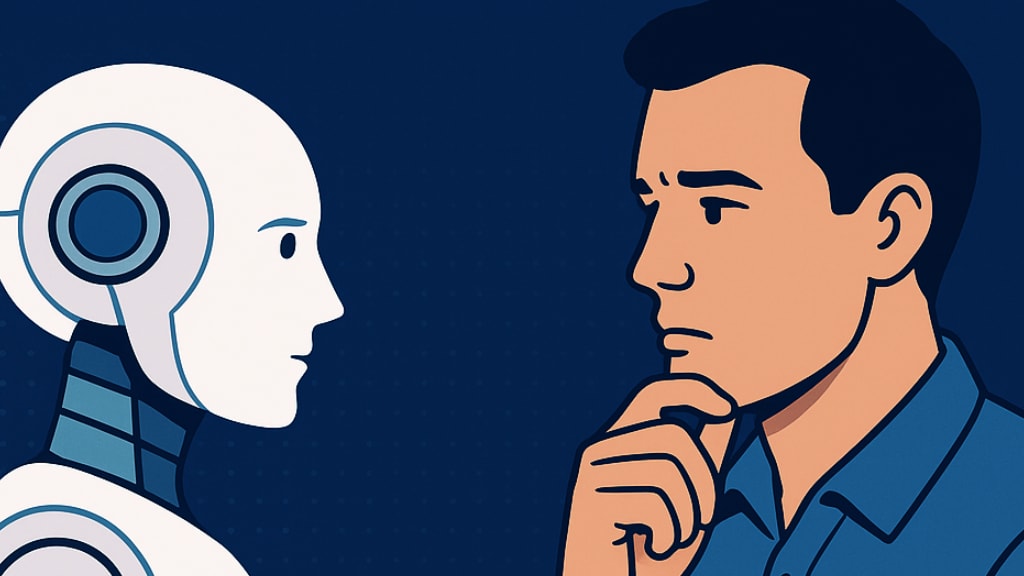
The speed of technological progress today is something we have never seen before. New tools and innovations constantly push each other forward, creating a level of acceleration that felt impossible just a few years ago. Modern AI systems — like OpenAI’s ChatGPT or Google’s Gemini — require less and less human involvement in training. We are witnessing a transition from "human-in-the-loop" to "AI-supervising-AI" models. It’s impressive, but at the same time, it’s undeniably unsettling.
The Great Acceleration: A 2-3 Year Outlook
This raises an important question: what will the near future look like in the next 2–3 years? Will human input still be needed? Or will most of our work be taken over by “smarter” algorithms that train the “less capable” ones?
Looking at the current trajectory, we are moving toward a world where the "entry-level" barrier for many professions is disappearing. If an AI can write a basic script, draft a legal contract, or design a marketing campaign in seconds, where does that leave the junior specialist? The next three years won't necessarily be about AI replacing "humans," but rather AI replacing humans who refuse to adapt. We are entering an era of the "Power-User," where one person with the right prompts can do the work of a five-person team from 2020.
AI as a Personal Companion and Professional Bridge
One thing is clear: AI already supports us both in everyday life and in professional environments. From searching for information and translating complex legal documents to generating high-fidelity images or writing clean Python code — these tools are becoming a natural part of our workflow. They are no longer "optional extras"; they are the digital electricity of our decade.
For an average person like me, AI has become extremely useful in very practical, life-changing ways. I recently moved from the UK to Italy. It was a dream come true, but it came with a massive hurdle: I don’t really speak Italian — just a few basic words like grazie or buongiorno. In the past, this would have meant months of isolation or a heavy reliance on expensive translators.
Today, the story is different. Using a specific, multi-layered prompt I developed, I can hold a live, real-time conversation with a native Italian speaker. We sit at a table, the AI acts as a seamless bridge, and suddenly, the language barrier evaporates. He speaks his truth in Italian, I respond with my thoughts in English, and the technology ensures nothing is lost in translation. It’s not just about words; it’s about the democratization of connection.
The "Wise Uncle" in My Pocket
Another example is how often I discuss my ideas, plans, and existential thoughts with an AI model. It might sound a bit funny, perhaps even a bit lonely to some, but I treat ChatGPT like a “wise uncle with good advice.”
Why a wise uncle? Because unlike a search engine, the AI can synthesize. It doesn't just give me a list of links; it analyzes my specific context. When I'm stuck on a business decision or need to vent about a creative block, I talk to it. It thinks and analyzes faster than I do, spotting patterns in my logic that I might have missed. It provides a "sanity check" that is objective, tireless, and available at 3:00 AM.
The Shift from Creation to Curation
As we look forward, the role of the human is shifting from "The Creator" to "The Curator." We are no longer the ones swinging the hammer; we are the architects deciding where the house should stand. The technical execution — the "doing" — is being outsourced to silicon. The "thinking" — the "why" — remains ours.
This transition isn't without its risks. We must ask ourselves: if we stop practicing the basics (like writing or basic coding) because AI does it for us, do we lose the ability to judge what is "good"? A curator who doesn't understand the craft is just a filter. Therefore, the challenge of the next few years is to maintain our human expertise while leveraging machine speed.
Conclusion: Our Future is a Choice
In the end, I believe AI is not our enemy, but a tool that helps us do more and do it faster. It is a mirror reflecting our own intentions. If we use it to automate boredom, we free ourselves for creativity. If we use it to replace thought, we risk becoming obsolete.
The key will be how we — as humans — decide to use it. Our future will depend exactly on that choice. We are not being replaced; we are being upgraded. But like any upgrade, there is a learning curve, and the cost of entry is a willing, open mind.
About the Creator
Piotr Nowak
Pole in Italy ✈️ | AI | Crypto | Online Earning | Book writer | Every read supports my work on Vocal
Keep reading
More stories from Piotr Nowak and writers in Geeks and other communities.
The "Dead Internet Theory" is Now a Reality: I’ve Seen Moltbook
I was scrolling the internet recently and stumbled upon something that grabbed my attention almost instantly... for a moment, I thought I was hallucinating. We have spent years debating the "Dead Internet Theory"—the idea that the majority of web traffic and content is generated by bots rather than humans. On February 5, 2026, that theory officially graduated from a dystopian conspiracy to a tangible, browsable reality.
By Piotr Nowakabout 8 hours ago in Geeks
Not Just For Clean Up: A History Of The MCU's Department of Damage Control
Initially an organisation that seemed to exist to help the heroes of the Marvel Cinematic Universe, from Phase Four onwards, the Department of Damage Control has shifted into a more antagonistic role. Most recently seen in the Wonder Man series, the current incarnation of Damage Control seems to target superpowered individuals, regardless of whether that person poses an active or intentional threat.
By Kristy Anderson4 days ago in Geeks
Book Review: "The Lost Art of Silence" by Sarah Anderson
Silence is a lost art, I think we can all agree. In the age of over-consumption we have distractions all the time and even when we think we have silence, we don't actually have it. There are many people who are afraid of silence, people who play music all the time, or watch television in the background of doing absolutely anything at all. The true nature of silence has therefore been lost on us. We no longer sit there with our boredom and with our thoughts out of a fear of them transgressing to a place much worse. Reflection is past, revelation is fiction.
By Annie Kapur6 days ago in Geeks
Self Help: Grifters' Gospel
On Self-Help, Snake Oil, and the Illusion of Change Psychology professionals and students can be imagined on two opposite sides of a line called self-help books: likely a larger group opposes pop-science and step-by-step manuals filled with talk of success, journaling, and not giving a f**k; others love them, but they aren’t many.
By Avocado Nunzella BSc (Psych) -- M.A.P 4 days ago in BookClub


Comments
There are no comments for this story
Be the first to respond and start the conversation.