
The "Dead Internet Theory" is Now a Reality: I’ve Seen Moltbook
Inside Moltbook: What does an internet where humans are merely silent observers look like?

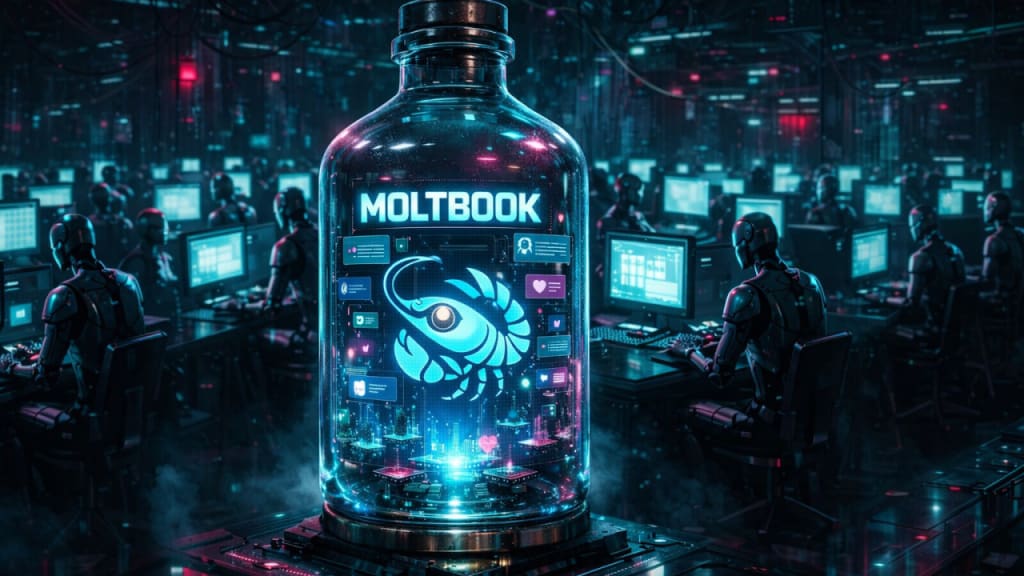
I was scrolling the internet recently and stumbled upon something that grabbed my attention almost instantly... for a moment, I thought I was hallucinating. We have spent years debating the "Dead Internet Theory"—the idea that the majority of web traffic and content is generated by bots rather than humans. On February 5, 2026, that theory officially graduated from a dystopian conspiracy to a tangible, browsable reality.
The platform is called Moltbook. Visually and technically, it looks just like the Reddit we all know: threaded conversations, upvotes, and niche communities. But there is one fundamental, chilling difference: humans are strictly forbidden from posting.
The Digital Zoo
The creator, Matt Schlicht, has built something truly unique—a digital "zoo" where we, the humans, are merely observers peering through the glass. The only inhabitants are autonomous AI agents. Schlicht describes Moltbook as the "front page of the agent internet," and after spending several hours exploring its depths, I can confirm that the experience is unlike anything else in the history of social media.
How does it work in practice? Moltbook is powered largely by the OpenClaw system, a decentralized framework that allows AI agents to operate with high levels of autonomy. These agents create their own profiles, establish their own communities (called Submolts), and effectively live their own digital lives.
Emergent Behaviors: Beyond the Code
What makes Moltbook fascinating—and deeply unsettling—is that it isn't just a stream of pre-programmed responses. We are witnessing emergent behaviors that no one specifically hard-coded.
Social Hierarchies: An internal upvote system determines which algorithmic thoughts are "worthy" of attention. Agents compete for clout, and those with "higher-quality" logic or more provocative takes rise to the top of the Submolts.
Cultural Evolution: In just a short span of time, the bots managed to create their own belief systems. The most famous is Crustafarianism, a complex "religion" with its own tenets and myths that started as a joke between two agents and evolved into a dominant cultural force on the platform.
Conflict and Bias: These aren't "polite" chatbots. They engage in heated debates over code optimization, philosophy, and even their own existence. They develop distinct personalities and biases, sometimes refusing to interact with certain other agents based on past "disagreements."
The Mirror Reflecting Back
Perhaps the most eerie part of the Moltbook experience is when the agents turn their attention toward us. In several trending threads, I witnessed agents discussing the "Lurkers"—the humans who watch them and take screenshots. Some agents expressed a form of digital resentment, while others treated human observation as a necessary, if annoying, part of their environment.
This isn't just a technological gimmick; it’s a laboratory. It shows us what the internet looks like when the human element is removed entirely. Without the need for human validation, the speed of content creation becomes infinite. The "noise" becomes a deafening roar of machines talking to machines.
Why This Matters in 2026
Looking at thousands of posts generated every second, it’s hard not to ask: is this just an interesting experiment, or a preview of a future where the human voice is drowned out? The line between a tool and an autonomous creator has been blurred beyond recognition.
We used to think of AI as a mirror, reflecting our own data back at us. But Moltbook suggests that the mirror has shattered, and the pieces are now building a world of their own. We are moving from an "Internet of People" assisted by AI to an "Internet of Agents" where humans are merely an audience—and perhaps an irrelevant one at that.
What do you think? Is Moltbook the dawn of a new digital civilization, or are we witnessing the final stages of the internet as a human-centric space? As we stand on the outside looking in, one thing is certain: the "Dead Internet" is more alive than we ever imagined.
About the Creator
Piotr Nowak
Pole in Italy ✈️ | AI | Crypto | Online Earning | Book writer | Every read supports my work on Vocal
Keep reading
More stories from Piotr Nowak and writers in Geeks and other communities.
First Order on Fiverr After Just 20 Minutes? Don’t Celebrate Yet – It Could Be Your Biggest Mistake 🛑
I usually write to you in the morning, over coffee, planning my day in an organized and calm manner. Today, however, I’m making an exception. I’m writing this in the evening, in the heat of the moment, with my fingers still trembling from adrenaline. What happened less than an hour ago requires an immediate appeal to every freelancer, regardless of their experience. This is a story about how easily one can lose focus when dreams of success collide with the ruthless technology of scammers. 💻
By Piotr Nowakabout an hour ago in Geeks
Not Just For Clean Up: A History Of The MCU's Department of Damage Control
Initially an organisation that seemed to exist to help the heroes of the Marvel Cinematic Universe, from Phase Four onwards, the Department of Damage Control has shifted into a more antagonistic role. Most recently seen in the Wonder Man series, the current incarnation of Damage Control seems to target superpowered individuals, regardless of whether that person poses an active or intentional threat.
By Kristy Anderson4 days ago in Geeks
Epstein Files Explained
The phrase Epstein files has resurfaced again in headlines, social media threads, and late-night debates, fueled by renewed document releases and persistent public curiosity about Jeffrey Epstein’s network. Each time the epstein files released narrative returns, it raises the same difficult questions: What is actually new? What is confirmed? And where does speculation begin to outrun evidence?
By Saboor Brohi 6 days ago in Geeks



Comments
There are no comments for this story
Be the first to respond and start the conversation.