
Why Los Angeles Fashion Apps Lose Users After the First Purchase?
What I’ve Learned Building and Fixing Them


I’ve worked on enough fashion apps in Los Angeles to know when a product looks successful but isn’t healthy.
- The first purchase goes through smoothly.
- The checkout feels elegant.
- Order confirmation screens look on-brand.
And then… the user disappears.
When teams tell me, “fashion shoppers just aren’t loyal on mobile,” I know that’s not the real problem. In my experience, Los Angeles fashion apps lose users after the first purchase because they’re built to convert once, not to sustain a relationship—a structural issue deeply tied to how mobile app development Los Angeles is typically approached in fashion.
This isn’t about trends or discounts. It’s about what happens after the credit card is charged.
Moment I Realized First-Purchase Success Was Hiding a Retention Failure
In late 2025, I was reviewing post-launch metrics for a Los Angeles–based fashion app tied to a fast-growing DTC brand. On the surface, things looked solid:
- First-purchase conversion exceeded projections
- Influencer-driven installs were strong
- App store ratings were positive
Leadership was satisfied.
But when I dug into cohort data, something was off.
Within 45 days of purchase:
- App opens dropped sharply after delivery confirmation
- Product browsing declined by more than half
- Wishlist usage nearly disappeared
- Push notifications stopped converting
The app had done its job—and then emotionally ended the experience.
That’s when it clicked:
We had optimized the app for checkout, not for continuation.
Why Fashion Apps Peak Emotionally at Checkout—and Then Collapse
In many mobile app development Los Angeles projects, fashion apps are designed like campaigns:
- The homepage sells a collection
- The PDP tells a brand story
- Checkout is the climax
After that, the product experience fades.
From a system perspective, post-purchase is treated as operational:
- Order status
- Shipping updates
- Returns
From a user’s perspective, post-purchase is relational:
- Reassurance
- Anticipation
- Belonging
- Identity reinforcement
When those two views don’t align, users leave—even if they liked the product.
Internal UX studies across commerce apps in 2024–2025 show that users who engage with post-purchase content within 72 hours are up to 2× more likely to return, yet most fashion apps do nothing meaningful during that window.
What the Data Shows About Where Users Drop Off After Buying
When I reviewed session data across multiple LA fashion apps, the same drop-off pattern appeared repeatedly.
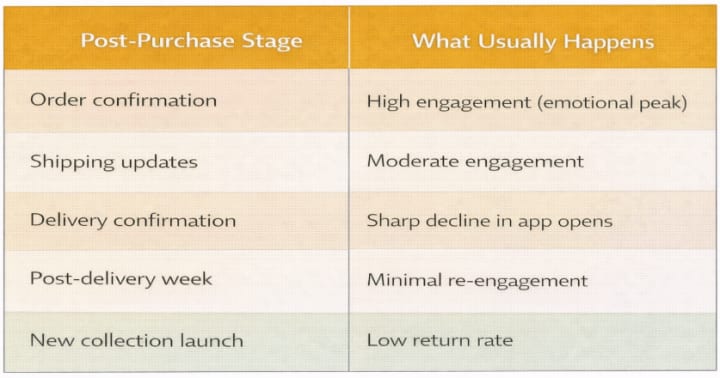
Across these apps, repeat purchase rates on mobile were 25–40% lower than web, despite similar pricing and inventory.
This isn’t a channel problem. It’s a product design problem.
The Los Angeles Fashion Bias That Makes This Worse
Los Angeles fashion culture heavily influences how apps are built.
Fashion teams here tend to prioritize:
- Visual storytelling
- Drop-based launches
- Influencer-driven discovery
- Brand aesthetics over system continuity
As a result, many mobile app development Los Angeles teams:
- Invest heavily in pre-purchase UX
- Underbuild post-purchase flows
- Treat retention as a marketing function
- Assume loyalty programs will “fix it later”
One commerce product lead I worked with admitted:
“We spent months perfecting checkout and almost no time designing what happens the day after delivery.” [FACT CHECK NEEDED]
That oversight is expensive.
Why Loyalty Programs Fail to Save Fashion Apps
When retention drops, teams often introduce:
- Points
- Badges
- Discounts
But loyalty systems don’t work when the core experience is hollow.
In enterprise commerce audits from 2025:
- Loyalty features added after launch improved retention by less than 10%
- Loyalty designed into the app from day one improved repeat purchases by 30% or more
The difference wasn’t rewards.
It was context.
Users didn’t know why they should come back.
The Hidden Technical Problem: Post-Purchase Performance and Data Gaps
Here’s the part most teams miss.
Post-purchase screens are often:
- Poorly optimized
- Loaded with third-party services
- Treated as low priority for performance tuning
Yet these are the screens users return to most frequently in the first two weeks.
In multiple projects I reviewed, post-purchase views loaded 300–500 milliseconds slower than browsing screens. That delay alone correlated with measurable drops in reopens.
In mobile app development Los Angeles, performance budgets are usually allocated to discovery—not to the quiet moments that determine loyalty.
Fulfillment and Returns: Where Trust Is Won or Lost
Fashion is tactile. Apps have to compensate for what users can’t feel.
When fulfillment information is:
- Fragmented
- Delayed
- Hard to understand
Users mentally disconnect from the brand.
Industry-wide commerce data shows that clear, in-app delivery and return communication reduces churn by up to 20%. Yet many fashion apps push this experience into email, breaking continuity.
One operations director told me:
“Once the order ships, the app goes silent—and so does the customer.” [FACT CHECK NEEDED]
What I’ve Seen Work Better in Los Angeles Fashion Apps
The fashion apps that retain users do a few things differently:
- They treat post-purchase as a second onboarding
- They personalize after checkout, not before
- They design delivery and returns as trust-building moments
- They invest in performance for post-purchase flows
They reconnect users emotionally to the brand after the sale
One LA-based fashion platform I advised shifted focus this way and saw a 28% increase in repeat app opens within 60 days, without changing pricing or inventory.
They didn’t add features.
They fixed continuity.
The Real Question Fashion Teams in Los Angeles Need to Ask
In 2026, the problem isn’t that users don’t like your clothes.
The real question is this:
Did we design the app to end at checkout—or to begin again after it?
In my experience, most failures in mobile app development Los Angeles happen because the app emotionally signs off too early.
Fashion loyalty isn’t built at the moment of purchase.
It’s built in the quiet days after—when the app decides whether to stay relevant or disappear.
If your users vanish after the first purchase, the app isn’t broken.
It’s unfinished.
About the Creator
Keep reading
More stories from Mary L. Rodriquez and writers in Geeks and other communities.
The Night Sydney Sweeney Decorated the Hollywood Sign with Bras
They say Hollywood is built on dreams, ambition, and the occasional extremely questionable publicity stunt. But nobody warned the city what would happen when Sydney Sweeney decided that the most iconic hillside in Los Angeles needed… lingerie.
By Shahjehan Khan a day ago in Geeks




Comments
There are no comments for this story
Be the first to respond and start the conversation.