
Why AI Training Data Is Critical to AI Model Accuracy and Performance
How Quality Data Shapes Smarter, More Accurate AI Models


Artificial Intelligence (AI) is only as powerful as the data that fuels it. Whether you're building a chatbot, an autonomous vehicle, or a fraud detection system, the AI training dataset used will largely determine the model's success or failure.
In this article, we break down why AI training data is vital to AI model accuracy and performance, guiding you through the Awareness, Consideration, and Decision stages of the buyer journey.
Awareness Stage: Understanding the Role of AI Training Datasets
What is AI Training Data?
AI training data refers to the structured or unstructured data used to train AI models. This data serves as the foundation upon which machine learning algorithms learn patterns, make decisions, and improve over time.
Why Training Data Matters
The quality and quantity of your AI training datasets directly impact:
- Model accuracy
- Predictive performance
- Bias and fairness
- Scalability
Statistics That Highlight Its Importance
- According to IBM, poor data quality costs the U.S. economy over $3.1 trillion annually.
- A McKinsey report reveals that 80% of AI project time is spent on collecting, cleaning, and labeling data. (source: McKinsey)
- Gartner predicts that through 2026, 85% of AI projects will fail due to biased or poor-quality training data. (source: Gartner)
Consideration Stage: Evaluating Data's Impact on AI Model Training

Real-World Case Study: Tesla’s Autonomous Driving Model

- Challenge: Tesla's early Full Self-Driving (FSD) models struggled in rare edge cases such as unusual road signage or construction zones.
- Solution: Tesla significantly increased the volume and diversity of its AI training datasets using camera data from its global fleet.
- Result: Improved vehicle performance in previously problematic conditions and better model generalization across geographies.
Decision Stage: How to Ensure High-Quality Training Data
Best Practices to Build or Acquire the Right AI Training Dataset
To train AI models effectively, businesses must focus on:
1. Define Clear Objectives
Start by understanding the use case. Whether it’s image recognition, sentiment analysis, or fraud detection—your dataset must align with your goal.
2. Source the Right Data
- Use public datasets when possible (e.g., ImageNet, COCO, OpenAI datasets).
- Invest in custom data collection for proprietary use cases.
3. Data Annotation and Labeling
- Use human-in-the-loop (HITL) workflows to improve data accuracy.
- Partner with professional data annotation services for high-quality labels.
4. Ensure Diversity and Bias Mitigation
- Collect data across demographics, scenarios, and edge cases.
- Apply bias-detection tools to audit your datasets.
5. Continuous Data Enrichment
- Retrain your model with new data periodically.
- Use feedback loops to capture mislabeled or incorrect predictions.
Case Study: Healthcare AI Model Training
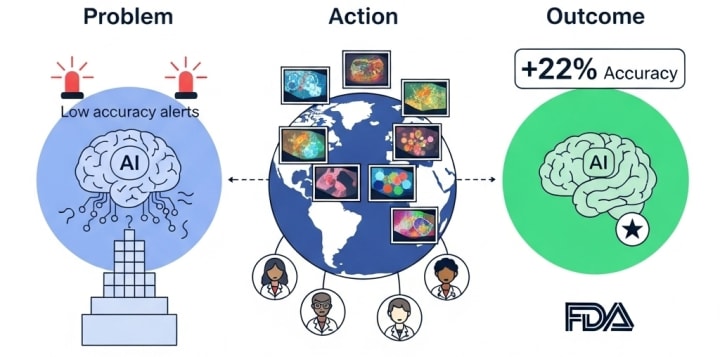
- Client: A U.S.-based medical startup
- Problem: Low diagnostic accuracy in AI-driven radiology tools due to homogeneous training data from a single region.
- Action Taken: Partnered with a data collection provider to source global, demographically diverse medical imaging data. The company also included human radiologists in the annotation process.
- Outcome: Model accuracy improved by 22%, reducing false positives and expanding FDA approval faster.
Key Takeaways: Why Training Data Makes or Breaks AI
- A high-quality AI training dataset is the backbone of model development.
- Good training data leads to faster convergence, higher accuracy, and reliable predictions.
- Organizations that prioritize training data management are more likely to see real ROI from AI investments.
Training Data Impact on AI Development
Model Development
- AI Project Stage: Model Development
- Data Requirement: Clean, labeled data
- Key Benefit: Improves learning and convergence rate
Model Evaluation
- AI Project Stage: Model Evaluation
- Data Requirement: Diverse, edge-case data
- Key Benefit: Ensures fairness and generalization
Model Deployment
- AI Project Stage: Model Deployment
- Data Requirement: Real-time, updated data
- Key Benefit: Supports continuous performance
Final Thoughts
Your AI model training is only as good as the data you feed into it. Whether you're developing a new AI system or improving an existing one, never underestimate the role of AI training datasets in determining success. Businesses that invest early in a proper data strategy will reap long-term performance and innovation benefits.
About the Creator
Silver Screen Magic with Mae West
American actress and singer Mae West became a popular film actress during the Great Depression. She started entertaining in vaudeville, then performed on Broadway, and finally went to Hollywood. She signed up with Paramount Pictures and made her debut in the 1932 film “Night After Night.” She also starred in musicals, comedies, and crime dramas. The American Film Institute named her one of the best classic Hollywood actresses.
By Rasma Raisters11 days ago in Geeks
The Summer I Was Chosen by a Northern Mockingbird
During the long, suspended days of the pandemic, a wild mockingbird began visiting my driveway and chose me, again and again. What started as a strange encounter became a brief, meaningful connection that I still carry with me.
By Erica Roberts 5 days ago in Petlife


Comments
There are no comments for this story
Be the first to respond and start the conversation.