


Reality—however you define it (and most define it as a deeply “multi-layered onion,” to borrow from Jim Goad)—cannot be denied having its own hypnotic, imprisoning power. We know, ultimately, that everything is an illusion, a surface. A blink of an eye, the pull of a trigger, and all is forgotten—all erased. Instantly.
For you? I don’t know. For me? I still don’t know.
All I know is that I don’t know (apologies to Operation Ivy).
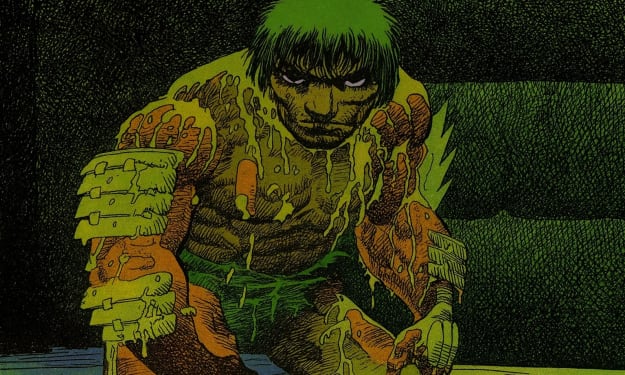
Wild Palms is a book, comic, graphic novel—whatever you wish to call it—that I’m still currently reading. But I wanted to dig in for this essay before any of it dripped from my cerebrum (onto the floor, pooling with the scum and spit). It concerns one Henry Wyckoff, rendered in an art style described as “hyperrealistic.” The picture frames of his existence pile stiffly into little mountains of perfect snapshot scenes—of affluent L.A. life, of celebrity, glamour, and even banality. And occasional moments of sheer horror.

Harry is married to Beth, has a son named Coty (a child star), and a baby named Deidre, who seems void of emotion. On the surface, his life is an insipid, affluent one-liner echoing down the suburban lawns and through the hallways of the posh houses of his picture-perfect lifestyle. But something is amiss. Harry begins to hallucinate—or is that simply the second layer of reality slipping in sideways from some other dimensional source?
What is the strange “reality” we assume, anyway? It seems to be a more solidified, less frenetic version of our nightly dreams and perambulations—a metastasizing concrete block of “here” we experience between our fitful, dream-haunted slumbers. Which is illusion, and which the concrete thing we experience as a group, as a species? What defines one, and dismisses another as “mere illusion”? What is consciousness, if it can be turned off and on instantaneously?
Insipid observations and mental non sequiturs (“It’s a miracle to make it to five and not be molested,” Harry observes of his mysterious son—who is revealed to not be his actual son, and who tries to eat his arm at one point) are the script of Wild Palms: the dialogue observations of the powerfully weird and the commonplace, side-by-side with name-dropped celebrities and short bursts meant to advance the story or frame the narrative. It’s a wild deconstruction of life by an invasive, chameleon-like force—an adjacent world wherein mysterious controllers, “The Fathers” (a group of Illuminati elites pulling the strings in a Hollywood cabal), and “The Friends,” led by Tully Woiwode, operate in shadow.

Tully’s eyes are ripped from their sockets by Beth’s mother, Josie. Beth and Josie, along with Page Katz (Harry’s lover—it’s suggested Josie, Beth’s mother, may not really be her mother, but an old lover), abduct him in the same manner they abducted his friend Tom—a fact that leaves him relatively unfazed. Harry, meanwhile, is revealed to be a pill addict, downing copious amounts of Percocet.
He hallucinates having a rhino head, takes a trip to an underground facility beneath a backyard pool, meets his “real” son, and is arrested for murdering his wife. Kafkaesque absurdity piles upon flat, boring reality—jump cuts interspersed with hip, obscure cultural references—until the narrative eventually crumbles into fragments. Are we to take any of this seriously?
Chapie, a man in a wheelchair who bears a strange resemblance to Stephen Hawking, is the inventor of virtual-reality glasses that reveal Senator Kreutzer and others as eighteenth-century fops in powdered wigs and silks. And what does this imply? A grand Illuminati conspiracy stretching back centuries? Are “The Fathers” sex traffickers, mind controllers, world shakers—something alien? Or are they simply a figment of a steadily deteriorating psyche whose landscape is littered with pop detritus, hip references, and an obsession with celebrity that’s as inscrutable as it is hollow and asinine?
In the end, we’re left with the “programmed assassin” narrative: Wyckoff becomes a stand-in for Oswald, perhaps to pull the trigger on Kreutzer—the father of “The Fathers” and founder of Synthiotics, an exterior trendy Hollywood “religion” that takes a direct shot at Scientology (Hubbard’s image appears here more than once).
The problem is, we have to ask ourselves by the end if we’re meant to take any of it seriously. After all, Harry Wyckoff could simply be insane; his interior dialogue may be no more reliable than Patrick Bateman’s. On the other hand, we live in an era when QAnon conspiracy theories about elite pedophiles, secret societies, mind control, virtual reality, and now AI, ask us to extend belief across the warped “neural landscape” (to borrow a phrase from J.G. Ballard), where familiar faces of the media appear to us stretched too thin, a little too tight.
Caught in a flashbulb moment of revelation, Wild Palms doesn’t seem far from the suppurating cultural skin of our own present—our oozing, transitory spiritual skin. (Rearranged, the letters could also read sink or inks. Considering this is a comic we’re writing about, perhaps all of them.)
In an interesting postscript, it’s worth noting the number of child stars—Coty in Wild Palms being one—who’ve come forward alleging abuse in Hollywood. Wil Wheaton, for example, has written a blog post accusing the makers of the 1980s low-budget horror film The Curse of abusive, dehumanizing, and dangerous behavior toward him and his younger sister. His infamous post includes a description of meeting with a “Middle Eastern” executive who had a table where a “holographic spider” was projected in the air—like something straight out of Wild Palms.
Comic Books and Graphic Novels Playlist
About the Creator
Tom Baker
Author of Haunted Indianapolis, Indiana Ghost Folklore, Midwest Maniacs, Midwest UFOs and Beyond, Scary Urban Legends, 50 Famous Fables and Folk Tales, and Notorious Crimes of the Upper Midwest.: http://tombakerbooks.weebly.com
A Planetary Alignment will coincide with Mercury Retrograde
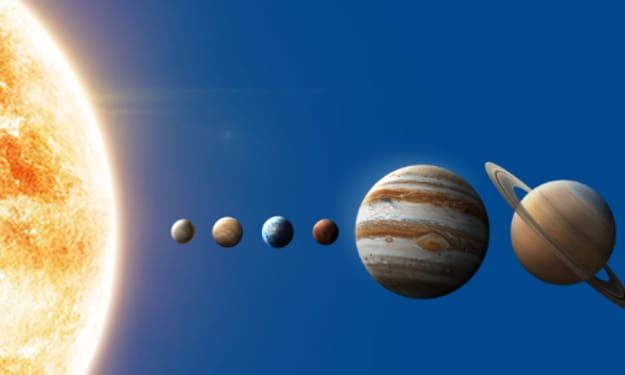
Double phenomena in the heavens Some people say in jest that the planets have aligned in their favor when life works the way they desire. Were you aware that there are seasons when things do line up in the heavens? There will be a planetary alignment AKA a planet parade, on February 28, 2026.
By Cheryl E Preston3 days ago in FYI


Comments
There are no comments for this story
Be the first to respond and start the conversation.