


Frank Miller, like Alan Moore, R. Crumb, Neil Gaiman, and a few others, is a titan in the reinvention of comics—the reboot into a new, adult-ready state of cultural being—insomuch as he literally reinvented the kooky, quirky Batman and redefined him for the world not as a wisecracking Adam West doing the “Batusi,” but as a brooding, cyberpunk anarcho-vigilante cum morally conflicted crime fighter in The Dark Knight Returns—the reverberations of which would be felt down through the decades and into the new century, the new millennium. Now, Batman is horror much, much more than humor—and even more human.
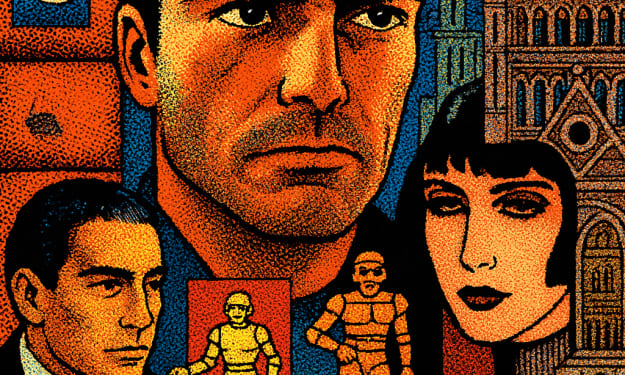
Ronin is a story I first encountered as a child. I had the first issue, and it was like no comic book I had ever encountered before, with its weird cross-hatching artwork and its demonic, dark, and frightening opening salvo of a lone, solitary ronin—a samurai who dishonored himself by letting a demon, Agat, come and kill his master in the form of a common wench.
Agat bore a samurai blade that literally drank blood. It was a strange, vampiric detail I never forgot.

Ronin walks into the future of Billy Challas, a literal human torso hooked into the system of Aquarius, a vast, seemingly underground cybernetic city run by an AI (which wouldn’t actually exist for about four decades) named Virgo—the brainchild of scientist Paul McKenna, who becomes the requisite “mad doctor,” and the head of the corporation behind it, Taggart, who is revealed to be not what he seems.
Billy is an experimental test case for McKenna’s “biocircuitry,” and is highly psychic, telekinetic (which must qualify as evolutionary mutation), and is childlike and traumatized by his abusive childhood. Virgo is mother and friend and everything to him, so when he manifests memories of a “past life” as the Ronin, he brings the solitary Japanese wandering warrior into his cyberpunk world, where the privileged live below in Aquarius, and the roving bands of marauders and gangs—the Blacks and the Nazis—live above.
Ronin, an armless, legless version (he is, after all, Billy incarnate in a new form—or at least it so seems), is quickly scooped up with his cybernetic limbs and presented as a gladiator, MMA-style fighter. I think.
At any rate, Casey, McKenna’s wife, is head of security and goes out looking to slay Ronin. She is captured by a gang, and the rest of the novel disappears into a world teetering between the uprising of robots à la Taggart and Virgo, and the revelation that Agat has followed Ronin into this world. Casey quickly becomes immersed in the world of Ronin and feudal fighting. The ending is rather diffuse and lacks text—it explodes the world, and you are left wondering at the poetry of it, and what was “real,” and what “illusion.”
The curious symbolism of armless, legless Billy, being the cerebral cortex from which all other tributaries of thought manifest as “reality” in Ronin, is obtuse. What is being said here? Virgo, whom he calls “Momma,” is by implication a feminine—the water-bearer of scolding discipline but also of guidance and love. Billy reawakens the romantic beauty of a world he can never know, of a love with Casey he can never know (he confesses this love). Casey is swept into the dual role of security commander in a cyberpunk, crime-ridden dystopian world, and of the female equivalent of Ronin, her love.
It is only Ronin, though, who never actually materializes as a solid characterization—remaining an enigma, almost a symbol: to Billy, of a heroism he could never know; to Casey, of a perfect romantic love that transcends the destructive, robotic maliciousness of Virgo’s rogue AI mind.
Fantasy and reality twist around each other like twin snakes upon the Mercurial staff of the world. Agat is the enemy of the feminine “whore”; sex with her, or indulgence in lust, is punishment—and the Ronin’s master Ozaki succumbs. The Ronin himself is austere and lonely masculinity searching for his female counterpart—his Yin and Yang.
Billy is neutered sexual possibility; Virgo—the Virgin—is in a pure, because fleshless, state. Casey is on the other side of Agat, his bloody sword, and the intermediary ghost of the Ronin; she is female possibility and Becoming.
On the whole, Ronin is a classic, a thing to be treasured—a story told in lurid reds and greens and even dark greys and solid blacks. Its style fuses manga with the French sensibility of a Moebius. It blends styles as convincingly and deceptively as a demon with a blood-drinking samurai blade.
Like the Ronin himself, it stands alone.
Comic Books and Graphic Novels playlist
About the Creator
Tom Baker
Author of Haunted Indianapolis, Indiana Ghost Folklore, Midwest Maniacs, Midwest UFOs and Beyond, Scary Urban Legends, 50 Famous Fables and Folk Tales, and Notorious Crimes of the Upper Midwest.: http://tombakerbooks.weebly.com
SpongeBob Reviews
If you haven’t yet slipped into the delightfully eerie world of “Scaredy Pants,” you are missing one of the most cleverly constructed episodes in the entire SpongeBob SquarePants canon, and the evidence is overwhelming. From the moment the episode opens with a thunderstorm‑lit Bikini Bottom, the creators signal a departure from the usual slap‑slap comedy to a richly layered, tension‑laden narrative that still delivers relentless chuckles. This is not just a Halloween‑themed gag reel; it is a masterclass in blending suspense with the series’ trademark absurdity, persuading you to stay glued to the screen as the tension escalates and the jokes land with surgical precision. By positioning SpongeBob as an earnest, if slightly over‑enthusiastic, aspiring horror writer, the episode invites viewers to empathize with his creative yearning while simultaneously delivering a satirical commentary on the genre itself—an artistic maneuver that persuades even the most skeptical adult fan to appreciate the show’s sophisticated storytelling.
By Forest Green3 days ago in Geeks



Comments (1)
Your breakdown of Ronin brilliantly captures both the visual and thematic complexity of Miller’s work. I especially appreciate how you explored the fusion of cyberpunk and feudal imagery—it really conveys the story’s enduring impact.