
Tripping on Heroin Became a Lot Scarier 25 Years Ago
Revisiting the Scottish cult-classic, 'Trainspotting', incites nostalgia and horror.

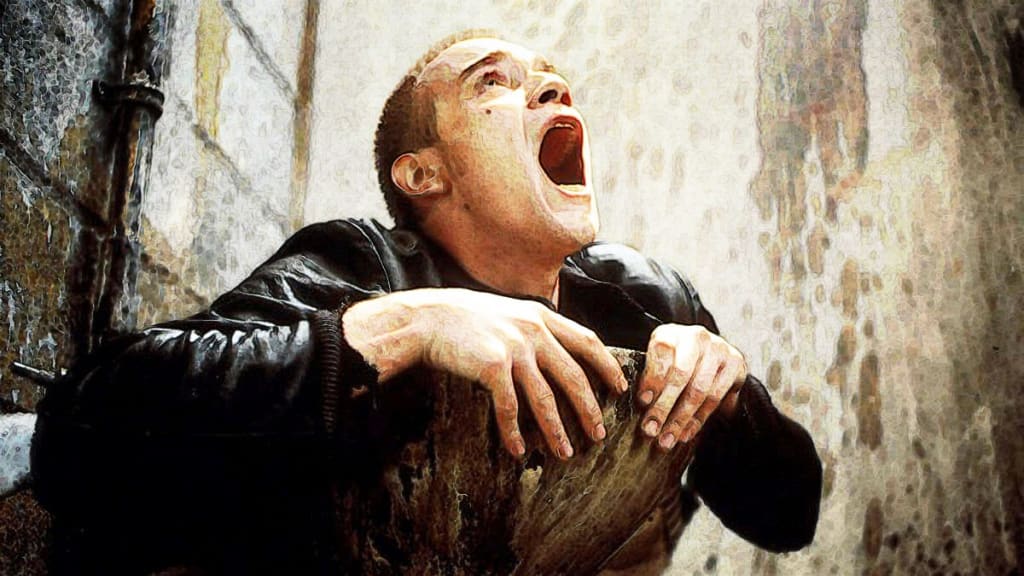
Back in high school, I used to hang out with drug dealers. I often sat in my friend’s bedroom where people usually came to buy or use drugs - sometimes both. The lights were dim, and soothing ambient music played in the background. The walls were covered with photos of ocean beaches - which I always thought of as places successful people went on holidays - and the air smelled of weed. It was the perfect setup to escape life. For some, that room was the only holiday destination they could afford to go to a few times a month.
That’s where I witnessed the first real conversation about heroin.
“Did you ever try it?” I heard the question. It was addressed to the teenage girl sitting next to me smoking a joint. The guy who asked her, we just called Rocker. I knew him from high school, but I didn’t actually know him. We never spoke. I wasn’t aware that he was a user, but it didn’t surprise me.
The chick answered “no” and passed the joint back to him. He hit it hard, kept the smoke in for a few seconds before he exhaled, and said, “I’ve done it once. It was amazing, unreal.” The girl’s face lit up with surprise and excitement. My face, I assume, looked like horror.
They were already high, but I wasn't. I was stone-cold sober, and that conversation was way too real for me. They continued chatting about heroin as if it was a cool thing to do. I’ve never heard anyone discussing heroin the way they did before - like it was something to achieve, something to look for. As if once you get to the top of the drug pyramid, there's the legendary substance, the undefeated champion, waiting for you.
I saw people smoke weed, hash, swallow pills, and snort cocaine, but heroin was different. It was the equivalence of a hopeless life from which there was no coming back.
I’ve only seen the drug in old drug prevention videos they showed us in class at school. You need to understand, growing up in a small Hungarian town, heroin wasn’t something people ever talked about.
Even my friends who used narcotics thought it was repugnant. Not cool. It wasn't a party drug to use for fun. It simply meant hopelessness, desperation, and potential mental problems. We believed, unanimously, who would even be stupid enough to try stuff like that? Homeless people, maybe? No. Apparently, there were guys, like Rocker, around us who used and girls that would possibly try the evilest drug of all.
In the early 2000s, by the time I heard about Trainspotting, it was already a cult-classic. Among teenagers in Hungary, it earned that status quickly because it was quasi-forbidden like porn. If you wanted to see it, you had to make sure that your parents, or other adults, weren't around when you pressed play on your VHS player. You didn't want to get caught while watching teenagers shoot heroin - it just wasn’t a good look.
At thirteen years old, watching the movie was like watching some nasty horror. But instead of blood, guts, and torture, you got to see dirty needles, terrifying hallucinations, and miserable withdrawal symptoms. It was a different kind of horror - more realistic, uncomfortably explicit, and mind-blowing. It scared the crap out of me. But, if you’ve seen it, you were considered cool - and, including me, everybody wanted to be cool.
After Trainspotting came out, it was infamously criticized for glamorizing drug abuse. But even being that young, it didn’t feel pro-drug to me at all. It was raw, uniquely stylish, but also horrific. I found it to be more of a cautionary tale than romanticized propaganda. Once I've seen it, the last thing on my mind was to go anywhere near heroin or anyone who ever used it. If anything, it was reassuring that even if you experimented with substances, you’d never give in to hard drugs.
The movie’s sheer depiction of overdose and addiction resembled the dangers and unpredictability of getting high. As a teenager, taking drugs was always an experiment with an unforeseeable outcome. You weren’t sure whether your trip was going to be a bad or good one. That gave you a rush of excitement, an adrenaline-kick to have an experience that was out of your control. It might’ve been magical, but it might’ve been traumatic. Trainspotting represented both scenarios.
What really made film iconic, and not just a fierce, visually stunning drug trip, was the delicate depiction of friendship among its characters. And that’s Irvine Welsh’s (the novel’s author) merit - Danny Boyle and John Hodge just transformed his material into a structure that fitted cinematic storytelling marvellously.
I say friendship, but it’s more like camaraderie, really. It's like a vow among addicts that's only sacred until it doesn't get in the way of the next score. Renton and his peers have a fragile loyalty, a unified bond, between each other that slips out of balance frequently due to their severe cravings.
But they’re also miserable Scotsmen, the sons of a nation that everybody hates, only bounded by blood they can’t escape. Renton’s monologue on a failed field trip makes that painfully evident. “We're the lowest of the low. The scum of the fucking Earth! The most wretched, miserable, servile, pathetic trash that was ever shat into civilization.”
At its core, I think this is why Trainspotting also resonated with many European people besides the UK. We, as Hungarians, related to it since our historical past was also a big wound that never stopped bleeding. We, too, tried to ignore it but couldn't unsee the fact that we were the children of a nation that’s inherently set up for failure and ruled by a corrupt, authoritative government.
Last week, the film turned 25 years old. Its impact, which changed Scottish cinema and the way we look at substance abuse forever, is still tremendous today. So much so, I’d say, that it can bring up faded memories from childhood to reflect on now, as a fully-grown, responsible adult. But watching that “worst toilet in Scotland” scene or the dead baby crawling on the ceiling is still pure horror.
About the Creator
Akos Peterbencze
Entertainment Writer. My life-long dream is to be as confident and cool as Jean-Claude Van Damme was in Hard Target. I write about pop culture and mental health.
Keep reading
More stories from Akos Peterbencze and writers in Geeks and other communities.
Marvel Zombie
The last entry into our 2025 superhero projects catalogue is Marvel Zombies. This was a show that was anticipated by absolutely no one and it disappeared from the public consciousness as quickly as it was released. There was nothing special about the project that made it a must see, or a must remember. In fact if anything it's a must forget.
By Alexandrea Callaghan27 days ago in Geeks
Book Review: "Madness Explained" by Richard P. Bentall
Some books take longer than others, and for me that means any books where there is a lot of in-depth science terminology. This book took me a while and so, instead of taking it around with me, I left it on my bedside table and read a few chapters here and there if I didn't have a headache. I had to go back and forth to an online dictionary sometimes and yes, there are tables and graphs in this book. BUT atop of all of this, I got through it and now here we are, with more knowledge and more understanding of the history of mental illness, and what that means for humanity.
By Annie Kapur7 days ago in Geeks


Comments
There are no comments for this story
Be the first to respond and start the conversation.