
Book Review: "Madness Explained" by Richard P. Bentall
4/5 - there are some points I disagree with but it is so well-written, everyone in this book is smarter than me...

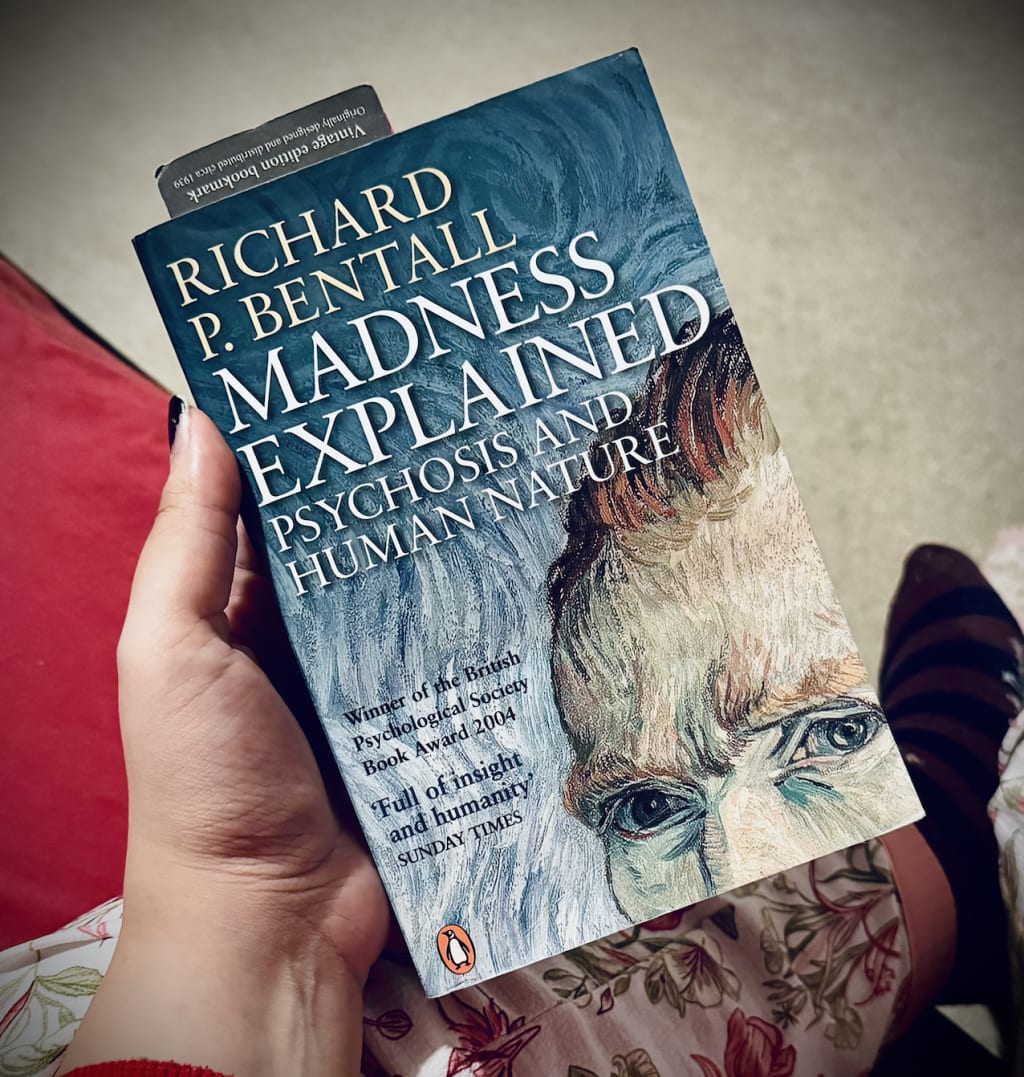
Some books take longer than others, and for me that means any books where there is a lot of in-depth science terminology. This book took me a while and so, instead of taking it around with me, I left it on my bedside table and read a few chapters here and there if I didn't have a headache. I had to go back and forth to an online dictionary sometimes and yes, there are tables and graphs in this book. BUT atop of all of this, I got through it and now here we are, with more knowledge and more understanding of the history of mental illness, and what that means for humanity.
First and foremost, the writer argues that having labels such as 'major depressive disorder' and 'schizophrenia' etc. are scientifically incorrect as they take symptoms that are wildly different and put them all under the same umbrella terms. Two people with the same diagnosis may share few, if any, symptoms, yet are treated as if they have the same condition. This definitely stops people from getting properly diagnosed for their conditions. Stating that someone does or has a certain thing because they now have a diagnosed condition is basically just circular logic - it definitely does not work. It took me a long time to understand what was actually wrong with this, but once I understood it made the entire book easier to reason with.
Another point made in the book is that madness exists in everyday human behaviour as well as in those who display behaviour considered 'mad' much of the time. We see that hallucinations, delusions, and mood disturbances are not alien intrusions into the mind, but exaggerated forms of processes everyone experiences, and they include: inner speech, belief formation, and emotional regulation. I don't fully agree with this because it is dangerous to insinuate that the majority of people experience symptoms associated with very rare mental illnesses. I'm pretty sure that is what TikTok is known for doing - convincing people who don't have mental illness that they do. The author actually says that drawing a boundary between what is normal human behaviour and what is 'madness' reduces stigma. I think that's all well and good, but it also disallows the people who are truly suffering to actually get better because now, everyone is getting told they are insane - especially when they aren't.

He gets critical of the biological explanations for mental illness. But I went in with a belief I hold quite strongly: there are certain mental illnesses that do have biological explanations, and there are some that do not. It is wise to make the distinction between these two types. Here is an interesting thing I want to look at though, the author doesn't actually deny that this is the case outright. But he insists that biological findings have been oversold, often driven by pharmaceutical interests. I think that may be the case in places like the USA but in the UK I cannot imagine that would be the sole driver of biological requirements for diagnosing people with complex mental health problems. Needless to say there were things we agreed with and disagreed with on these points.
But the next point he makes that I am more inclined to agree with even though I support the requirement for biological interventions in order to diagnose complex mental health conditions. This is that there are masses of adverse life traumas that play into why someone would develop a mental health problem. He links childhood trauma, neglect, bullying, poverty, and social exclusion to later experiences such as paranoia, hallucinations, and depression. He also states that these are stronger and often exemplified by genetic and biological explanations. Importantly, he reframes symptoms as understandable responses to experience rather than signs of internal defect. For example, paranoia may develop in individuals who have learned, through repeated harm, that the world is dangerous.
There are many other aspects of this book which cover the requirements for treatment other than medications, emotional traumas which lead to the mind displaying symptoms commonly associated with certain mental illnesses and of course, lots of tables and graphs you have to read. I'm choosing to keep this one short because I might revisit it soon and expand on it. I may have to give it another read to fully grasp what the main message is.
About the Creator
Annie Kapur
I am:
🙋🏽♀️ Annie
📚 Avid Reader
📝 Reviewer and Commentator
🎓 Post-Grad Millennial (M.A)
***
I have:
📖 300K+ reads on Vocal
🫶🏼 Love for reading & research
🦋/X @AnnieWithBooks
***
🏡 UK
Keep reading
More stories from Annie Kapur and writers in Geeks and other communities.
Book Review: "Tell No One" by Harlan Coben
“Don't show me paradise and then burn it down” - Tell No One by Harlan Coben Harlan Coben's stories are great. I've read many of his books and the American author has also had his works as the inspiration for many a Netflix show (which I have also seen the majority of). Many people don't know that I like his works and apart from going off on weird tangents in his books (which I have slowly come to appreciate) - his output into the world of thriller is at least, less formulaic than James Patterson (though, the Woman's Murder Club was a huge part of my late-teens - I loved 5th Horseman it was probably my favourite from the series). But Tell No One by Harlan Coben was not only a great thriller - it was also free on my phone. Yes, that is why I read it!
By Annie Kapur2 months ago in Geeks
Goodbye, Mr. Duvall
It is turning out to be an interesting year. I was in the middle of teaching a class when a pop-up appeared on the screen announcing the death of Mr. Robert Seldon Duvall (yes, that was his full name). I was in the middle of a discussion on the obsession we have with winning when it comes to sports (the Winter Olympics was a theme), and I felt as though things were coming full circle. We had already lost Gene Hackman last year, and along with that titan, it feels though one particular golden age has closed off to be replaced by...?
By Kendall Defoe 23 days ago in Geeks
Marvel Cosmic Tier Characters Power Rankings
The Marvel Universe is filled with titans — beings whose power can level planets, bend reality, or punch holes in space itself. But not all heroes (or cosmic entities) are on equal footing. Whether it’s raw strength, energy projection, cosmic awareness, or sheer invulnerability, this ranking breaks down fifteen of Marvel’s most powerful characters — based entirely on their comic versions.
By Top Ranked3 days ago in Geeks



Comments (2)
Yes, there's a lot of misdiagnosis happening they're always put under the same umbrella term. This book seems to be very eye opening and thought provoking
Thank you for sharing this, Annie, another great informative review and one for the TBR list