
Top Data Structures Every Python Programmer Should Know
Data Structures You Should Master in Python

In the ever-changing field of technology, Python is a powerful, versatile programming language that developers opt for because of its readability and ease of use. To tap the full potential of Python, however, mastering data structures is necessary.
Data structures form the very core entities of data organization and, therefore, storage. They allow for the efficient manipulation and retrieval of data. In this blog, we will discuss which are those data structures you must master in Python and how they can polish your programming skills.
1. Lists:
Description:
Lists are one of the most commonly used data structures found in Python. They are ordered collections that can be modified and contain all kinds of data types like integers, strings, or even other lists.
Use Cases:
Keeping Items in Order: Using a list, you can ensure items are kept in a specific order and so access them by their index.
Using Stacks and Queues: It is also easy to manipulate a list so it acts as a stack, LIFO, or queue, FIFO.
my_list = [1, 2, 3, 'four', 5.0]
my_list.append(6) # Adding an element
print(my_list) # Output: [1, 2, 3, 'four', 5.0, 6]
2. Tuples:
Description:
Tuples are similar to lists, but they are immutable, in the sense, that their contents cannot be changed after they have been created. They also maintain an order and can have mixed data types.
Use Cases:
Immutable Data: Tuples come in handy when you wish to store data that must not be modified, like coordinates or RGB color values.
Returning Multiple Values: Functions can return multiple values as a tuple.
my_tuple = (1, 2, 3)
print(my_tuple[0]) # Output: 1
3. Dictionaries:
What's it?
Note: In some languages, dictionaries are referred to as hash maps, hash tables, or hashtables.
Dictionaries are unordered lists of key-value pairs. They provide efficient lookups, making them ideal for associative arrays.
When to Use:
Store Data with Unique Keys: Use dictionaries when you have unique keys and values to associate- such as in a phone book.
Count Items: Count items easily using dictionary keys.
my_dict = {'name': 'Alice', 'age': 30}
print(my_dict['name']) # Output: Alice
4. Sets:
Definition:
The elements of a set are unordered and distinct, immutable. Their main use is for membership testing and for removing duplicates.
Applications:
Executing Mathematical Set Operations: This might be the most straightforward way to do this; sets are very convenient for union, intersection, and difference operations.
Keeping Unique Items: You could also use sets to keep track of unique entries or even user IDs, for example.
import array as arr
my_array = arr. array('i', [1, 2, 3, 4])
print(my_array[1]) # Output: 2
5. Arrays:
Explanation
Arrays are sequences of elements of the same type and have a fixed size. As such, they are more memory efficient for numerical data compared to lists.
Use Cases
Numerical Computations: Libraries such as NumPy allow easy handling of huge data in arrays.
Handling of Matrices: Arrays are the basics of linear algebra applications.
import array as arr
my_array = arr. array('i', [1, 2, 3, 4])
print(my_array[1]) # Output: 2
6. Queues:

Definition:
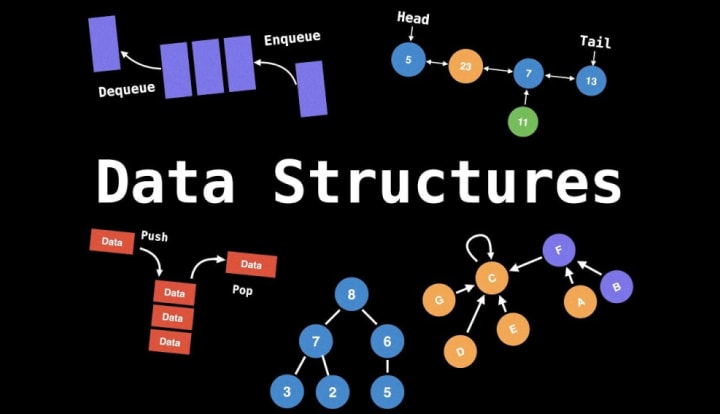
A queue is a collection based on the FIFO principle; elements can be appended from the rear and can be dequeued from the front.
Example Use Cases:
Scheduling of tasks: This is based on queues wherein it is used in task scheduling or managing requests in applications.
Breadth-First Search Algorithms: It is also utilized in graph traversal techniques.
from collections import deque
my_queue = deque([1, 2, 3])
my_queue.append(4) # Adding to the end
print(my_queue.popleft()) # Output: 1
7. Stacks:
What are stacks?
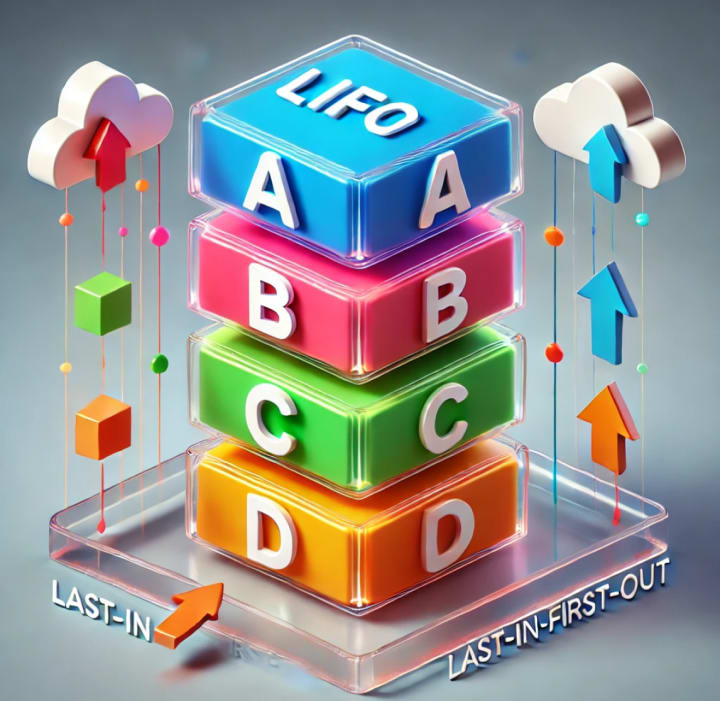
Stacks are groups that obey the LIFO (Last In, First Out) principle: the last one to be put in is the first one to be taken out.
Applications
Undo Functionality in Applications: Stacks are used in numerous applications for maintaining a history of actions.
Parsing Expressions: Useful in algorithms that demand backtracking.
my_stack = []
my_stack.append(1)
my_stack.append(2)
print(my_stack.pop()) # Output: 2
8. Linked Lists:
Description
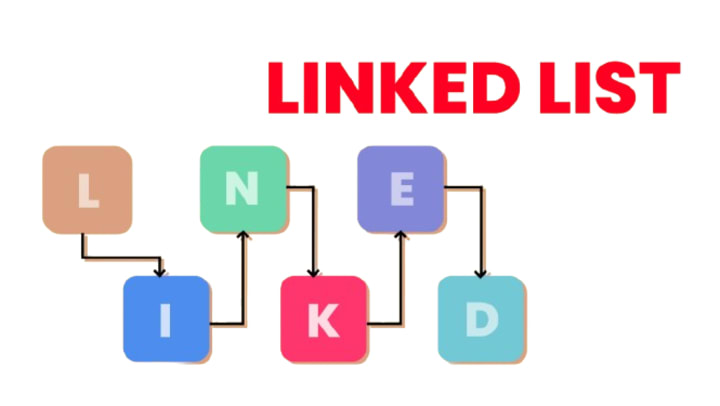
A linked list is an implementation that works off of nodes. Each node contains data as well as a reference, or link, to the next node. They are dynamic in size, so insertions and deletions occur very efficiently.
Use Cases
Dynamic Memory Allocation: Dynamic resizement with link lists and efficient memory use.
Implementing Stacks and Queues: They can also be applied in the development of stacks and queues.
Class Node:
def __init__(self, value):
self.value = value
self.next = None
head = Node(1)
second = Node(2)
head.next = second # Linking nodes
9. Heaps:
Explanation
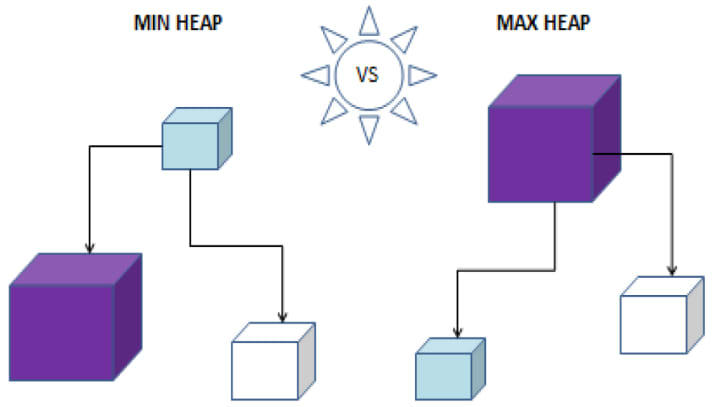
Heaps are a specialized tree-based data structure, that satisfies the heap property of a max-heap or min-heap, so elements can be accessed always by efficiently fetching the maximum or minimum element.
Usage Scenario
Priority Queues: Heaps are used extensively in priority queues, where the elements are served according to the priority assigned.
Scheduling Algorithms: Useful in many algorithms that require ordering.
import heapq
my_heap = []
heapq.help push(my_heap, 3)
heapq.help push(my_heap, 1)
print(heapq.heap pop(my_heap)) # Output: 1
10. Graphs:

Explanation
Graphs: These are collections of vertices connected by edges, either direction or undirected. They are easy to illustrate complex relationships.
Applications
Network Representation: Used in social networks, transportation systems, etc.
Algorithm Implementation: Required in implementing Dijkstra's and A* algorithms for pathfinding.
Class Graph:
def __init__(self):
self.graph = {}
def add_edge(self, u, v):
if u are not in yourself.graph:
self.graph[u] = []
self.graph[u].append(v)
g = Graph()
g.add_edge(0, 1)
g.add_edge(0, 2)
Why Master These Data Structures?
Efficiency: Using the right data structure enhances the performance of your applications several notches.
Problem Solving: Most coding challenges and algorithm problems require a good understanding of data structures.
Building a Framework: Data structure knowledge helps you build strong and scalable applications.
Conclusion:
Mastering data structures with Python is an important requirement for any developer who would like to enhance his skills in programming and creating applications efficiently.
If you seek the best in Python development services, then look no further than Tuvoc Technologies. We are a Custom Python Web development company. Our domain experts in India deliver best-in-class Python development services India for your specific needs. Let's help you unlock the full potential of Python for your next project.
Hire Python Developers in India today to learn more about our services!
About the Creator
Keep reading
More stories from Thomas Adman and writers in Geeks and other communities.
Choosing the Right Framework for Your Business: Angular vs. React
There are several options offered by you when selecting a framework or module for JavaScript front-end development, such as VueJS, TezJS, and Svelte. But amongst developers, Angular and React are two of their most well-liked choices.
By Thomas Admanabout a year ago in Chapters
Silver Screen Magic with Mae West
American actress and singer Mae West became a popular film actress during the Great Depression. She started entertaining in vaudeville, then performed on Broadway, and finally went to Hollywood. She signed up with Paramount Pictures and made her debut in the 1932 film “Night After Night.” She also starred in musicals, comedies, and crime dramas. The American Film Institute named her one of the best classic Hollywood actresses.
By Rasma Raisters7 days ago in Geeks
Book Review: "Odyssey" by Stephen Fry
If you know anything about me you will know that Stephen Fry is one of my favourite people on this earth. He's a proper polymath and has a great personality with it - he also reminds me of Oscar Wilde in some ways. I've read the other books in the series but this is the one I was truly waiting for because I love the story of the Odyssey. I've read different translations over the years and of course, we all remember it being included in the 2016 Nobel Prize Lecture by Bob Dylan - it is truly one of the most impactful stories of all time. No wonder Christopher Nolan is currently directing the anticipated movie.
By Annie Kapur3 days ago in Geeks



Comments
There are no comments for this story
Be the first to respond and start the conversation.