
Book Review: "Odyssey" by Stephen Fry
5/5 - ...the best of the series so far...

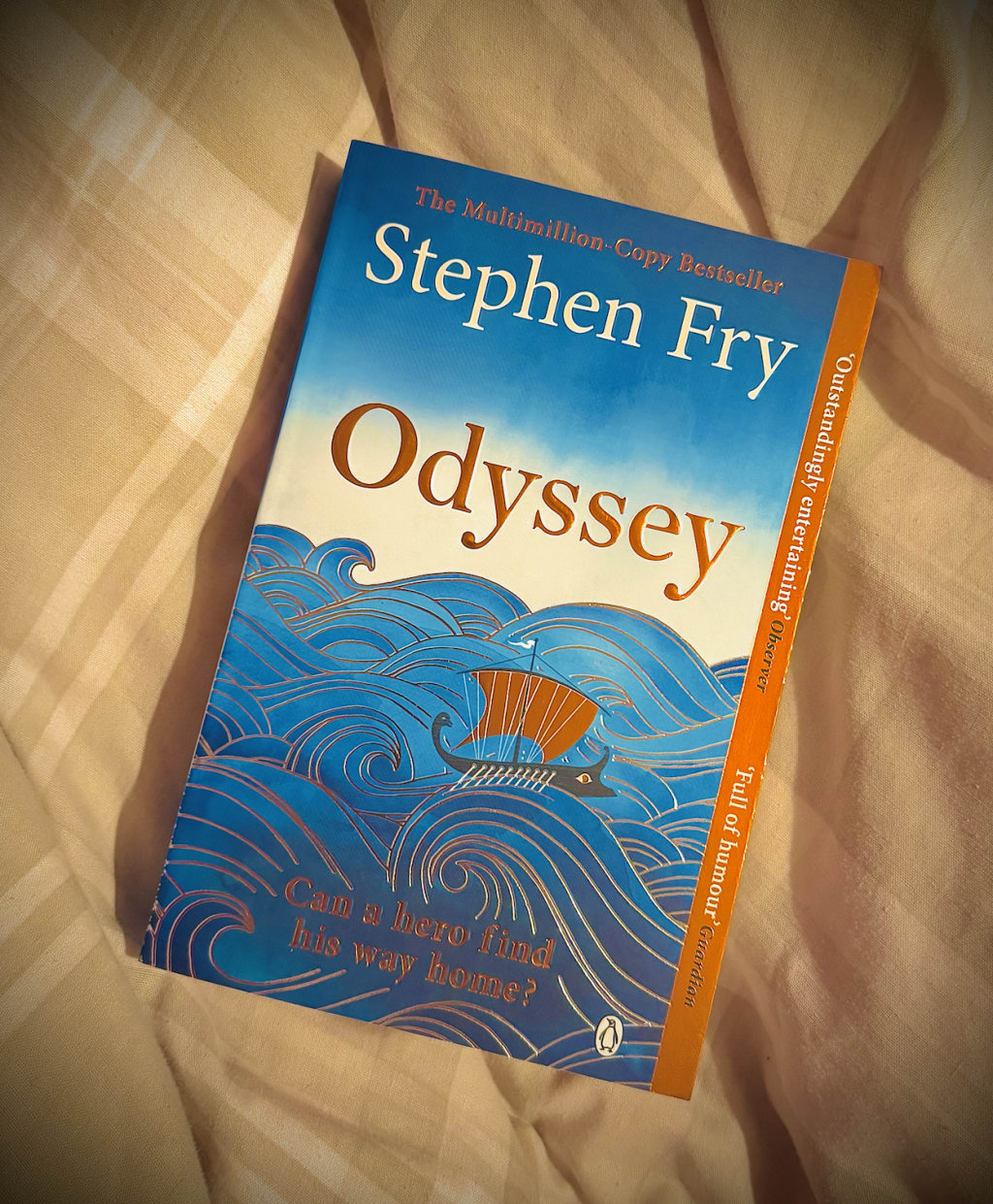
If you know anything about me you will know that Stephen Fry is one of my favourite people on this earth. He's a proper polymath and has a great personality with it - he also reminds me of Oscar Wilde in some ways. I've read the other books in the series but this is the one I was truly waiting for because I love the story of the Odyssey. I've read different translations over the years and of course, we all remember it being included in the 2016 Nobel Prize Lecture by Bob Dylan - it is truly one of the most impactful stories of all time. No wonder Christopher Nolan is currently directing the anticipated movie.
I think that Stephen Fry gets Odysseus right. Odysseus isn't the smartest guy in the room, he is basically the one who is able to adapt the fastest - which is why he survives and how he thinks of his cunning plan. With him it isn't just about the start and the 'journey' (to which he lends a name), but it is also foreseeing where he might end up. The author definitely presents the atmosphere as something that emphasises the post-war mood and tone. When we in the modern day think of 'post-war' we think of recession and some amount of loss - why should it be different back then? We see this world in crisis through the story - a dark and demanding world is just beginning. I love Stephen Fry's writing because not only can you almost hear him reading it to you - but it is probably the most accessible version of the book I have ever seen. If you're daunted by the prospect of reading a archaic version (or rather a snooty version) of Odyssey then I would recommend trying this one out.
The Gods are presented to us as caricature versions and exaggerated expressions of human vices. Athena represents strategic intelligence and restraint and Poseidon is wounded pride and uncontrollable rage. When Poseidon obstructs Odysseus’s journey, it mirrors the consequences of Odysseus’s own arrogance. Athena’s guidance reflects moments of clarity and self-control. The gods do not remove human responsibility; instead, they intensify it - they play with it. It is surprisingly modernist whilst also retaining what makes the Odyssey a mythical masterpiece.
Whilst the section telling the story of Odysseus and the Cyclops may be revered as a thrilling piece of the Odyssey, Stephen Fry teaches us that it is actually Odysseus's greatest moral failure. He initially uses his intelligence, the intelligence he is well-known for, to rescue his men and yet - he is struck down by the pride of having to name himself. His power has gone to his head. He transforms a private victory into a public boast, triggering Poseidon’s wrath and condemning his crew to years of suffering. The episode becomes emblematic of a recurring pattern: Odysseus survives monsters but struggles to survive himself.
The philosophical core of the book is of course, Odysseus's trip to the underworld. Odysseus encounters the dead not as enemies, but as reminders of loss, regret, and unfinished life. This memento mori is so important to the way in which Stephen Fry presents Odysseus as essentially a flawed and exhausted man who has simply gone on too long with an ego the size of the Empire State Building. Achilles’ declaration that he would rather be a living servant than a dead hero dismantles the glamour of glory entirely. Once he has seen Achilles, it becomes clear to him - he cannot continue subjecting others to himself and his want for being well-known. It grounds the whole book in this solemn sense of grief. It is no longer just about getting home - it is about who you will be when you get there.
To conclude, I will have to say that this is probably my favourite book in the series so far. It is a wonderful story in which Stephen Fry pays careful attention to how he should make Odysseus a human being we can understand and analyse whilst also not losing sight of the giant mythology that surrounds the epic. Home becomes something that must be earned for him, violence and justice are never the same thing and thus, Odysseus must learn that he only has one equal in this world - one he can never outsmart: Penelope.
About the Creator
Annie Kapur
I am:
🙋🏽♀️ Annie
📚 Avid Reader
📝 Reviewer and Commentator
🎓 Post-Grad Millennial (M.A)
***
I have:
📖 300K+ reads on Vocal
🫶🏼 Love for reading & research
🦋/X @AnnieWithBooks
***
🏡 UK
Keep reading
More stories from Annie Kapur and writers in Geeks and other communities.
Book Review: "Madness Explained" by Richard P. Bentall
Some books take longer than others, and for me that means any books where there is a lot of in-depth science terminology. This book took me a while and so, instead of taking it around with me, I left it on my bedside table and read a few chapters here and there if I didn't have a headache. I had to go back and forth to an online dictionary sometimes and yes, there are tables and graphs in this book. BUT atop of all of this, I got through it and now here we are, with more knowledge and more understanding of the history of mental illness, and what that means for humanity.
By Annie Kapur2 months ago in Geeks
Goodbye, Mr. Duvall
It is turning out to be an interesting year. I was in the middle of teaching a class when a pop-up appeared on the screen announcing the death of Mr. Robert Seldon Duvall (yes, that was his full name). I was in the middle of a discussion on the obsession we have with winning when it comes to sports (the Winter Olympics was a theme), and I felt as though things were coming full circle. We had already lost Gene Hackman last year, and along with that titan, it feels though one particular golden age has closed off to be replaced by...?
By Kendall Defoe 23 days ago in Geeks
Weedle Exposed: The Tiny Bug Pokémon That Hides Surprising Power and Evolution Secrets
Weedle is one of the most recognizable Bug-type Pokémon in the franchise, representing the beginning of a journey that teaches trainers strategy, patience, and the excitement of evolution. Its tiny, worm-like body and simple design make it approachable for beginners, yet its evolutionary line holds significant power and tactical potential for those who invest time and care in its growth.
By Lukáš Hrdlička2 days ago in Geeks


Comments (1)
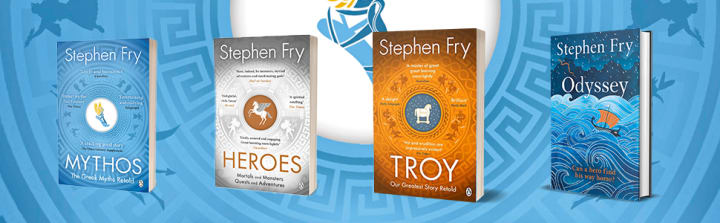
I have read Mythos, Heros and Troy are on my shelf and this is ordered. Thanks for this Anniw