
The Running Man (2025) Review: Glen Powell Ignites Edgar Wright’s Furious, Timely Dystopian Thriller
Edgar Wright’s The Running Man (2025) reimagines Stephen King’s dystopian nightmare with sharp political urgency, a star-making turn from Glen Powell, and a brutal vision of entertainment-as-weapon. Here’s why this thrilling update feels uncomfortably relevant in 2025.

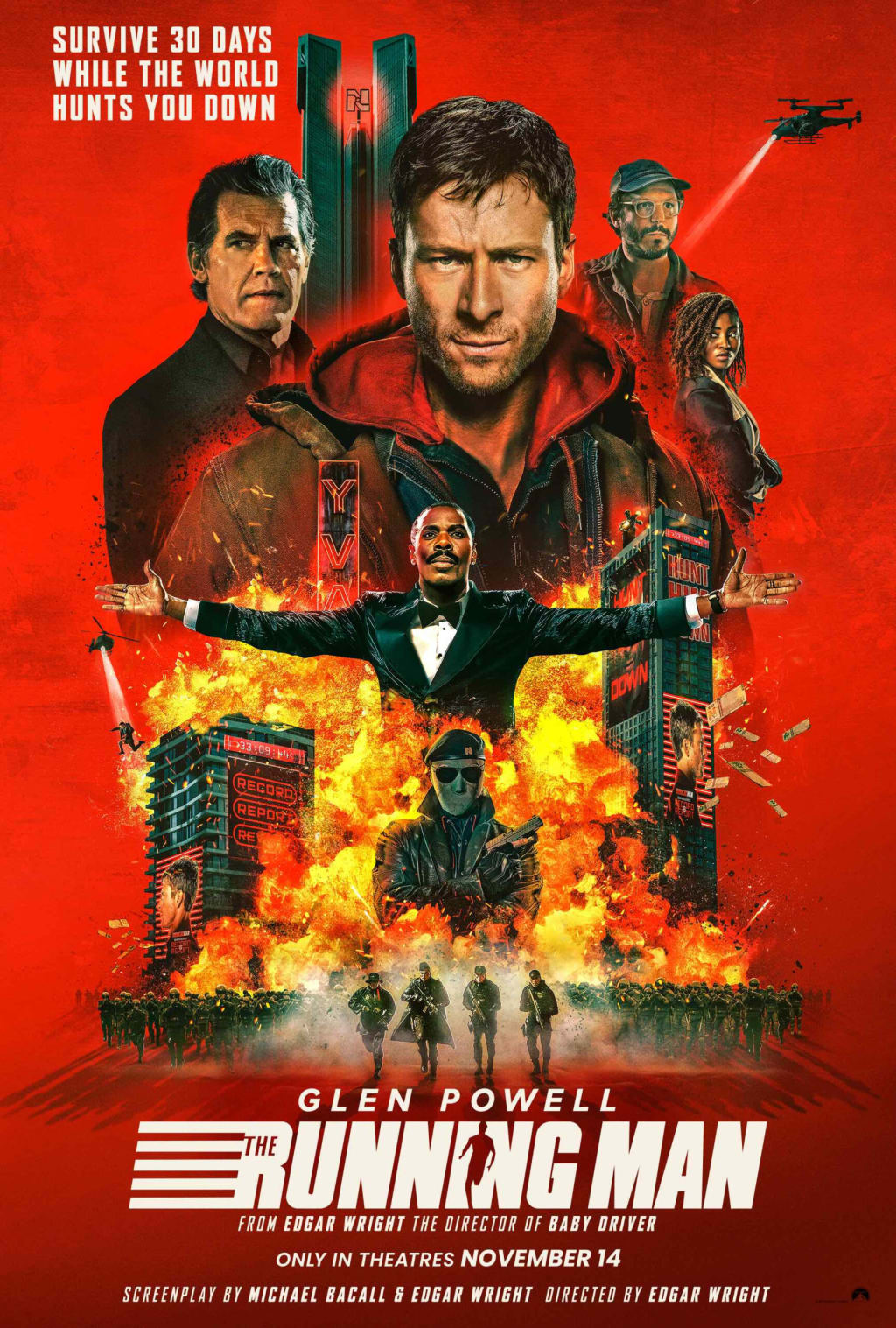
The Running Man (2025)
⭐⭐⭐⭐½ (4.5/5)
Directed by: Edgar Wright
Written by: Michael Bacall, Edgar Wright
Starring: Glen Powell, Josh Brolin, Katy O’Brien, Colman Domingo
Released: November 14, 2025

A Dystopian Nightmare Rooted in Real-World Inequality
Edgar Wright’s The Running Man stars Glen Powell as Ben Richards, a man punished for the crime of doing the right thing. In Wright’s razor-edged dystopia, surveillance is constant, the government is openly fascist, and corporations own not just the labor force but the truth itself. When a coworker is injured on the job, Ben passes the information to a union organizer. His reward? Blacklisting. Firing. A sudden erasure from even the most dangerous and degrading jobs left to the poor.
At home, Ben and his wife, Sheila, are barely surviving. She works double shifts at a sleazy nightclub to keep food on the table for their infant daughter. When the baby falls dangerously ill, the medicine that can save her is wildly overpriced — as everything essential is in this America. Desperate, Ben turns to the only place left for the poor: The Network, the media empire controlling every screen and every narrative in the country.
The Network offers game shows where contestants can win money — but each show is humiliating, cruel, or potentially deadly. Their crown jewel is the most sadistic spectacle on television: The Running Man.

The Game: Survive 30 Days or Die Trying
In The Running Man, survival is the only rule. Contestants have thirty days to stay alive while professional killers — and a bloodthirsty audience — hunt them for sport. Viewers can win prizes for tipping off the killers, turning every citizen into a potential traitor.
Ben arrives intending to compete in a lower-stakes game, but his fire, intelligence, and refusal to bow catch the eye of Dan Killian (Josh Brolin). Killian, a smirking puppet master of mass entertainment, sees a potential ratings phenomenon. He personally recruits Ben for the deadliest show on earth.
If Ben survives the full 30 days, he’ll win one billion dollars. The number is intentionally obscene. Even if he fails, he can make money by staying alive or killing hunters. Ben doesn’t want to kill anyone — until he realizes the game is rigged, and Killian won’t hesitate to manipulate, sabotage, or murder to keep his show on top.

Edgar Wright Brings Teeth, Rage, and Relevance
It’s no surprise Edgar Wright co-wrote and directed this adaptation; what is surprising is how ferocious and politically pointed he allows it to be. Where the 1987 Schwarzenegger movie leaned campy, Wright leans angry.
This is a story of class warfare, and Wright doesn’t shy away from it. The wealthy manipulate the masses. Entertainment is weaponized to keep people numb, afraid, or complicit. The government and media work hand-in-hand to maintain power. Ben Richards becomes an unwilling symbol of a cultural uprising, not because he wants to be a revolutionary, but because he refuses to surrender his humanity.
As Ben survives each ambush and exposes each injustice, he becomes more beloved by the people — and far more dangerous to The Network.

Revolutionaries, Propaganda, and the Fight for Dignity
Ben eventually crosses paths with a network of resistance fighters, played by Daniel Ezra and a surprisingly grounded Michael Cera. They’ve spent years trying to topple The Network’s propaganda empire, and Ben’s very public struggle is the spark they need.
Wright frames them not as extremists or ideologues, but as ordinary people pushed to extraordinary action. They want what Ben wants: a fair shot at survival in a world designed to crush the poor. Wright isn’t delivering manifesto — he’s articulating something far simpler:
People shouldn’t starve. People shouldn’t die because medicine is unaffordable. People deserve a wage that lets them live.
None of this is radical on its face. In 2025, though, it feels revolutionary.
The one-billion-dollar prize is deliberately absurd. In this world, The Network can pay it easily; they simply don’t want to. Even in fantasy, the rich treat life-changing money as pocket change.
A Thrilling, Uncomfortably Timely Blockbuster
As the story unfolds, Wright presses further into the contrasts between spectacle and suffering. Ben Richards isn’t asking for a handout; he’s asking for fairness, stability, and the chance to keep his child alive. Powell plays him with sharp charisma — a man beaten down but never broken, angry but never cruel, righteous without being self-righteous.
On the other side, Brolin’s Killian and Colman Domingo’s Bobby T (the oily, smiling host of The Running Man) embody a very modern kind of villainy: corporate sociopathy with a grin. Their entitlement is the engine of the story. Their greed becomes the seed of their downfall.

Final Thoughts: A Dystopian Thriller That Hits Harder Than Expected
The Running Man (2025) works as a propulsive, crowd-pleasing action spectacle, but what lingers is how sharply it reflects the world outside the theater. Wright didn’t make this film to lecture — he made it to entertain — yet the times have caught up with its themes. In an era of runaway wealth, struggling families, and entertainment designed to numb us, the movie feels less like fiction and more like a warning we’re already ignoring.
Glen Powell anchors it with one of his strongest performances, a balance of charm, desperation, and moral fire. And Wright delivers one of his most muscular, politically conscious films to date — a razor-edged thriller that crackles with energy and uncomfortable truth.
It’s rare for a blockbuster to be this fun and this furious at the same time. But that combination is exactly what makes The Running Man essential viewing in 2025.
About the Creator
Sean Patrick
Hello, my name is Sean Patrick He/Him, and I am a film critic and podcast host for the I Hate Critics Movie Review Podcast I am a voting member of the Critics Choice Association, the group behind the annual Critics Choice Awards.
Keep reading
More stories from Sean Patrick and writers in Geeks and other communities.
Silver Screen Magic with Mae West
American actress and singer Mae West became a popular film actress during the Great Depression. She started entertaining in vaudeville, then performed on Broadway, and finally went to Hollywood. She signed up with Paramount Pictures and made her debut in the 1932 film “Night After Night.” She also starred in musicals, comedies, and crime dramas. The American Film Institute named her one of the best classic Hollywood actresses.
By Rasma Raisters6 days ago in Geeks
Premier League in Italy: How to Watch
The 2025–26 Premier League season is underway, marking the 34th edition of the competition and the 127th year of top-flight English football. Liverpool start their title defense with confidence after lifting their second Premier League trophy last season, but the return of Leeds United, Burnley, and Sunderland ensures fresh rivalries – including the long-awaited Tyne–Wear derby, back for the first time since 2015–16.
By David Cook7 days ago in Geeks




Comments (1)
Even from your review, Sean, it sounds a little too hunger-gamey for me. I would probably still watch it because it's based on King's work and because I like Glenn Powell but sometimes I feel like nothing knew can be told through dystopias now and real life is worse than that anyway, because of its slow dread.