
The Phoenician Scheme Review: Wes Anderson’s Flat-Affected Redemption Tale of Greed, Faith, and Absurdity
Wes Anderson’s The Phoenician Scheme (2025) stars Benicio Del Toro, Mia Threapleton, and Michael Cera in a stylized, flat-toned satire exploring greed, redemption, and father-daughter reconciliation amid Anderson’s signature visual precision.

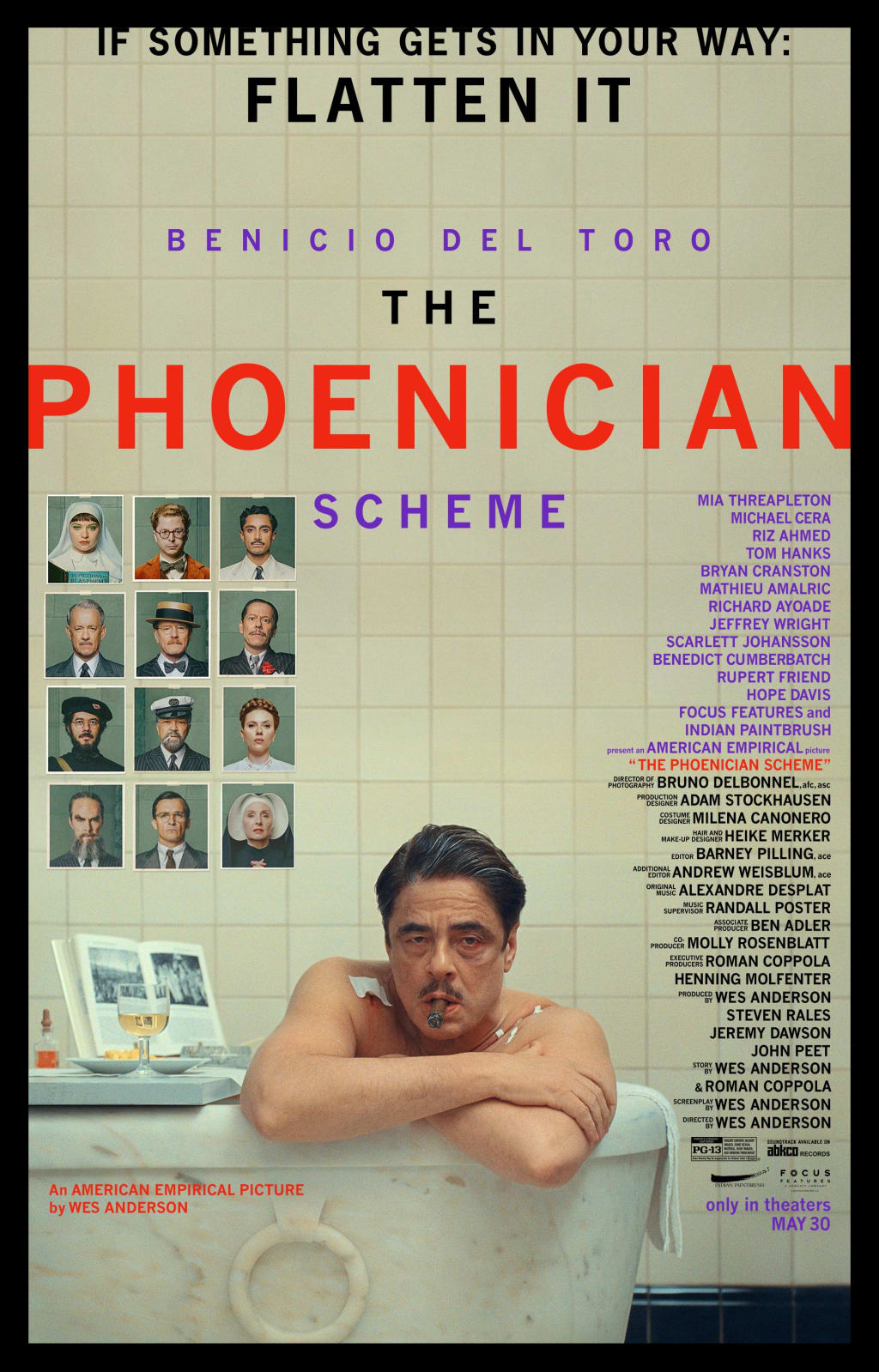
The Phoenician Scheme
Directed by Wes Anderson
Written by Wes Anderson & Roman Coppola
Starring Benicio Del Toro, Mia Threapleton, Michael Cera
Release Date: May 30, 2025
Published: June 9, 2025
“If something gets in your way, flatten it.”
⸻
1. A Mantra for Korda—and Anderson
This is the mantra of Zsa Zsa Korda (Benicio Del Toro), the central figure in The Phoenician Scheme, the latest pastel-drenched offering from Wes Anderson. But it might as well be Anderson’s own creative mission statement. Faced with a story about redemption, legacy, and moral reckoning, he chooses—brilliantly—to flatten the affect of every performance. In doing so, he strips his characters of outsized emotion, allowing their internal struggles and the film’s stylized absurdity to rise to the surface.
2. The Plot: Greed, Survival, and an Inherited Empire
Set in the fictional country of Phoenicia, the plot follows millionaire industrialist Zsa Zsa Korda as he prepares to enact his most dubious business venture yet—one that could exploit the country and its people for generations. But his enemies, including rival governments and corrupt officials, are circling. At the start of the film, Korda narrowly survives his seventh plane crash, a surreal moment that sets the tone for the bizarre dangers to come.
Fearing the end, Korda begins putting his affairs in order. His most shocking move? Naming his estranged daughter Liesl (Mia Threapleton)—a soon-to-be nun—as the sole heir to his empire. Liesl is initially resistant, but Korda lures her with promises of helping the church and investigating the mysterious death of her mother. Her agreement sets the stage for a tense father-daughter alliance built on conflicting moral codes.
3. Supporting Players and Stiff Performances That Sing
Hovering around the edges is Bjorn (Michael Cera), a shy, awkward tutor initially hired to oversee Korda’s nine disinherited sons. He quickly becomes Korda’s assistant and, inevitably, falls for Liesl, who is clearly uninterested and committed to her spiritual path. As Korda schemes to fleece his business partners to cover a financial shortfall, Liesl and Bjorn accompany him through a gauntlet of absurd, muted encounters with characters played by Tom Hanks, Bryan Cranston, Scarlett Johansson, and Jeffrey Wright.
The performances are uniformly restrained, almost anti-emotional. Del Toro delivers each line with a stony cadence, setting the tone for the rest of the cast. Threapleton mirrors his rhythm perfectly, while Cera’s hesitant quiver adds a fragile layer of comedy. Even in heated moments, the actors adhere to a stiff, controlled tempo that transforms ordinary dialogue into deadpan brilliance. It’s a testament to their skill that they evoke so much while doing, on the surface, so little.
4. Flat Affect as Comedy and Craft
This flat delivery is no accident. Anderson seems to be channeling the spirit of Ernst Lubitsch and Howard Hawks—directors who, in the early talkie era, brought verbal wit into a medium still shaped by silent film expressionism. In The Phoenician Scheme, Anderson flattens emotion to highlight the tension between what is said and what is truly felt, creating a comedic friction between visual chaos and internal stillness.
5. A Spiritual Tug-of-War Between Father and Daughter
Zsa Zsa and Liesl mirror each other in fascinating ways. He’s a lifelong atheist inching toward belief through surreal nightmares in which he negotiates with God—played, in a stroke of casting genius, by Bill Murray. These black-and-white dream sequences echo classic film tropes while revealing Korda’s growing dread. Meanwhile, Liesl’s serene faith is tested by the lure of vengeance, temptation, and the moral gray zones her father embodies. Their arcs intersect in a subtle dance of contradiction: he’s seeking salvation; she’s tempted by sin.
6. Anderson’s Obsession With Flawed Men
Anderson’s career-long fascination with flawed, powerful men is alive and well here. Like Royal Tenenbaum or Herman Blume, Zsa Zsa is both ridiculous and poignant. His stubborn refusal to show weakness conceals a desperate need for connection and legacy. Liesl’s icy resolve hides turmoil of her own. As the two grapple with their past and potential futures, The Phoenician Scheme becomes a meditation on generational wounds and the possibility of grace.
7. Precise Visual Chaos and Elegant Absurdity
All of this unfolds with Anderson’s signature precision: symmetrical compositions, vibrant palettes, whimsical costuming, and surreal production design. Even fight scenes—like a ridiculous yet refined scuffle between Del Toro and a bushy-browed Benedict Cumberbatch—are staged like theatrical pantomime, their silliness undercut by the film’s unshakable visual order.
8. A Painter With a Camera
In the end, The Phoenician Scheme is more than another stylistic exercise from Wes Anderson. It’s a deeply funny, melancholic, and surprisingly spiritual fable about legacy, belief, and the absurd ways we search for meaning. Anderson remains one of cinema’s few true auteurs—a master painter using the language of film to create intricate, emotional tapestries where every brushstroke counts.
What do you think of Wes Anderson? Have you seen The Phoenician Scheme? If so, what did you think? Share your thoughts in the comments. Check out my articles on The Phoenician Scheme and Wes Anderson's new Criterion Collection set at Medium.com/Reelscope where I have been contributing movie news stories and deep dives on upcoming films and movies that fascinate me like the early 2000s Fantastic Four movies. Follow the links to visit my work at Medium.com/Reelscope.
Tags:
Wes Anderson, The Phoenician Scheme review, Benicio Del Toro, Mia Threapleton, Michael Cera, 2025 movies, indie film, satire, film analysis, auteur cinema, redemption arc, flat affect performance, faith in film, art house
About the Creator
Sean Patrick
Hello, my name is Sean Patrick He/Him, and I am a film critic and podcast host for the I Hate Critics Movie Review Podcast I am a voting member of the Critics Choice Association, the group behind the annual Critics Choice Awards.
Keep reading
More stories from Sean Patrick and writers in Geeks and other communities.
Silver Screen Magic with Mae West
American actress and singer Mae West became a popular film actress during the Great Depression. She started entertaining in vaudeville, then performed on Broadway, and finally went to Hollywood. She signed up with Paramount Pictures and made her debut in the 1932 film “Night After Night.” She also starred in musicals, comedies, and crime dramas. The American Film Institute named her one of the best classic Hollywood actresses.
By Rasma Raisters6 days ago in Geeks
After a military hiatus, BTS is back with a world tour and a new album set for 2026.
After a four-year hiatus caused by mandatory military service and personal pursuits, global K-pop sensations BTS have officially teased their long-awaited return to live performance with the announcement of a "comeback world tour" scheduled for 2026 and 2027. A new era for the septet and their devoted fanbase, known as ARMY, is signaled by the historic announcement, which was initially confirmed by the band's management and widely reported by international media.
By Raviha Imran6 days ago in Geeks



Comments
There are no comments for this story
Be the first to respond and start the conversation.