
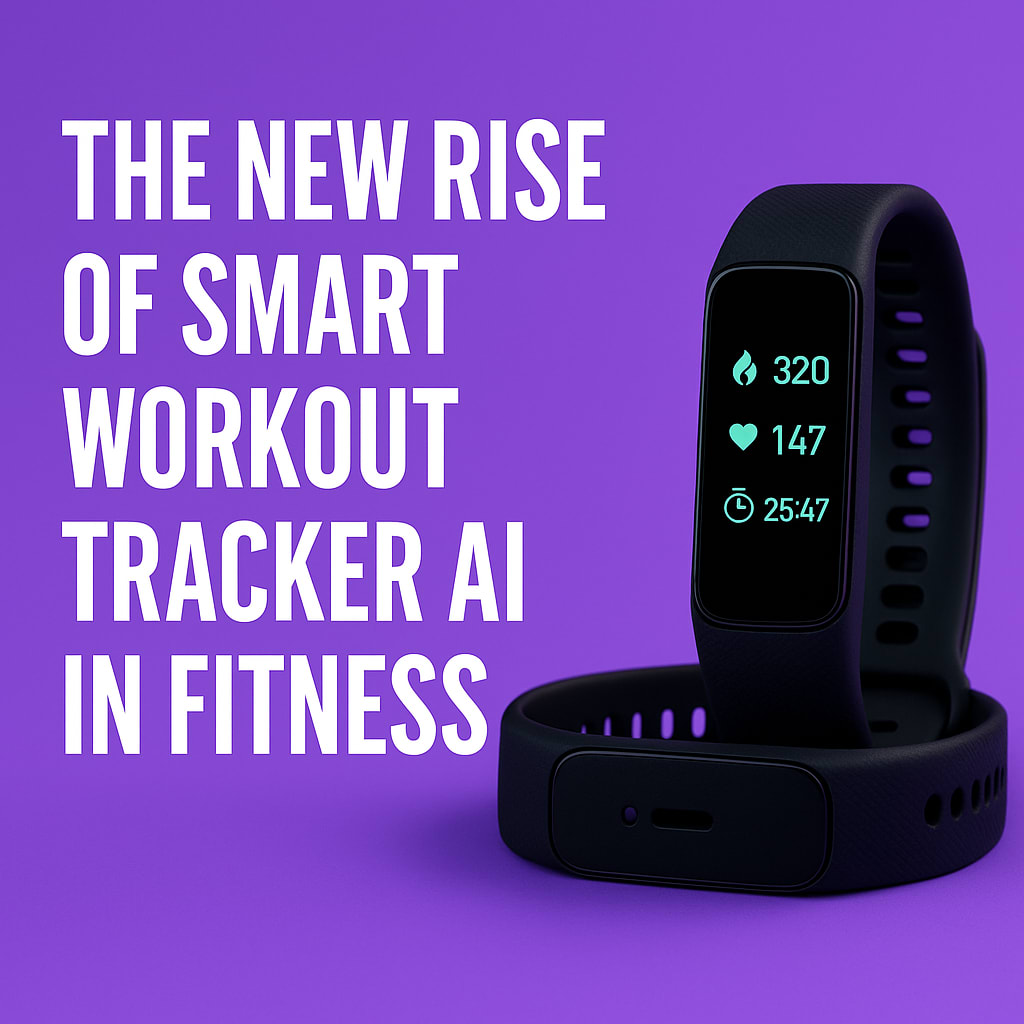
The New Rise of Smart Workout Tracker AI in Fitness
Where AI Fitness Might Be Heading Next

I’ve done this before.
No, really. I have attempted to "get back in shape" more times than I would care to admit. It always begins the same way: sudden inspiration, a new app to download, or even a gym membership that I swear I will use this time. And then...nothing happened. Life gets insane and I miss one day and then a week and suddenly I'm right back here scrolling through my phone at 11 PM wondering why can't I just stick with something.
I knew I had to do something when my doctor told me that my blood pressure was creeping up even if it wasn’t worrisome yet. What’s the problem? I’m thirty-four, have a desk job that wears me out, and have gotten pretty skilled at talking myself out of working out. “I’ll go tomorrow.” “I’m too tired tonight.” “I’ll start over on Monday.”
You already get it, don't you?
This is where it gets weird. A couple of weeks back, while aimlessly browsing YouTube, I stumbled upon a video about AI workout trackers. Not the usual fitness tech stuff. I've used Fitbit, Apple Watch and even tried two months on Peloton before it became the most expensive coat hanger in the world. This was different. The movie spoke about several apps which apparently adjust in real time to you. They're watching how you move and listening to how you breathe, and they change the workout as you go.
I stopped. Then, I rewound it. Watched it again. Wait a second—is this just some kind of marketing
Here’s the thing: I’m not sure. Highly unsure. I work in marketing; I know how easily a terrible product can be masked with buzzwords and shoddy fake reviews from people who probably got paid to smile while holding a smoothie. But somehow this felt different. The AI claimed to do more than count reps and steps-per it was “learning” me, knowing when I struggle, supposed to feel motivated or told back off.
So I fell down the rabbit hole. Started to look into it. And to be honest? The more I read, the more it became clear to me that this is not just another fitness trend. This is really happening, and it's kind of... changing things?
The Part Where I Figure Out I've Been Doing It Wrong
For years, I mistakenly believed that fitness trackers were supposed to motivate me by showing my stats. For example, knowing how many steps I have walked or how many calories I have burned would make me want to continue. But that is not the way I get motivated. They become just background noise within a week. Another notification I swipe away.
Nor am I, apparently. Published in 2023 by the Journal of Medical Internet Research, a study conducted at Stanford analyzed over 200,000 users of fitness applications. They found that about 73% stop using their fitness applications within the first month. Seventy-three percent. Practically everyone. The researchers noted that most apps fail because they do not attempt to instruct users on safe and proper exercise -instead relying on the user to "motivate" themselves.
When I read it, it felt different. That's what kept coming to mind.
But what of AI workout trackers? This is something totally different. This is not just recording notes passively. It gives suggestions DURING the workout. Not in an annoying way with continuous loops of "you got this!" and other motivational statements but real suggestions using your phone's camera to check on your form in real time noticing when squat depth fails, wrong muscles are being used as compensation or injury due to stubbornness to take a break sets in (that last one could be just for me).
Last Thursday I gave it one more shot. Left my phone on the counter, started doing some simple bodyweight exercises. Thirty seconds in, the software interrupts me: “That lunge is making your right knee cave in. Try to make your stance wider.”
I pause. Check my form. My form is okay- that IS happening to my knee.
Okay that’s … helpful?
The Numbers That Caught My Eye
That made me dig further. I want to know that what I'm trusting with my joints and back isn't just snake oil from Silicon Valley, right?
There is actual science that supports it now. Study of 2024 by the American College of Sports Medicine comparing AI form correction to video based instruction found two groups, one receiving real time feedback from an AI and another following pre recorded workout videos. After eight weeks, they were making sixty four percent fewer mistakes with their form. Here’s the part that really surprised me, they were two point three times as likely to keep be working out regularly after three months.
2.3 times. That’s quite a big gap!
And then there’s the side of preventing injuries, which happens to be the most important thing for me right now. I’m not aiming to get ripped for Instagram. I just want to move about without hurting myself. According to the National Safety Council, in 2023 approximately 468,000 people visited emergency departments with exercise-related injuries.^1 Most of these could have been avoided if they had better form.
AI is supposed to catch mistakes before they turn into injuries. That’s what the theory says.
The Problem for the Sceptic (Or: Why I’m Still Not Completely Sure)
Look, I'm not going to sit here and say that AI workout trackers are great. Because they're not. I've had plenty of issues. If the lighting is bad, it loses you completely on camera tracking. It doesn't always give sensible feedback-at times even borderline nonsensical! And let's be honest here for a second; it's somewhat disturbing that an app watches everything I do…yes yes yes-I know it's just computer vision algorithms and there's no human down in some server room somewhere judging my burpees.
But here’s the thing. For all its flaws, this is the first piece of fitness tech that has made me want to continue using it long after I should have completed my review. It isn’t about motivation. It’s about getting feedback. Serious detailed criticism which helps me improve immediately.
That, I believe, is the change happening here. From passive tracking to active coaching. From “Here’s your data; good luck figuring out what to do with it,” to “Here’s what you’re doing wrong and here’s how to fix it right now.”
Wait, though. I’m getting ahead of myself—
The Charlotte Part (And Why Local Tech Is More Important Than You Think)
Here's a random thought that might not relate to anything else I'm talking about.
I live in Charlotte. Specifically, the Dilworth neighborhood. And I have observed over the last few years how massively the tech community has grown here. We're not Silicon Valley, but something is growing here beneath the surface. The mobile app development has taken a weird stronghold mostly on fintech because of the banks but also on health tech and logistics and many other things.
And I think this is important for the AI fitness thing because, apps are no longer coming only from the usual suspects. They’re coming from smaller teams and developers in different parts of the world who are actually using the technology they make. People who live in Charlotte, have normal jobs and lives, trying to stay healthy without making fitness their full time job.
You can see that groundedness in the apps. Not so much about being perfect as about being long-lasting. Not so much about making you feel guilty for missing a workout, but getting you back on track the next day.
The conflicts I can't quite figure out
This is where I'm stuck, though, and I don't have a clear explanation for it.
On the one hand, I like that AI workout trackers are making it easier for people to get active. You don't need a trainer. You don't need to spend a lot of money on equipment. You only need your phone and some room. That's huge for folks like me who aren't going to pay $200 a month for a gym membership they never use.
But are we losing something on the other hand? There is a human element to having a real coach who knows you, can read your body language, and can tell when you're just going through the motions and when you're really having a hard time. Can an algorithm really take its place? Should it?
I read somewhere, maybe Wired or The Atlantic or someplace, the average personal trainer charges between $60 and $100 per session. Most people cannot afford that on any regular basis. If AI can give them even 70% of that value for $15 a month, isn’t that still better than nothing? Better than people not working out at all because they cannot afford to get good advice?
Still, it's kind of a weird question if you ask me.
What the study says and what it doesn't.
A meta-analysis from late 2024 which combined 47 different studies on AI fitness coaching is what caught my eye. The main point was that workouts guided by AI for beginners and intermediates helped them acquire strength and enhance cardiovascular health just as well as if they were being personally trained. Also, the users of the program stuck with their regimen better-nearly possible because most had probably worked out at home in pyjamas at 6 a.m. someone would never know.
Here is the problem: The AI does not yet work for advanced athletes or those who are already hurt. It cannot make those fine adjustments a good human trainer would make. The authors write, "AI may effectively support mass participation and provide people with movement basics but it's unlikely to replace high-level coaching anytime soon."
Which is fine. I am not much of an athlete. I can barely touch my toes, and huff and puff if ever I run up the stairs too quickly.
For people like me? This much tech will do.
What Really Changed (And What Didn't)
It's been about five weeks since I started using one of these AI trackers every day. Here's the honest truth: I'm not transformed. I'm not posting shirtless progress pics or running marathons. My blood pressure is... slightly improved? At least my doctor seemed pleased at my last checkup.
But here’s what changed: I was actually working out. Three or four times a week. More than I had been able to do in years. And it wasn’t because suddenly I became more motivated or disciplined; it was because getting in became easier, less hassle about what workouts to choose, and whether or not they were chosen perfectly. The app just takes care of that. And I can focus on moving.
According to CDC, only about 23% of adults in the US achieve the guidelines for both aerobic and muscle-strengthening activities. I was definitely not in that 23%. Now? Maybe I'm getting closer. Small victories, right?
Is that enough? I think so. For now, at least.
The Future Bit (This Could Be Too Hopeful)
I keep wondering where this is going. Right now, most of these AI trackers are FAR focused on fixing form and structuring workouts. But what happens when they start getting more information? Sleep habits, stress levels, nutrition, recovery measures. Not just telling you what to do but also when to do it based on how you feel that day.
That's probably on its way. It might even be here now, though I haven't found it yet.
Statista reports the market size of AI Fitness to reach approximately $6 billion by 2028. Up from just $1.2 billion in 2023, that is quite an increase! Growth like that requires investment and hard work-consider this as further fuel for the technology to become better, smarter, more personalized toward you.
And I’m…cautiously excited? I didn’t think I’d ever feel this way about fitness tech again.
Yes, that’s right. I’m still not sure. Still waiting for the other shoe to fall. Still half-expecting to lose interest after a month and go back to how I used to be.
But for now? I’m coming. And that’s more than I could say six weeks ago.
Maybe that's enough.
About the Creator
Silver Screen Magic with Mae West
American actress and singer Mae West became a popular film actress during the Great Depression. She started entertaining in vaudeville, then performed on Broadway, and finally went to Hollywood. She signed up with Paramount Pictures and made her debut in the 1932 film “Night After Night.” She also starred in musicals, comedies, and crime dramas. The American Film Institute named her one of the best classic Hollywood actresses.
By Rasma Raisters6 days ago in Geeks


Comments
There are no comments for this story
Be the first to respond and start the conversation.