
Why AR Fitting Rooms Are Becoming Retail’s Next Big Move?
How Virtual Try-Ons Are Quietly Reshaping the Way We Shop

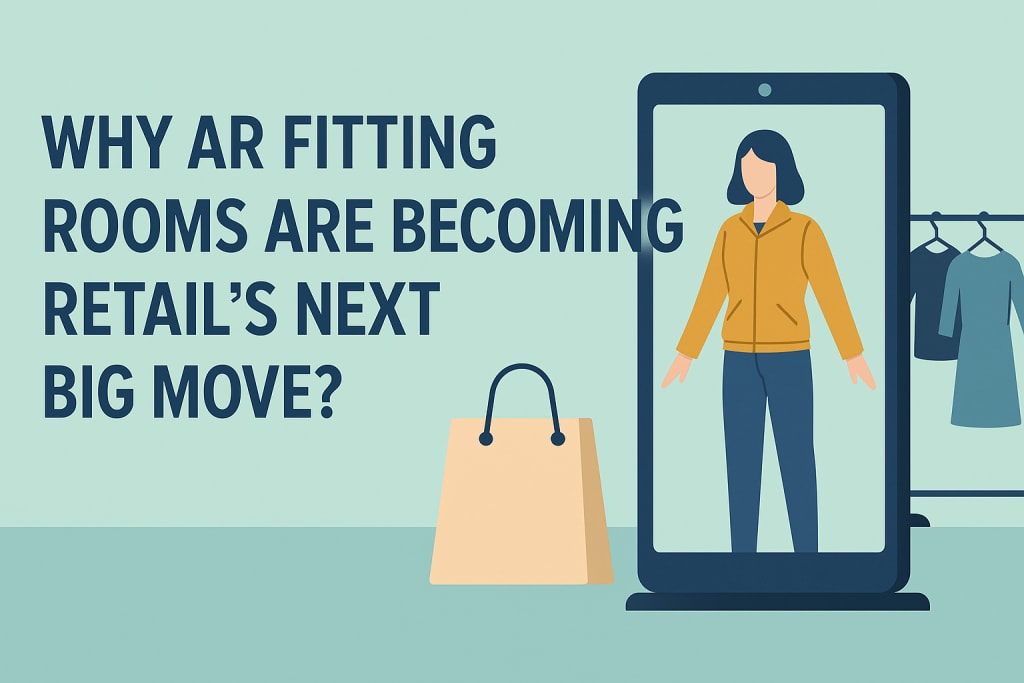
Why AR Fitting Rooms Are Becoming Retail’s Next Big Move?
Walk into a clothing store today and you’ll notice something different. Not on the shelves, not even in mannequins-those haven’t changed much. It’s the quiet shift happening in the corner: a screen, a camera, and a customer turning slowly as a digital version of a jacket clings perfectly to their body. No changing stall. No zipper fight. No awkward lighting.
That’s the AR fitting room—once a novelty, now a serious part of retail’s future. And honestly, it’s hard to imagine shoppers going back after experiencing how smooth and oddly fun it feels.
The Problem With Traditional Try-Ons
Trying on clothes in physical stores has always been a mixed experience.
Lines. Messy rooms. Wrong sizes. Staff knocking on the door to check if you “need anything.”
Things are not rosy for the retailer either. High return rates. Inventory constantly being moved in and out of fitting areas. Limited space.
AR fixes all these with no added pressure on any side.
How AR Fitting Rooms Actually Work
From a consumer point of view, the technology is almost laughably simple. You step in front of the screen. You wave your arms. And it maps clothes onto your body in real time using either depth sensors or camera-based body tracking.
But here's what's really interesting,
It captures body proportions, the lighting is well enhanced, and also a flow of fabric which outfits appear close to how they would look in real life. Not perfect, but much better comparison with trying on clothes based on some model that does not even remotely represent you.
This is one major reason brands love it: A single digital sample can be displayed in every color, size and style without requiring dozens of physical pieces.
Reasons Consumers are Fast Adopting It
Three major reasons:
1. There is no pressure.
He can try on outfits. He does not have to feel any kind of way about anything that has to do with the physical fitting rooms.
2. Decision becomes faster.
Trying on twelve outfits in less than five minutes changes the whole energy of shopping.
3. Truer picture.
AR helps a customer see how clothes fall on her shape, not a model’s.
This is not to replace real try-on experiences; it enables customers to get an accurate idea before they reach for the hanger.
Retailers See Something Bigger
For stores, it is a lot more than just some fancy gadget. It tells them what the shoppers like, which styles they interact with, and where exactly in the process they hesitate. All that data defines future designs and stock choices and even layout decisions.
There’s also a cost angle to it. Fewer returns mean less damaged items counted against returns as well as fewer fitting rooms to maintain.
AR creates that moment for shoppers—a moment they actually talk about—something stores rarely get anymore.
Online Shopping Wants In Too
The uptrend of virtual fitting solutions available in online stores follows suit.
Customers can either upload a photo or use their body scan, and then try on clothes while at home. No guesswork. No waiting for the package to find out that the sleeves are too short.
This is where cities building smart digital solutions come in. In places like Milwaukee, the growth of mobile app development Milwaukee is helping retailers integrate AR into their online storefronts, giving customers a more confident shopping experience even without stepping into a store.
Is This the Future of Fashion Retail?
It’s starting to look that way.
As AR gets better, both technically and in naturalness or believability, then this is a process toward eventual digital try-on parity with physical try-on. And at that point,[…] retail layouts, staffing, and even manufacturing may change in ways we haven’t fully imagined yet.
Here’s the really fun part. This shift feels surprisingly human. It gives people confidence and saves time while removing all awkward parts of shopping- yes! leaving those enjoyable parts intact.
AR isn't just making retail better; it's changing how we figure out what feels right to wear.
FAQs
1. What is an AR fitting room?
It’s a virtual try-on solution display that shows on the screen how clothes would look on the shopper’s body using either a web camera or phone camera, with no actual fitting rooms involved.
2. How accurate are AR fitting rooms?
Quite close visually by reading body shape and movement as well as lighting. Not perfect but provides much better knowledge of fit than attempting to imagine from photographs.
3. Do AR fitting rooms completely replace the traditional try-on?
They serve as a preview so that shoppers can narrow down their choices before trying actual pieces. Many use both.
4. Are AR try-ons useful for online shopping?
Yes. They reduce mistakes with sizing, lower returns and help shoppers be more sure about what they’re buying.
5. What technology do these systems use?
Most depend on body-tracking cameras, depth sensors, and fabric simulation to place the clothes on in real time.
6. Do AR fitting rooms store my body data?
This varies by retailer. Many systems process visuals temporarily without saving personal information. Always check the store’s privacy policy.
7. Can AR fitting rooms show different colors and sizes?
Yes. That’s one of their biggest perks—you can switch colors, lengths, and styles instantly without searching through racks.
8. Are AR fitting rooms expensive for stores to install?
There is some setup required but most retailers find the store long term savings- less returned merchandise ,more items not damaged out of stock because they were tried on and smoother operations worth any investment.
9. Do these systems work for all body types?
Most contemporary AR applications can generate a diverse array of forms and dimensions. More or less accurate, the purpose is to display something real for every customer.
10. Will AR fitting rooms become common in all stores?
That’s the way it’s going. As technology improves and becomes easier to install, more retailers are adopting AR at brick-and-mortar as well as web locations.
About the Creator
"Beyond the Gates" Turns One!
It seems like yesterday. It really, truly does. As those who read my stories know, I have had a love-hate relationship with soaps for nearly my entire life; I hate soaps but love their villainesses. I guess I was basically waiting for that perfect soap to finally hit the small screen. One with good angles, one that isn't so over the top, and one with good representation.
By Clyde E. Dawkins3 days ago in Geeks


Comments
There are no comments for this story
Be the first to respond and start the conversation.