
The Lovely Bones: A Haunting Journey Through Loss, Hope, and Healing
Exploring the emotional depth and visual beauty of Peter Jackson’s adaptation of Alice Sebold’s bestselling novel ---
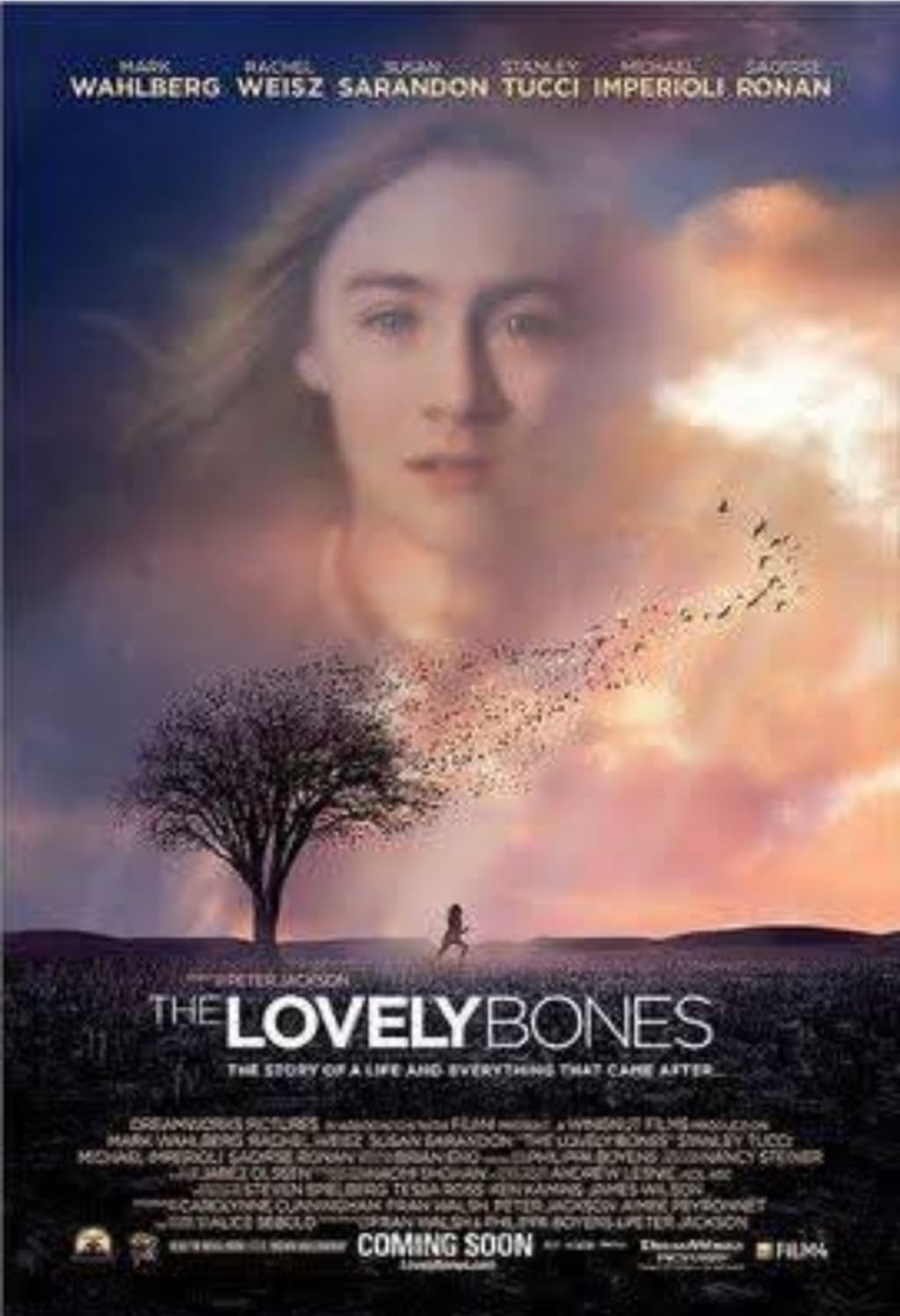
Some films linger long after the credits roll—not because of shocking twists or dazzling effects alone, but because they touch something deep in our hearts. The Lovely Bones is one such film. Released in 2009 and directed by Peter Jackson, this adaptation of Alice Sebold’s acclaimed novel is a poignant blend of tragedy, hope, and the enduring strength of love. It’s a story that forces us to look at the fragility of life, the persistence of memory, and the unbreakable bond between the living and the departed.
At its heart, The Lovely Bones tells the story of Susie Salmon (Saoirse Ronan), a 14-year-old girl whose life is abruptly cut short by her neighbor, George Harvey (Stanley Tucci). The film’s opening minutes establish Susie as a bright, spirited teenager with a passion for photography and a hopeful view of the world. But her dreams and future are stolen in an instant, setting the stage for a journey that is as heartbreaking as it is beautifully told.
What makes the narrative unique is its perspective—Susie narrates her own story from the “in-between,” a liminal space between the living and the dead. From here, she watches her family grapple with her loss, unable to fully move on yet desperate for justice. The film alternates between her ethereal observations and the raw reality her loved ones face on Earth. This dual viewpoint adds emotional complexity, making it more than a simple crime drama.
One of the most striking aspects of The Lovely Bones is the way it visualizes the “in-between.” Peter Jackson uses sweeping landscapes, shifting colors, and dreamlike imagery to depict Susie’s limbo. Fields bloom into oceans; seasons change in the blink of an eye. It’s an ever-changing reflection of her emotions—sometimes serene and full of wonder, other times turbulent and threatening. These visuals are not just beautiful for their own sake; they carry symbolic weight, representing Susie’s internal struggle between holding on and letting go.
Saoirse Ronan’s performance is one of the film’s most powerful elements. At just 15 years old during filming, Ronan conveys a maturity and emotional range that makes Susie unforgettable. Her portrayal captures both the innocence of a young girl and the wisdom of someone forced to confront mortality too soon. Stanley Tucci, in stark contrast, delivers a chilling and deeply unsettling performance as George Harvey. His understated menace makes the character all the more disturbing, earning Tucci an Academy Award nomination for Best Supporting Actor.
The supporting cast is equally compelling. Mark Wahlberg plays Jack Salmon, Susie’s father, whose grief transforms into an obsessive quest to find her killer. Rachel Weisz portrays Abigail Salmon, Susie’s mother, who struggles with her grief in quieter, more distant ways, highlighting how loss affects individuals differently. Susan Sarandon provides a brief but memorable turn as the eccentric grandmother, offering moments of levity amidst the sorrow.
But The Lovely Bones is not simply a murder mystery or a supernatural drama—it’s a meditation on grief and resilience. The title itself refers to the bonds and emotional connections that grow in the aftermath of tragedy. In Susie’s absence, her family becomes stronger in unexpected ways. They find new forms of love and understanding, building a foundation from their shared pain. In this sense, the “lovely bones” are the structures of healing and togetherness that emerge from loss.
The film does not shy away from showing the darker aspects of grief: denial, obsession, and the temptation to seek revenge. Jack Salmon’s relentless suspicion of Harvey nearly destroys him, while Abigail’s retreat from her family reflects the ways in which some people cannot bear the constant reminder of pain. Yet there is also catharsis. By the end, Susie accepts her fate and releases her hold on the living, allowing her family—and herself—to find peace.
Critics were divided upon the film’s release. Some praised its ambition and emotional depth, while others felt the fantasy sequences distracted from the central story. However, there’s no denying the artistry and emotional weight it carries. For many viewers, the film succeeds in capturing the bittersweet nature of life and death, leaving a lingering impression long after the final scene.
Watching The Lovely Bones is not an easy experience. It deals with themes—murder, loss, and the afterlife—that naturally stir strong emotions. Yet it also offers beauty, hope, and the reminder that love transcends even the most final of boundaries. Peter Jackson’s adaptation may take creative liberties from Sebold’s novel, but it preserves the emotional core: the voice of a young girl whose story is both tragic and uplifting.
In the end, The Lovely Bones invites us to reflect on the lives we touch and the legacies we leave behind. It challenges us to find meaning in grief, to see beauty even in the midst of pain, and to believe that the bonds we form in life can endure beyond death. As Susie Salmon says, “These were the lovely bones that had grown around my absence—the connections, sometimes tenuous, sometimes made at great cost, but often magnificent—that happened after I was gone.”
And that, perhaps, is the film’s most enduring message: even in loss, there is love, and in love, there is something eternal.
About the Creator
Hasbanullah
I write to awaken hearts, honor untold stories, and give voice to silence. From truth to fiction, every word I share is a step toward deeper connection. Welcome to my world of meaningful storytelling.
Keep reading
More stories from Hasbanullah and writers in Geeks and other communities.
Taylor Swift’s “The Life of a Showgirl”: A Glittering New Era of Music and Storytelling
Taylor Swift is stepping into a dazzling new chapter with her twelfth studio album, The Life of a Showgirl, set to premiere on October 3, 2025 . This marks her first full-length release since The Tortured Poets Department and the grand finale of her groundbreaking Eras Tour. The album isn’t just another drop—it’s a vivid reawakening, a statement of creative clarity packaged in a stunning showgirl aesthetic .
By Hasbanullah5 months ago in Geeks
Silver Screen Magic with Mae West
American actress and singer Mae West became a popular film actress during the Great Depression. She started entertaining in vaudeville, then performed on Broadway, and finally went to Hollywood. She signed up with Paramount Pictures and made her debut in the 1932 film “Night After Night.” She also starred in musicals, comedies, and crime dramas. The American Film Institute named her one of the best classic Hollywood actresses.
By Rasma Raisters4 days ago in Geeks
The Devil's Cut
“Comrade, finally you’re awake.” The voice was smooth, sensual. A flickering incandescent bar was all that lit the white, sterile room. All Vladimir remembered was everything going black. He tried to move his arms and found them strapped to the gurney.
By Matthew J. Fromm3 days ago in Fiction


Comments
There are no comments for this story
Be the first to respond and start the conversation.