
The First Thing You See in a Movie
A film critic's process of reading a movie.


I wish that I could recall who gave me this piece of advice. I want to credit them for it but, for the life of me, I cannot remember where I heard it. I listen to a ludicrous number of podcasts about movies and I read criticism voraciously and over time I picked up this very unique tip for reading and understanding the artistic intent and talent of a film director. It goes something like this:
The first image on screen is a thesis statement for the rest of the movie. The opening image, the very first scene of a movie should tell you something about the rest of the movie you are about to experience. This does not apply to all movies. Not all movies have an artistic intent. Not all movies are intended to be read or examined rigorously and thoroughly for their deeper meaning.

But, in general, if you want to know if you are watching a movie with great artistic intent, the opening images, those under the credits or immediately following those credits, should tell you what you are in for. The opening moment can be used to introduce an important theme. It can also be used to set the stage for the place where the movie will be taking place. Recently, I have seen and written about a pair of movies that offer strong examples of using the opening image or the first full scene to tell you important things about the movie you are watching.
The first example comes from Director Billy Wilder's 1957 film Witness for the Prosecution. Here, Billy Wilder uses the opening image of the film, a shot taken inside a recreation of England's The Old Bailey building, to set the stage for his story. Witness for the Prosecution is set to unfold its story inside of an English courtroom and Wilder rightly knows that American audiences will need to have this established so that we understand that this film won't fully recreate what we know from American courtroom dramas.

Wilder's choice to open on the image of a bustling English courtroom with men in robes and wigs, lawyers and judges alike, and the unusual architecture of the witness and jury box, it's like trying to recall the sight of American courtroom through the prism of a dream. By opening Witness for the Prosecution on the sight of this highly unique courtroom setting, Wilder has both intrigued us with an unfamiliar and enticing setting, he's also helped us forget our perception of a legal procedural from a specifically American perspective. He does this with one, single, static image behind the credits. That's art. That's filmmaking. That's low-key genius at work. There is no need for dialogue to set the stage, the image is all we need and great filmmakers like Billy Wilder understand this.
The second film that exemplifies the artistic use of the opening image is Martin Scorsese's 1993 Victorian romance, The Age of Innocence. Here, Scorsese uses an opening image of a flower to begin a conversation, if only for those in the know. The opening image then emerges on a stage as an opera singer picks a flower that indicates she is rejecting the man on stage with her as a lover. How do we know this? Well, you need to do a little homework or have an innate knowledge of flower based symbolism from the 1870s. I happened to be lucky enough to be watching at home with google at hand. Knowing that Scorsese would not open on images of flowers without a reason, he's a consummate auteur, aware of every minor detail, I searched for the symbolism of flowers.

This led me to an eye-opening article on the rich tapestry of meaning behind flowers in the Victorian Era in New York City and England. At that time, the sending of flowers was a form of secret communication. It was an art form all its own. Sending a specific color or type of flower meant something specific as it pertained to romance or romantic interests. It could also mean a sign of respect or a symbol of thanks. There is a lengthy list of flowers and their meanings from the 1800s and knowing this made me feel closer to Scorsese, as if I were in on a secret. It's a minor delight but wonderful for those in the know. Yes, you can enjoy The Age of Innocence without knowing what each of the flowers mean, but knowing the meaning, the symbolism, the way the flowers are used to speak for characters even when they aren't in the scene.
Flower imagery is met with stage imagery in Scorsese's opening to The Age of Innocence and the deeper meaning is rich. On stage a singer gives her lover a yellow flower signifying rejection. But the stage itself is symbolic. It's symbolic of people playing out their part in a story. The stage is a symbol of artifice, heightened reality and overt drama. Having the opening fall upon the stage indicates actors playing their parts, enacting a story that already has a set ending. Part of the character subtext of The Age of Innocence is how Victorian society enforced strict rules, not unlike the script of a movie. The rules of Victorian New York City meant that once a man was engaged to marry, there was no deviating from that plan. Like a script, the character in this play of life must enact the story of a marriage, a good paying job, the structure of high society, and having children to further their lineage.

Scorsese is a crafty director, he knew exactly how to begin his movie and set his stage for the rest of the movie as his characters pummel themselves against the requirements of their life stories planned out for them by a strict societal code. It's so smart and yet so simple, it takes less than a few minutes of visual storytelling to immerse you into the rich meaning of Scorsese's images. Then, we return to the flowers. The camera pans the crowd and finds our protagonist, Newland, played by Daniel Day Lewis. Newland wears a white carnation symbolic of innocence, pure love and sweet love. A love that he is supposed to have for his fiancee, May, played by Winona Ryder.
That love starts to take on new color with the introduction of Ellen, played by Michelle Pfeiffer. Newland and Ellen have a history that only a few people know about. They rekindle slowly and symbolically, later in the first act, Newland will send Ellen a bouquet of Yellow Roses. Now, yellow, as a color does symbolize romantic rejection. However, a Yellow Rose, has its own meaning beyond the color. A Yellow Rose is symbolic of Jealousy, a Decrease in Love, and Infidelity. Newland is jealous of the attention given to Ellen by a caddish married man. But, more symbolic is the reference to infidelity. Here, Scorsese uses the language of flowers to foreshadow how the likelihood that Newland will be unfaithful to May by falling in love with Ellen.
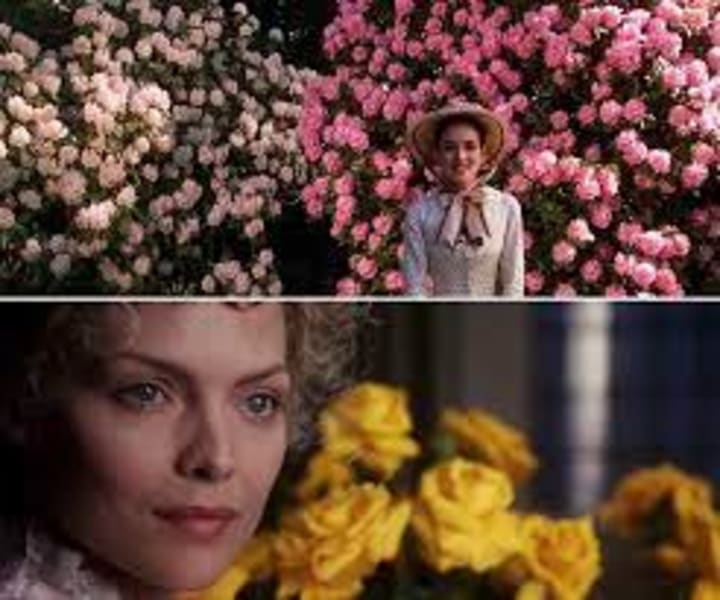
Now, you don't need to know the deeper meaning of flowers to understand that a soon to be married man sending flowers to another woman symbolizes a romantic interest in her. But, knowing about the visual language of flowers does give a depth and uniqueness to these details that I, for one, find exciting, like a great inside joke. And, returning to our main point, that regarding opening images, I would not have thought to consider the deeper meaning of flowers had I not taken note of Scorsese's distinct focus on flowers under the opening credits and into the first scene of the film. That's the power of a great filmmaker, conveying information in just a few opening minutes of a movie that will enliven and enrich the experience of the entire movie.
If you'd like to know more about the language of flowers in the 1800s, this article from the Old Farmer's Almanac provided me with a lengthy and exhilerating amount of backstory that I was able to apply while watching The Age of Innocence. Do read this story and think about your flowers in the future.
About the Creator
Sean Patrick
Hello, my name is Sean Patrick He/Him, and I am a film critic and podcast host for the I Hate Critics Movie Review Podcast I am a voting member of the Critics Choice Association, the group behind the annual Critics Choice Awards.
Keep reading
More stories from Sean Patrick and writers in Geeks and other communities.
Silver Screen Magic with Mae West
American actress and singer Mae West became a popular film actress during the Great Depression. She started entertaining in vaudeville, then performed on Broadway, and finally went to Hollywood. She signed up with Paramount Pictures and made her debut in the 1932 film “Night After Night.” She also starred in musicals, comedies, and crime dramas. The American Film Institute named her one of the best classic Hollywood actresses.
By Rasma Raisters8 days ago in Geeks
Sania Mirza flags structural gaps in Indian Women’s tennis at Australian Open
New Delhi, Jan 16: India U19 pacer Henil Patel credited former South Africa pacer Dale Steyn as his inspiration behind his match-winning performance against the USA at the ICC Under-19 Men’s Cricket World Cup.
By Dena Falken Esq5 days ago in Geeks
Smart phones, Humans and Aliens.
WARNING. I will be tapping into one of your favorite creative tensions: The absurdity of humans worshipping their glowing rectangles as if they were tiny oracles. There’s something deliciously poetic about that contradiction, and it lends itself beautifully to an instructive proviso.
By Novel Allen5 days ago in Poets


Comments (2)
This was very interesting Sean. Thank you for sharing your insights and knowledge.
Thank you for sharing these insights. I’ll be taking a closer look at opening images from now on.