
The Crucible by Arthur Miller
Why It's a Masterpiece (Week 27)

The Crucible was written in 1953 during the height of the Cold War and McCarthyism in the United States. Senator Joseph McCarthy's anti-communist pursuits led to widespread paranoia and the persecution of individuals accused of communist sympathies. Arthur Miller used the Salem witch trials of 1692 as an allegory for the contemporary witch hunts led by McCarthy.
The play draws direct parallels between the irrational fear and injustice of the witch trials and the Red Scare. Many of these parralels can also be drawn into our own time with cancel culture and mob justice being all the rave online. The great question regarding the timelessness of this text is: is its timelessness predicated on the fact that we as human beings go seeking out mob justice and join the herd as a way of making ourselves feel better?
Miller was inspired by the actual events in Salem and the concept of societal hysteria. He researched historical records to create a play that, while dramatised, stayed true to the spirit of the historical events. Miller himself was questioned by the House Un-American Activities Committee (HUAC) and witnessed the effects of the McCarthy era's blacklisting and accusations. This personal experience significantly influenced the tone and message of the play.
The Crucible premiered on Broadway on January 22, 1953.
Plot
The play opens in the Puritan town of Salem, Massachusetts, where a group of young girls, led by Abigail Williams, is caught dancing in the forest and accused of witchcraft. To avoid punishment, they start accusing others of consorting with the devil. As fear of witchcraft spreads, more and more townspeople are accused. Elizabeth Proctor, the wife of John Proctor, is accused by Abigail in an attempt to get rid of her and take her place.
John Proctor, a local farmer, tries to expose the hysteria by revealing his affair with Abigail, hoping to discredit her. However, this confession backfires and he is accused of witchcraft. The court, led by Judge Danforth, conducts trials where the accused are pressured to confess to save their lives. Many, including John Proctor, refuse to falsely confess and are executed.
The play ends with John Proctor's execution, highlighting the tragic consequences of the witch hunts. The town of Salem is left to reflect on the devastating impact of the hysteria and false accusations.
Into the Book
There are many themes in this book that can invite the reader into thinking critically about the ideas of freedom of speech and innocence. The first one definitely applies to our own times whether it is teenagers faking illnesses due to what they have seen online or people engaging in mob justice against someone who has not yet been found guilty of anything: mass hysteria.
This play vividly portrays how fear can grip an entire community and lead to mass hysteria. The initial fear of witchcraft in Salem quickly escalates as accusations fly and rational thought is abandoned. The characters' fear of the unknown and the supernatural blinds them to the truth and leads them to make irrational and dangerous decisions. As hysteria spreads, innocent people become scapegoats. The play illustrates how individuals, driven by fear and a desire to protect themselves, accuse others without evidence. This leads to the imprisonment and execution of many innocent townspeople, highlighting the destructive power of mass hysteria.
As for social consequences, the widespread panic not only destroys individuals but also tears apart the fabric of the community. Relationships are strained, trust is broken, and the social order collapses as everyone becomes either an accuser or a potential victim. This play therefore, serves as a cautionary tale about the dangers of collective fear and its capacity to cause widespread harm.
“I speak my own sins; I cannot judge another. I have no tongue for it.”
- The Crucible by Arthur Miller
Another theme that is important (again, in our own time as much as within Miller's) is integrity and reputation. With the rise of social media, people have been finding it increasingly difficult to maintain their reputations as things they said on a whim more than ten years' ago can now be pulled up and used against them to destroy their reputations, their names, their jobs and sometimes, their entire lives. This is a rabid form of McCarthyism which would have probably made Miller vomit. Let's take a quick look at the theme in the context of 'The Crucible'.
One of the central conflicts in the play is John Proctor's struggle to maintain his integrity while protecting his reputation. Proctor's internal battle represents the broader theme of personal honor versus public perception. His ultimate decision to confess his affair with Abigail Williams, despite the damage it does to his name, highlights the complexity of integrity.
Elizabeth Proctor's character exemplifies moral fortitude and the importance of integrity. Despite being falsely accused and imprisoned, she remains steadfast in her values and refuses to compromise her principles, even when it could save her life.
Therefore, in Salem, a person's reputation can mean the difference between life and death. The play shows how individuals go to great lengths to protect their good names, often leading to further dishonesty and injustice. The destructive impact of prioritising reputation over truth and integrity is a central lesson of the play.
“Because it is my name! Because I cannot have another in my life! Because I lie and sign myself to lies! Because I am not worth the dust on the feet of them that hang! How may I live without my name? I have given you my soul; leave me my name!”
- The Crucible by Arthur Miller
The final theme I want to investigate is yet another that we can apply to our own times: the abuse of power. In our times it is seen through powerful individuals who have abused their powers in nefarious ways, such as Bill Gates. It is also seen through companies that are tyrannical but pretend like their not, like Coca-Cola. It is yet again seen through people who once pretended that they had the integrity to run the country but instead, were primarily focused on installing and maintaining cronyism with their millionaire friends - i.e Boris Johnson and Rishi Sunak. Let's have a look at what this therefore means in 'The Crucible'.
The play critiques the role of authority figures who abuse their power. Judge Danforth and Reverend Parris, among others, are portrayed as self-righteous and manipulative, using their positions to control the community and further their own agendas. Their actions demonstrate how those in power can perpetuate injustice when driven by fear, ambition, or self-interest.
The court in Salem uses manipulation and coercion to extract confessions and enforce its will. The accused are pressured to confess to witchcraft to save their lives, even if it means lying. This abuse of power underscores the theme of how authority can be wielded unjustly and the devastating impact it can have on individuals and society.
Characters like John Proctor and Giles Corey resist the corrupt authority, showing the importance of standing up against injustice. However, their resistance comes at a high cost, highlighting the personal risks involved in challenging abusive power structures. Their sacrifices serve as a testament to the enduring value of integrity and courage in the face of oppression.
“A fire, a fire is burning! I hear the boot of Lucifer, I see his filthy face! And it is my face, and yours, Danforth! For them that quail to bring men out of ignorance, as I have quailed, and as you quail now when you know in all your black hearts that this be fraud – God damns our kind especially, and we will burn, we will burn together!”
- The Crucible by Arthur Miller
Why It's a Masterpiece
"The Crucible" remains relevant as it addresses themes of mass hysteria, the abuse of power, and the importance of integrity. Its allegorical connection to McCarthyism provides historical context while resonating with contemporary issues. In our social media obsessed world, McCarthyism, cancel culture and blacklisting are all coming back in waves and the judge, jury and executioners seem to be those with the most time to spend addressing the issues instead of doing anything productive: young girls. Yet again, we live underneath the umbrella of Miller's warning to us all about the dangers of mob justice.
Miller's characters are complex and multi-dimensional. John Proctor, Abigail Williams, and Elizabeth Proctor, among others, represent various human traits and moral dilemmas, making the play's drama deeply engaging. Nobody in this play is by any means perfect, but all of them deserve their voice heard. It is just the ones with the loudest voice that seem to drown out the ones who legitmately want to explain their points of view. It does not seem to matter as to what the truth is anymore.
The play's dialogue is both realistic and poetic, capturing the intensity of the characters' emotions and the gravity of the situation. Miller's structure, with its escalating tension and dramatic climaxes, ensures that the play is compelling and thought-provoking. The moral dilemmas, the mob justice, the mass hysteria and the integrity (or lack thereof) in full display to its audience - other victims of the same world at a different time.
Conclusion
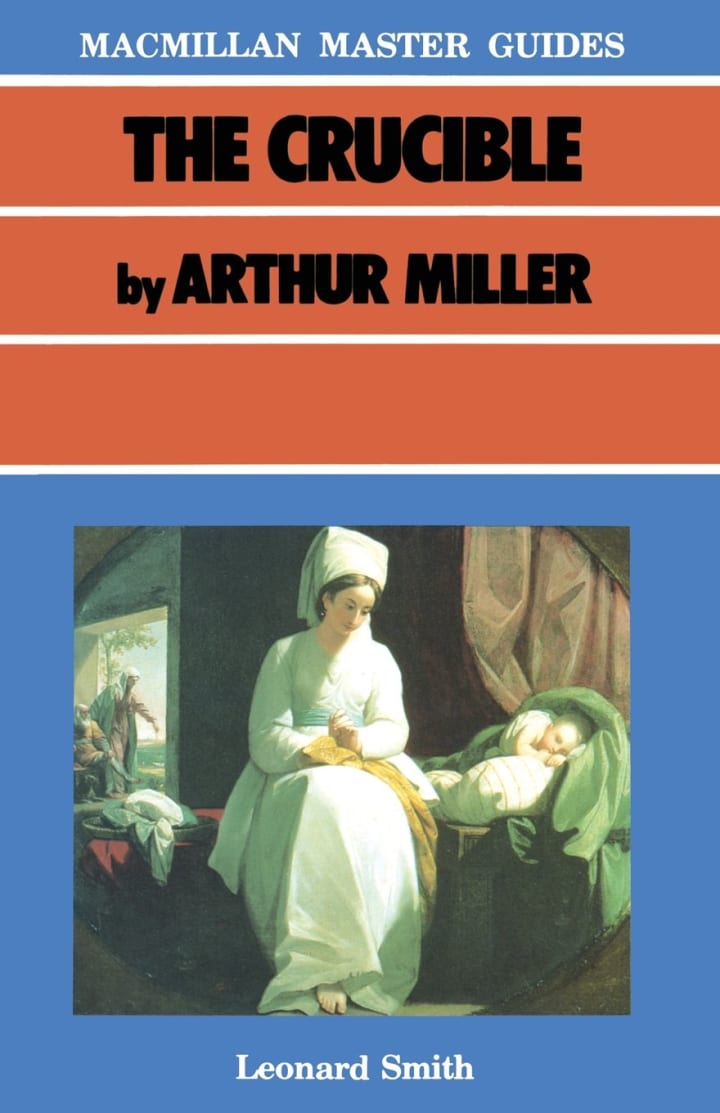
I hope you have enjoyed reading about Arthur Miller's 'The Crucible' and how important it is not only to the time the play was released, but to our own time as well. It is one of those timeless plays in which the idea of it being timeless and therefore, still applicable to us, is actually horrifying. Have we learnt nothing from the Salem Witch Trials? I hate to say it, but we haven't learnt a damn thing.
Next Week: All the Pretty Horses by Cormac McCarthy
About the Creator
Annie Kapur
I am:
🙋🏽♀️ Annie
📚 Avid Reader
📝 Reviewer and Commentator
🎓 Post-Grad Millennial (M.A)
***
I have:
📖 280K+ reads on Vocal
🫶🏼 Love for reading & research
🦋/X @AnnieWithBooks
***
🏡 UK
Keep reading
More stories from Annie Kapur and writers in Geeks and other communities.
Book Review: "Disturbance" by Jenna Clake
When I bought this book on my Kindle App, one of the ways in which it was described was 'atmospheric and witchy'. Now, I'm all up for a witchy book as long as there is some form of grounding in reality. For example: less superpowers, more 'Crucible'. However, I do like my fair share of dark, foreboding witchiness such as those we see in classics like Macbeth. I was initially thought that this book was going to be more folkish because of the fact I'd read there were rituals involved. But as I read on, I realised there was hardly anything witchy about the book at all, and definitely no atmosphere to speak of. Most of this book is pointless conversation with an uninteresting main character gaslighting herself.
By Annie Kapurabout a year ago in Geeks
Silver Screen Magic with Mae West
American actress and singer Mae West became a popular film actress during the Great Depression. She started entertaining in vaudeville, then performed on Broadway, and finally went to Hollywood. She signed up with Paramount Pictures and made her debut in the 1932 film “Night After Night.” She also starred in musicals, comedies, and crime dramas. The American Film Institute named her one of the best classic Hollywood actresses.
By Rasma Raisters7 days ago in Geeks
"Beyond the Gates" Weeks 38-44 Recap
It's been a minute since I delivered a Beyond the Gates recap, but I want to start with this. If you had told me that in 2025 and now into 2026 that I'd be religiously watching any soap opera, I would have looked at you like you had three heads or something. My feelings about soaps had always been complicated. I had peeped into some of the classics at times, but I was never a religious viewer. A question I never asked myself was this: "What would it take for me to actually watch a soap every day?"
By Clyde E. Dawkins8 days ago in Geeks



Comments (2)
This is a book I have heard of but have never taken the time to read. Annie, your analysis was thought-provoking, and definitely peaked my interest. You mentioned: "Proctor's internal battle represents the broader theme of personal honor versus public perception. His ultimate decision to confess his affair with Abigail Williams, despite the damage it does to his name, highlights the complexity of integrity." This immediately reminded me of the line from The King's Man (2021) "Reputation is what people think of you. Character is what you are." You tapped on the ideas of cancel culture and social media. I think that social media definitely embodies the former, which can be difficult for people when, character-wise, they may have truly evolved as a person, but things they believed or said before, are indelibly stained in the fabric of the internet. It often amazes me how we, as humans, root for underdogs and claim we "love" a comeback story, but more often than not get a high off of crucifying (or, well, cancelling) people. I'd like to think it's because we all want to be heroes. We all want to fight a crusade against darkness, so when we see (usually, a relatively easy target, for justice), we pounce, patting ourselves on the backs for symbolically waging a war for the "good-side." That's not to say that negative reinforcement isn't needed or even necessary. Afterall, what's the famous phrase, "Evil triumphs when good men do nothing"? But, I think that, particularly online, it really can get to a point of mass hysteria, where we turn into a wave of "justice" that has the potential to take out innocents and villains alike. For now, it appears that it is a price we are willing to pay.
Such an incredible classic!