
The 3 Legendary Sannins
An in-depth exploration of the Legendary Three Sannin—Jiraiya, Tsunade, and Orochimaru—and their deep roots in Japanese folklore

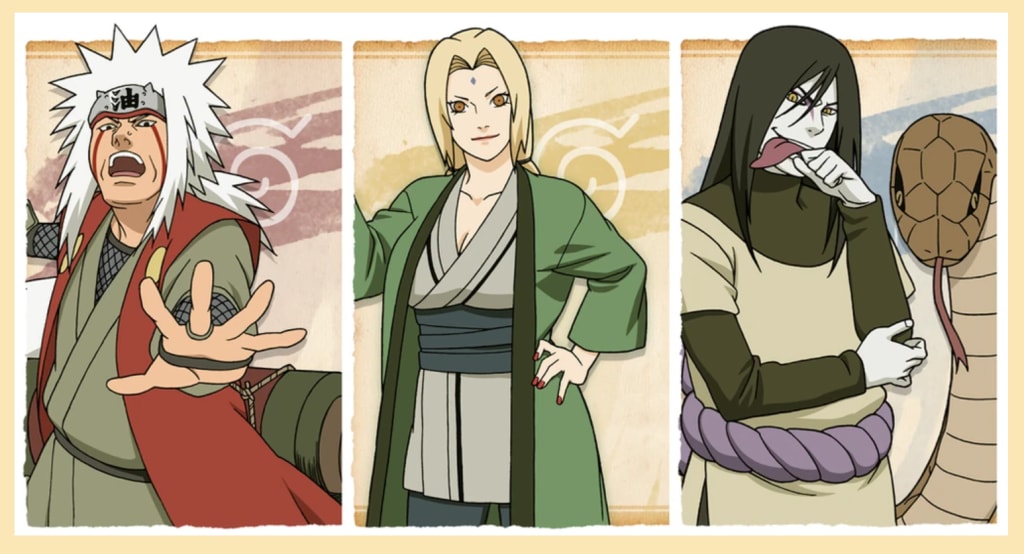
Naruto’s Legendary Sannin are not arbitrary. They’re part of a lineage tracing back over 200 years—Edo-period fantastical tales infused into modern anime. By embedding elements like toad-slug-snake dynamics, faithful character archetypes, and folkloric plotlines, Masashi Kishimoto created a contemporary epic tethered to Japanese myth. They serve as perfect examples of how anime can bring ancient tradition to global screens—maintaining authenticity while adapting structure and themes for new audiences.
The Legendary Sannin—Jiraiya, Tsunade, and Orochimaru—are among the most iconic figures in Naruto, but their roots reach far deeper into Japanese folklore. All three characters trace back to the Edo-period folktale *Jiraiya Gōketsu Monogatari (“The Tale of the Gallant Jiraiya”)**, serialized from 1839 to 1868 and later adapted into kabuki plays. This narrative introduced a powerful trio entwined by magic, relationships, and elemental balance—modernized brilliantly in Naruto through summoning jutsu, character relationships, and symbolic resonance.
In the original folktale, Jiraiya—literally “Young Thunder”—is a disgraced heir from Kyūshū who becomes a valorous bandit in Echigo. He seeks vengeance for his fallen clan, journeys to Mount Myōkō, and meets a toad spirit who grants him shapeshifting magic. He uses this power to aid the oppressed. He soon meets Tsunade, a virtuous maiden who uses slug magic taught by a mountain hermit who is secretly a snail. The two fuse their powers, eventually falling in love and marrying. Meanwhile, Jiraiya’s disciple—Yashagorō—learns snake magic, becomes corrupted, and assumes the name Orochimaru, eventually betraying his former master and poisoning both him and Tsunade. The tale ends abruptly—poison leaves the duo unconscious, rescued by a loyal retainer—establishing a thematic motif of unwavering heroism and betrayal under the weight of magical legacies
The legend’s toad–slug–snake motif reflects sansukumi-ken, a traditional Japanese hand-gesture game akin to rock–paper–scissors, where frog/beats–slug, slug–beats–snake, snake–beats–frog. This cyclical hierarchy captured Edo-era imaginations and was often depicted in ukiyo-e prints. In the folktale, slug magic overpowers snake magic, snake magic overpowers toad magic, and toad magic defeats slug magic—mirroring this deadlock.
Jiraiya: The Toad Hero Reinvented
The folkloric Jiraiya shapeshifts into a mighty toad, riding atop toad allies from Mount Myōkō, and frees his land from wrongdoing. In Naruto, this legacy is vividly reimagined: Jiraiya trains on Mount Myōboku alongside toads like Gamabunta, masters Sage Mode, and becomes Naruto’s beloved mentor and chronicler. His journey mirrors the legend—wandering, righting wrongs, and ultimately sacrificing himself in a confrontation with Pain. Notably, his final words echo the folktale itself: he hopes Naruto’s story will be “a bit better,” directly nodding to the tale’s ambiguous, abrupt end.
Tsunade: Slug Magic and Leadership
In folklore, Tsunade learns slug magic from a snail hermit and aids the hero—often depicted as Jiraiya’s bride—in magical conflict against serpent foes. The folktale even grandfathered in Katsuyu, the slug spirit & seal-bearer who binds Tsunade to her power. In Naruto, Tsunade becomes the “Slug Princess,” able to summon Katsuyu from Mount Myōboku. She revolutionizes medical ninjutsu, trains Sakura and Shizune, and ultimately becomes the Fifth Hokage—ushering in healing and stability to her world. Her slug-based powers are emblematic: they overpower Orochimaru’s snake jutsu, reinforcing the sansukumi hierarchy.
Orochimaru: Serpent Ambition and Betrayal
Orochimaru’s origins lie in betrayal: in folklore, a once-loyal retainer of Jiraiya and Tsunade who gains snake magic, poisons them, and becomes a serpent-centric figure of ruin. Kishimoto echoes this transformation. His Naruto Orochimaru transitions from curious prodigy to serpent-worshiping villain obsessed with forbidden jutsu, immortality, and body-transfer. His betrayal of Konoha, manipulation of the Sound Village, and near-immortality mirror the folktale’s Orochimaru in both nature and narrative.
Kishimoto doesn't merely borrow names or animal icons—he internalizes the folktale’s core values. The sansukumi-inspired power triangle is literal: Jiraiya’s toads are vulnerable to snake jutsu; Tsunade’s slugs are effective against snake techniques; and snakes counter toad techniques. The triad also mirrors emotional arcs: Jiraiya protects and sacrifices, Tsunade transforms grief into leadership, and Orochimaru’s ambition leads to exile. Their interconnected stories parallel the folktale’s themes of loyalty, power’s allure, and the struggle between unity and betrayal. The resurgence of Jiraiya Gōketsu Monogatari via Naruto exemplifies how anime can revive historical folklore for global audiences. Japanese scholars and pop-culture analysts highlight that Kishimoto’s adaptation not only entertains but also educates, exposing international viewers to Edo-period storytelling, kabuki traditions, and sansukumi games. “The slug toad and snake relationship… it wasn’t created to be cool. It was to reference Jiraiya Monogatari… interesting battle between ninja who embody characteristics of each animal.” The tale’s resonance is palpable: Naruto’s global popularity has sparked renewed interest in kabuki studios, historical prints, and homages to Edo-era lore—serving as cultural soft power grounded in authentic heritage.
By embedding these three deep-rooted folk characters—Jiraiya, Tsunade, and Orochimaru—into his narrative, Kishimoto reinterprets centuries-old Japanese folklore for a multi-generational, global audience. Through elemental balance, character roles, thematic arcs, and direct quotes (especially Jiraiya’s aspirational final message), Naruto doesn’t just reference the folktale—it concludes it, continuing the legend rather than merely imitating it. In doing so, the series weaves ancient myths into modern mythology, making Edo-era tales relevant, relatable, and riveting once more.
About the Creator
JRManglicmot
A Striving father and husband, trying to be the best I can be. I'm not perfect, but I try to be the one my family can look up to. I stumble and make mistakes from time to time, most often, but I try to learn from my mistakes.
Keep reading
More stories from JRManglicmot and writers in Geeks and other communities.
Demon Slayer: Bridging Japanese Folklore and Modern Anime
Demon Slayer: Kimetsu no Yaiba has captivated audiences worldwide, not only for its compelling storytelling and stunning animation but also for its deep roots in Japanese folklore and history. Set during the Taisho era (1912–1926), the series masterfully intertwines traditional themes with modern anime sensibilities, creating a unique narrative that resonates across generations.
By JRManglicmot9 months ago in Geeks
Spongebob Review
The episode “Valentine’s Day” opens with a bright, sugar‑spun carnival setting that immediately signals the festive intent of the story, and the animators spare no effort in embedding every booth, ride, and cotton‑candy stall with heart‑shaped motifs that pulse with a playful, romantic optimism. SpongeBob, ever the eager romantic, is armed with a meticulously handcrafted valentine that he intends to deliver to Patrick, hoping to cement their friendship in a tradition that feels both sincere and mischievously earnest. Sandy, whose scientific pragmatism is juxtaposed against the sheer silliness of the holiday, offers a technologically enhanced “gift‑launcher” that can propel the valentine across the midway without the risk of accidental crushing by a rogue clown. The episode’s opening scenes are a masterclass in setting tone: the shimmering lights, the muffled carnival music, and the subtle background chatter of other sea‑creature patrons combine to immerse the viewer in a world that is simultaneously familiar and whimsically exaggerated.
By Forest Green7 days ago in Geeks


Comments
There are no comments for this story
Be the first to respond and start the conversation.