
TCM Film Festival: 'Tex Avery at MGM'
The Turner Classic Movies Film Festival will celebrate animator Tex Avery's unique time at MGM studios.


The Turner Classic Film Festival, May 6th through the 9th on TCM and HBO Max, is treading into the minefield that is the legacy of one Tex Avery during the 2021 TCM Film Festival. One of the centerpieces of TCM’s Saturday morning is the documentary Tex Avery: The King of Cartoons, a 1988 52 minute documentary that has rarely been seen as it has mostly been out of circulation in the last few years. It’s on YouTube but if you’re in America, and you don’t have one of those VPN disguises, you aren’t able to watch it. Thus the show, Saturday morning at 6 Am Eastern time on TCM is a rare opportunity to see the documentary.
The documentary is followed on Saturday morning at 7 Am Eastern time by Tex Avery at MGM, a 56 minute collection of some of Avery’s most beloved work at MGM where he went after his acrimonious falling out at Termite Terrace, aka Warner Brothers Animation. The seven chosen Tex Avery at MGM shorts are remarkable moments in the history of American animtion. They’re also the 7 Avery shorts that can be shown on television in this day and age. (More on that later in this piece)
Here’s a series of short form reviews of these seven fascinating Avery shorts in the spotlight at TCM Fest…
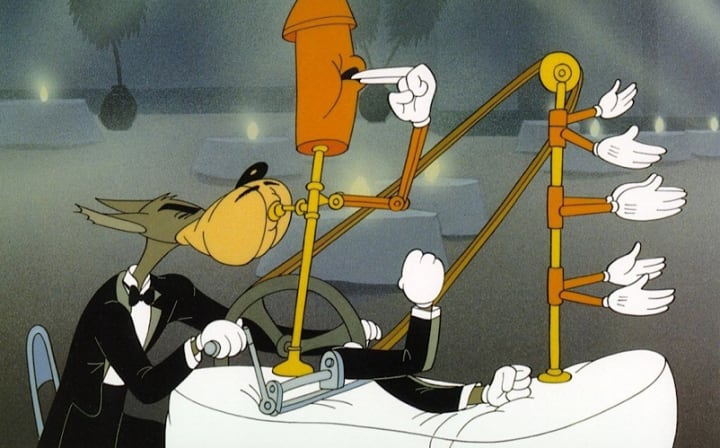
Red Hot Red Riding Hood - 1943
Have you ever wondered about the origin of the Wolf Whistle? It’s that sing-song whistle that became associated with men ogling attractive women in the streets. The origin is slightly more literal than you might think as it originates from a wolf cartoon character. In 1943, Tex Avery directed the 7 minute short Red Hot Red Riding Hood which features the characters of the famed folk tale in a sexed up jazz age narrative.
The story begins traditionally with Red Riding Hood about to make her sojourn to grandma’s house and the wolf waiting along her path. A narrator sets the scene but is then interrupted by the characters, Red, The Wolf and Grandma. In this meta-narrative moment the characters object to the idea of acting out this story in the traditional telling. So, taking to heart the criticism, the narrator shifts the narrative from the forest to the Jazz age.
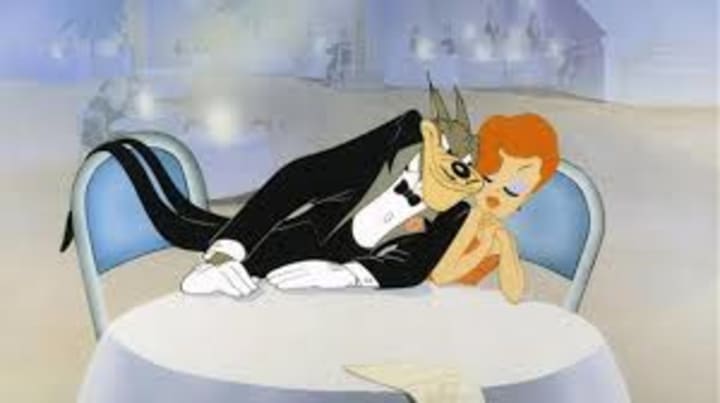
Now, the story of Red Riding Hood is one where the Wolf is a caddish gent attending a jazz club where Red is the star performer. The Wolf ogles and whistles and pops his eyes out at the beautiful Red and attempts to seduce her. She rebuffs him and his asking for a date by telling him that she’s headed to grandma’s house, now reimagined as an after hours club for those who don’t want the party to end.
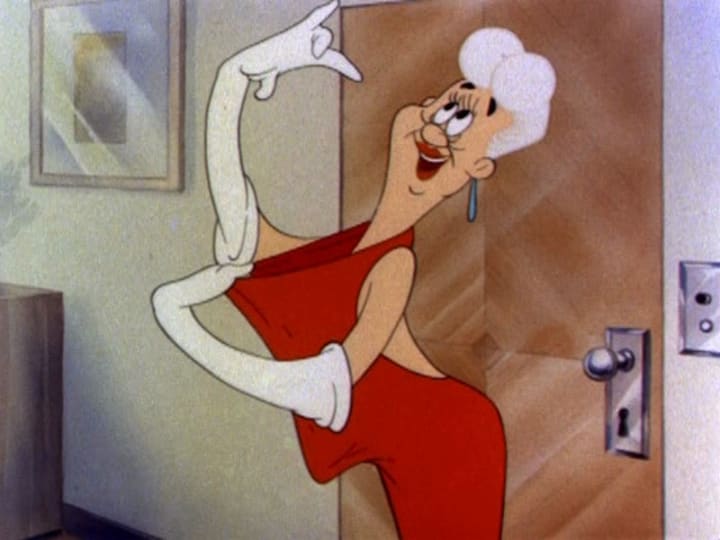
Grandma also gets a significant reimagining. As the Wolf arrives at Grandma’s, searching for Red, he encounters grandma, a man-eater of the highest degree. Grandma chases after the Wolf for a kiss which terrifies the Wolf to his core. The two engage in a slapstick chase involving classic animated gags involving heights, doors that open to an abyss and windows covered by bricks to comically block escapes. The Wolf manages to escape Grandma’s clutches and returns to the Jazz Club a changed man, having sworn off ‘Dames.’
However, after once again seeing Red Riding Hood perform her stage show the Wolf immediately switches gears and being tempted again by Red Riding Hood, the Wolf takes his own life with a gunshot to the head. That’s no joke, that’s the set up for the punchline at the end which finds the Wolf’s ghost rise from his corpse and return to his wolf-whistling, catcalling antics, once again aimed at the super sexy Red. Never let be said that Tex Avery didn’t think outside the box.
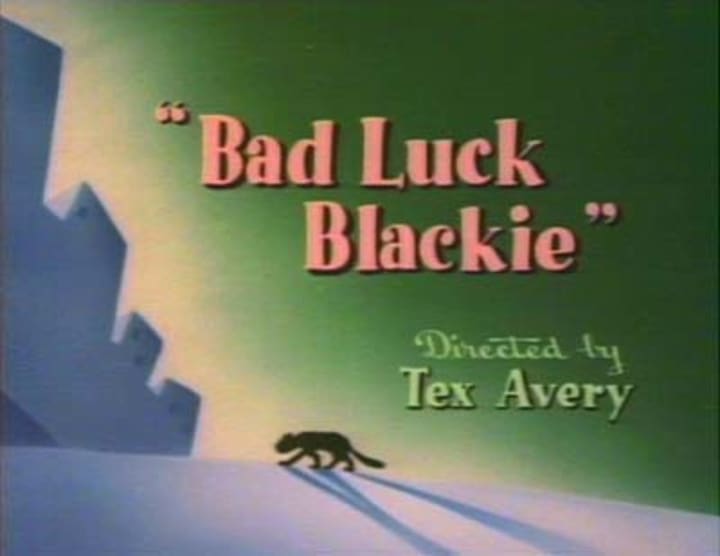
Bad Luck Blackie - 1949
Bad Luck Blackie had me a little nervous based on the title and the year it was made, but the cartoon is oddly wholesome in execution, aside from one unfortunate bit of Blackface. The story has a small white cat being menaced by a large dog, a bulldog named Spike, later renamed Butch when he became part of the Droopy Dog extended universe. As the unnamed Kitten is making his latest escape from Spike’s horrific, menacing, laughing presence, the Kitten meets Blackie who, as a favor to the kid, walks in Spike’s path causing something heavy to fall on Spike’s head.
Blackie then gifts the Kitten a whistle with the instructions to blow the whistle any time Spike is coming after him. This leads to a terrific series of gags in which the Kitten goes to ever more barren locations to escape Spike, blows the whistle and Blackie magically appears to cross Spike’s path in ever more comically unlikely ways. It’s classic Avery with high level use of music and sound effects for high comic effect and an ever increasing zaniness.
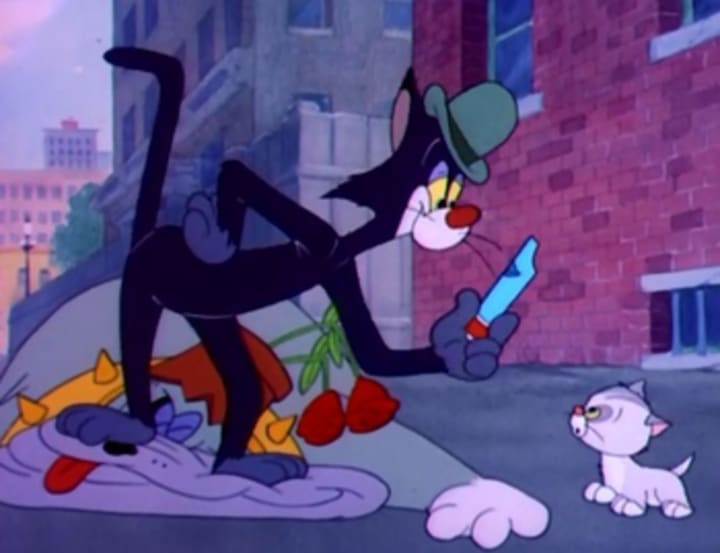
The shift in the story comes when Spike plots to sap Blackie’s powers. Stealing the whistle from the kitten, Butch calls forth Blackie only to lambaste the black cat with white paint which magically takes away his powers. This allows Spike to capture Blackie and begin to beat him mercilessly. That is, until the Kitten hatches a plan. If paint can take away Blackie’s powers, black paint can give the Kitten powers. So, the kitten dives into a can of black paint, rescues Blackie and Spike ends up with the whistle in his gut and a bad case of hiccups.
This is a classic of Avery style with underdogs getting one over on bullies and baddies. It’s a favored theme of Avery’s work as even Bug Bunny could be viewed as an underdog, facing off against a hunter with a gun while Bugs only has his wits to get by. There is nothing particularly special about Bad Luck Blackie but in the canon of Tex Avery it has a strange wholesomeness to it, that is perhaps more notable as it plays at TCM Fest immediately after the super-horny Red Hot Riding Hood.
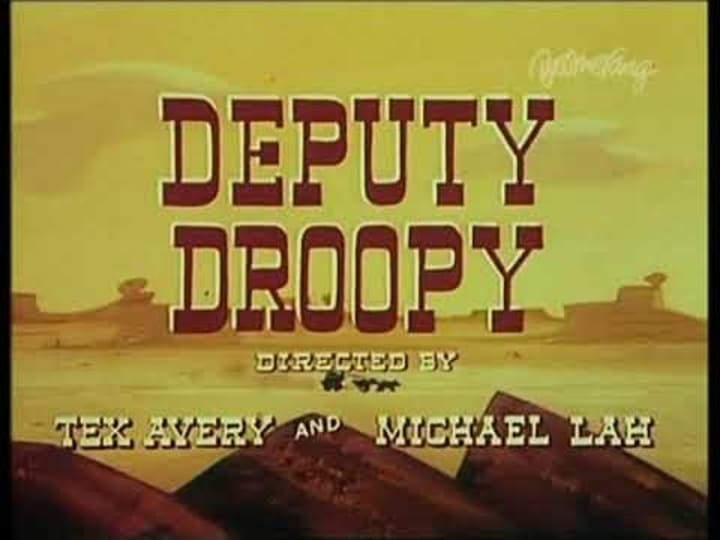
Droopy in Deputy Droopy - 1955
Droopy in Deputy Droopy is one of Avery’s more incredible deployments of cartoon anatomy and cartoon physics. The premise has Droopy portraying a Deputy in the old west. Droopy is tasked with protecting a safe full of prospector gold while the Sheriff is in the room next door taking a nap. The Sheriff tells Droopy that if he hears any kind of noise, he will come running in firing his gun in all directions. Overhearing this, a pair of thieves decide they need to be as quiet as possible in subduing Droopy and breaking into the safe.
This leads to a series of gags in which Droopy causes no end of injuries to the thieves who then run to the hills nearby to let out their screams of agony. The most outlandish sequence has one of the thieves glued to the floor and unable to run and scream after being hit in the backside with a board with a nail in. So, the thief takes off his own head, places it on his partner’s head and sends him back to the hill to scream for him.
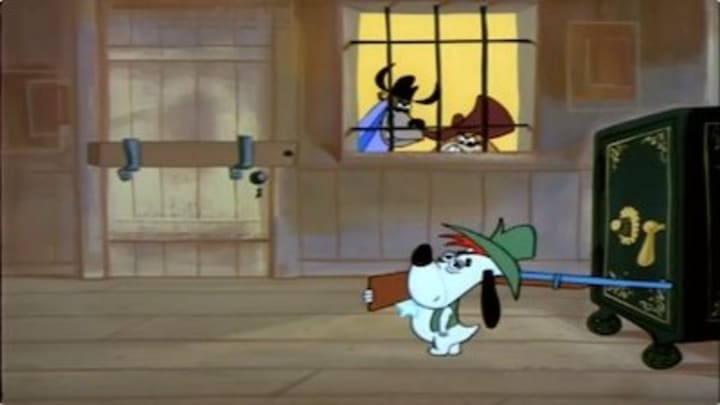
I’ve never thought much about Droopy Dog. His name pretty much tells you all you need to know. He moves slow, he talks slow, and the gag is that everyone underestimates him based on his droopy exterior. That’s certainly the case here as Droopy repeatedly foils the thieves and they just keep coming back. Deputy Droopy demonstrates one of Avery’s other quirks, his inability to reach a satisfying ending for his stories. Here, the whole short ends on a gag that just sort of exists. It’s not funny but it is strange and kind of amusing. It plays as if Avery just needed an ending and went with the first sort of twist he could put on this material.
Screwball Squirrel - 1944
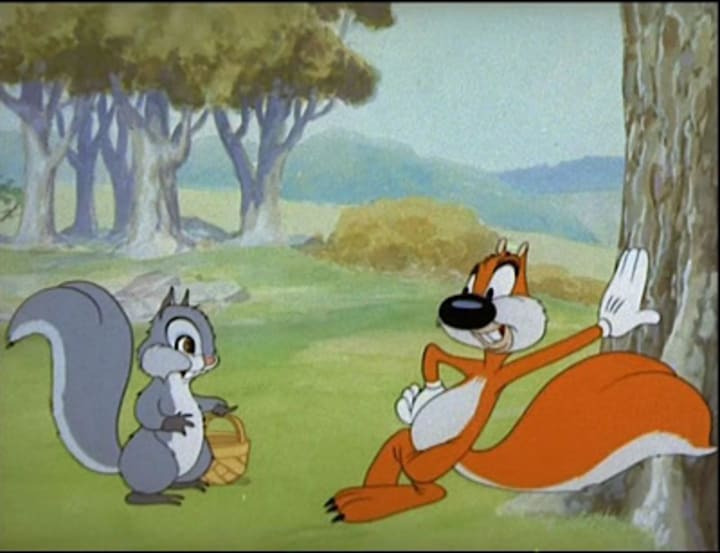
I had never heard of the character Screwy Squirrel before I watched this short or at least I thought I hadn’t heard of him. Then, I was reminded of a line in Who Framed Roger Rabbit where Screwy is name checked alongside animated penguin, Chilly Willy. This 1944 short, Screwball Squirrel, was the introduction to Screwy Squirrel at MGM and in the canon of Tex Avery. Screwy would go on to appear in four more of Tex Avery’s shorts, though one, Big Heel-Watha, is so ugly and racist toward Native Americans that is no longer circulated by MGM.
Screwball Squirrel isn’t particularly funny or memorable. He appears to be a riff on Bugs Bunny, whom Avery had helped to develop at Warner Brothers before his less than amicable break with Warner's. Screwy is a fast talking, quick witted Squirrel who delights in tormenting a dog named Meathead whom he goads into a lengthy chase that makes up the seven minute run time of this short. And that’s it, there are a couple of too the camera, fourth wall gags that echo one of Avery’s favorite go to gags, acknowledging the audience, but Screwball Squirrel is probably the least memorable of the shorts in this collection.
Screwy would go on to a rather infamous and strange cartoon death. The short Lonesome Lenny, 1946, not featured at TCM Fest's celebration of Tex Avery, finds Screwy having been killed by the protagonist, Lenny, a large sheepdog, in a death that mimics the end of the unfortunate rabbits at the hands of a character named Lenny in John Steinbeck's Of Mice and Men. The final image of Lenny is the crushed squirrel holding a sign that says 'Sad ending, isn't it?' Then Screwy closes his eyes for the last time. Screwy has since been reborn, and was even briefly voiced by Paul 'Pee Wee Herman' Reubens.
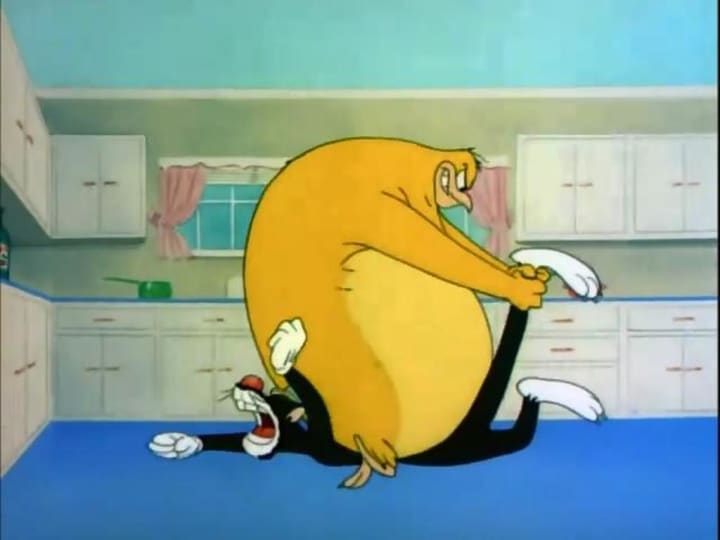
King Size Canary - 1947
King Size Canary plays like Tex Avery’s take on Warner Brothers’ Sylvester and Tweety. It's an interesting coincidence that Termite Terrace had just stopped using Sylvester the cat in 1946, after his introduction during Avery's run in the late 30s. Anyway, the story has a hungry black cat seeking a meal and spotting a house with an open window. The house is guarded by a bulldog whom the cat subdues with a comical amount of sleeping pills. Once inside the home however, the Cat finds an I.O.U for food in the fridge and similar gags throughout the empty cupboards of the kitchen. Then the cat spots a mouse. The tough talking mouse tells the cat that he should instead turn his hunger toward the giant canary in the other room as he’d make a more satisfying meal.
What the cat finds however is not a giant canary, but a perfectly ordinary one. However, the cat has found a growth formula in the kitchen and thus tries that on the canary. This works to make the canary HUGE but also so large and tough that the cat is no match for the canary. So the cat takes the growth formula himself and then the Canary takes the formula again. Eventually the mouse and the dog also take the formula until finally only the cat and mouse are left standing atop the globe and the cartoon ends with them agreeing to be pals.
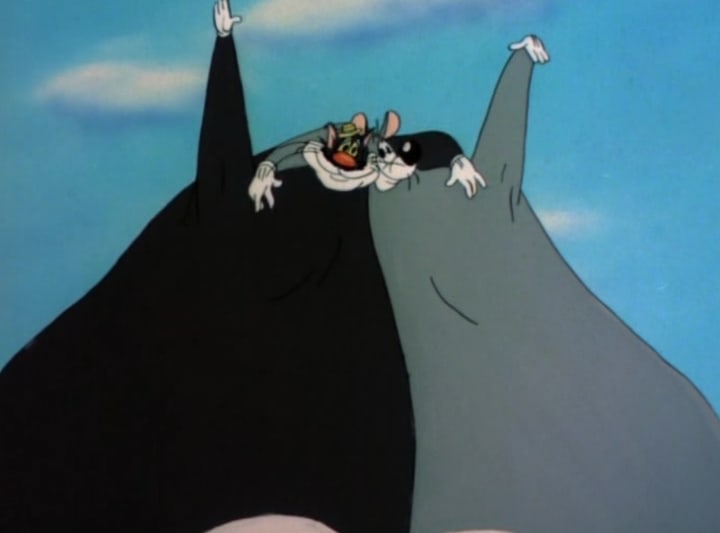
Is it funny? Kind of, yeah. In 1994 it was voted one of the 50 greatest cartoons of all time by a group of 1000 animators so that’s something. King Size Canary goofy, over the top and outlandish but I didn’t find myself laughing all that hard or all that much. And then there's the ending, yet another example of Avery not being able to find a satisfying punchline and settling with taking the story to its most literal conclusion. It’s amusing enough, but that’s about it from a modern perspective.
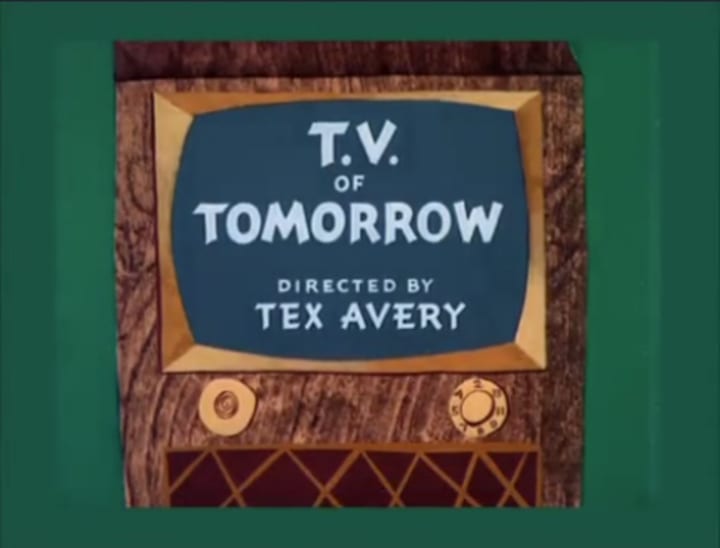
TV of Tomorrow - 1953
TV of Tomorrow was part of an unusual series of ‘Of Tomorrow’ titles from Tex Avery which played off of a borderline science fiction premise. It was a parody of modern future looking news shows that attempted to tell viewers what the world of the future might look like as technology advanced to remarkable degrees. The series of shorts popped up over Avery’s tenure at MGM and showed his unique power at MGM who appeared to allow Avery to follow his muse as he saw fit. These ‘Of Tomorrow’ pieces, include The House of Tomorrow (1949), The Car of Tomorrow (1951), and The Farm of Tomorrow (1954). Only The TV of Tomorrow is featured at TCM Fest.
The premise of each of these shorts is the same, an announcer introduces a series of products that satisfy a very specific niche audience. In The TV of Tomorrow there are TV’s that also double as washing machines or stoves. There is a TV built to deal with distortion from passing airplanes by shooting those planes down with a built in turret. And there is a TV with a windshield wiper that clears away the fuzz from your favorite channels.
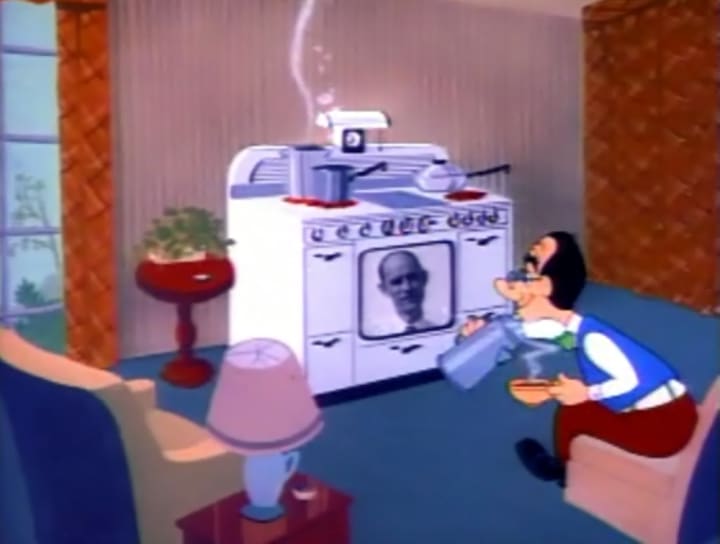
The TV of Tomorrow is a tad bit on the horny side as at least three of the models have been built with the bachelor in mind. These include a TV with a keyhole, made for peeping toms, a TV made for the modern plunging neckline where the bottom of the screen resembles a large bust, and finally a model with two stacked screens so you can see ALL of the picture. Here Avery mixes a real picture in the TV, a real life actress in a skimpy costume that can be seen in the altogether with this special TV. Avery was rather prescient regarding the television as he predicts TV invading the bathroom, and entire homes with the TV at the center of all activities. It was becoming true in the 1950's and it is entirely true today.
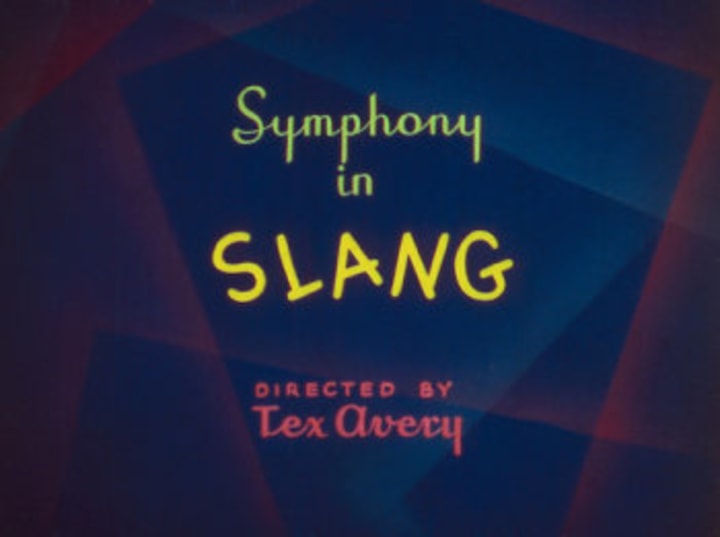
Symphony in Slang - 1951
Symphony in Slang is a rather remarkable and ingenious cartoon short. It’s a series of awful dad jokes and OK Boomer literalism before such a thing had a name. An unnamed young man arrives in Heaven and when speaking to Saint Peter at the gates, uses so much modern 50’s slang that Saint Peter can’t understand a word the young man says. In need of help, Peter turns to the late Dictionary creator, Noah Webster to help interpret the young man’s life story.
What follows are extraordinarily literal jokes that lampoon the modern, by way of 1951 slang, of the Boomer generation. One example has the young man state that he got a job working for a boss who was ‘short handed,’ but when he couldn't ‘cut the mustard,’ he was ‘given the boot,’ and went back to his ‘hole in the wall.’
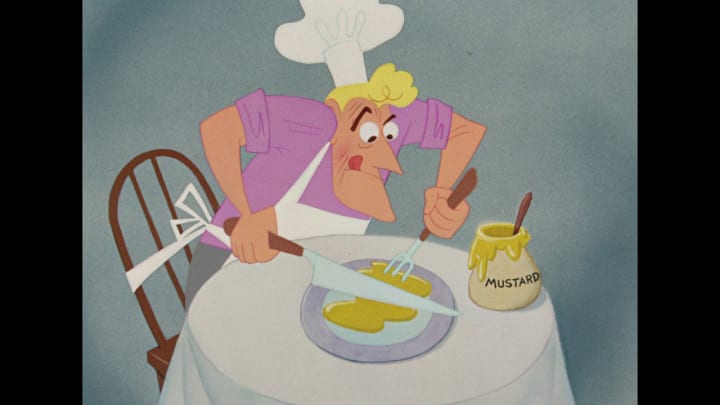
Symphony in Slang is a bit of an absurdist masterpiece as Avery ignores all context clues in favor of a swirling, unending vortex of literalism that I could not help but be taken with. Symphony in Slang is now one of my favorite cartoons ever just for the sheer volume of lunatic literalism that Avery and his team pack into 7 minutes of screen time.
Reckoning
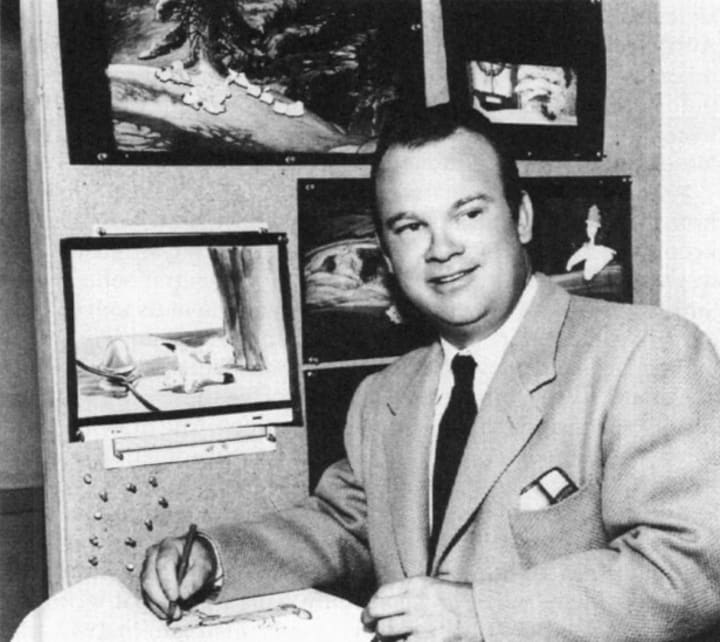
One thing you won’t find regarding Tex Avery via his featured place amid the celebration of American cinema that is the The TCM Film Festival, is any sort of reckoning with Tex Avery who, though undeniably one of the pioneers of animated comedy, was also responsible for some of the worst aspects of our animated American history. A list of his work on Wikipedia collects all of his time at MGM which encompasses nearly 70 animated shorts over 15 years.
Of that group, not mentioned in our veneration of Avery are shorts such as Uncle Tom’s Cabana, a cartoon deemed so racist by one report ‘it set movies back 10 years,’ or The Car of Tomorrow, also not available today due to ugly and insensitive stereotypes of Asian and Native Americans. Then there are his numerous shorts that employ blackface, not white actors in makeup but rather the stereotypical drawing of non-black characters or even animal characters in what approximates blackface in an animated feature.
I'm not pointing this out to call out TCM Fest or to 'cancel' Tex Avery. But, with the many thoughtful and informative aspects of TCM Fest, especially a wonderful look at the so-called L.A Rebellion, which focuses on pioneering Black directors from the UCLA Film School of the 1970's, I feel TCM is missing an opportunity in Tex Avery. It's a chance to create a dialogue about our shared history and how to reckon with it. This was a good opportunity for a scholarly discussion of Avery and animation from Termite Terrace to today. Perhaps that's something TCM Fest might consider for the future. For now, you can enjoy the slightly less problematic work of Tex Avery when Tex Avery at MGM airs at 7 Am Eastern time on Saturday, May 8th, on Turner Classic Movies.
About the Creator
Sean Patrick
Hello, my name is Sean Patrick He/Him, and I am a film critic and podcast host for the I Hate Critics Movie Review Podcast I am a voting member of the Critics Choice Association, the group behind the annual Critics Choice Awards.
Keep reading
More stories from Sean Patrick and writers in Geeks and other communities.
Movie Review: 'Nobody'
Hutch is a rather diffident fellow, a serious normie, on the surface. Hutch's life rarely changes from day to day. He has a routine like clockwork, a seriously boring marriage, on the brink of collapse from the weight of apathy, and two normie kids. It appears, again, on the surface, to be a painfully normal existence. And yet, something in Hutch’s manner causes you to wonder about him. His workouts are rather intense for a man whose life is spent behind a bean counter desk.
By Sean PatrickExclusive • 5 years ago
Marvel Zombie
The last entry into our 2025 superhero projects catalogue is Marvel Zombies. This was a show that was anticipated by absolutely no one and it disappeared from the public consciousness as quickly as it was released. There was nothing special about the project that made it a must see, or a must remember. In fact if anything it's a must forget.
By Alexandrea Callaghan25 days ago in Geeks
Emma Watson, Sir Lenny Henry and Sir Elton John lead British Diversity Awards
The prizes will be handed out at a glittering ceremony in London on March 25 2026 and Harry Potter actress/activist Watson will compete with Henry and John for the top gong of Media Personality of the Year with the musician competing alongside his husband David Furnish.
By Dena Falken Esq5 days ago in Geeks




Comments
There are no comments for this story
Be the first to respond and start the conversation.