


Divorced, beheaded, died. Divorce, beheaded, survived. We all know the rhyme, and the tale that goes with it. A man - or in this case, King Henry VIII - meets a pretty girl, finds her attractive, pursues her, and wins her heart. But when something goes wrong, he gets rid of her by any method he sees fit, whether by divorce or death. That’s all these women seem to be known for - and in Six, they think so too. This musical is a chance for the royal wives to explain their stories, with a few twists of course. They see this as a way for everyone to see their side of the story, and get the audience to understand their point of view. Through the entire show, the queens outdo each other in musical numbers, in a competition to see who put up with the “biggest load of crap” while married to Henry. What has historians scratching their heads, though, is that Henry (by all accounts) was very tender to his wives, and addressed them as "sweetheart” often. It’s well-known that he was very generous, and his wives were given huge settlements of land and jewels. It was also documented that he was immensely considerate when they were pregnant, making sure they had everything they needed. This contradiction is what shocks historians, and anyone in love with history - that once the King had fallen out of love, he just cut his wives off completely and got rid of them.
Catherine of Aragon: Divorced
Married: 24 years (1509-1533)
Her Song: "No way"
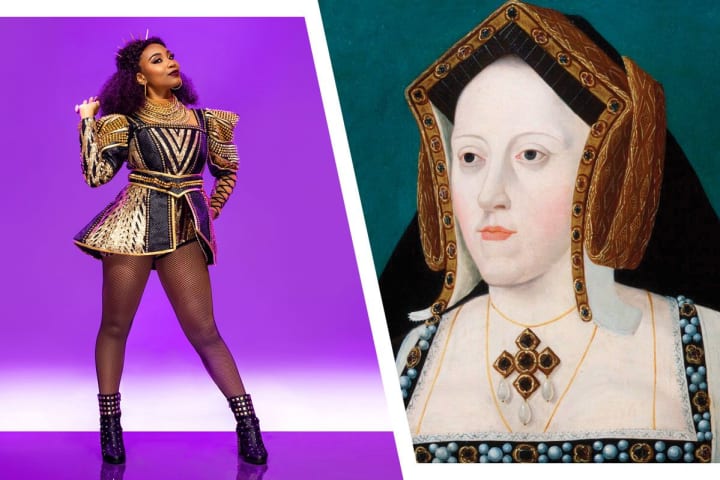
Her entire song is true; they were married for twenty-four years. Catherine was originally planning to wed Henry’s older brother, and did so, but he died not long after their marriage. She was sent home, and soon after, Henry came back and found her, and they were then wed. During that time, it was heavily documented through letters that they had a happy marriage. Henry wrote to Anne’s father, telling him that if he could choose all over again, he would still choose his daughter. In all honesty, he may have loved her more than his other wives, who he later loved in different ways. In an article by history enthusiast Jillianne Hamilton, she talks about how Henry loved all his wives in his own way. He loved his first wife, Catherine, because she made him feel like a hero, as he saved her from her depression - but his love died when she could not give him a son. That seemed to be the biggest problem in their marriage. There was no issue with Catherine getting pregnant, and she frequently was, but the problem arose when she kept having miscarriages. Even when she finally was able to carry a baby to full term, it was a girl, who we all know today as Mary. Henry was disappointed, and referred back to an Old Testament verse that got to his head, where it said he couldn't have a son due to marrying his dead brother's wife & widow. The song Catherine sings in the show mentions this, and how it is a crazy notion. She also asks for a reason she should go, and asks what she had done to be treated like that, but she does not get one. She even sings about how she has not said anything during all his affairs, and that part is true - she was able to turn a blind eye to it. So, thinking this was the cause, he grew to resent her and started to look for someone else. This is where he started to take an interest in Anne Boleyn. It took many years, but he was able to divorce her, and sent Catherine to a nunnery. That’s where she remained for the rest of her life, and up until her death, she didn't accept Henry as the supreme head of the church in England. Tragically, she died of cancer, without ever seeing her daughter.
For more information: https://www.biography.com/royalty/catherine-of-aragon
Anne Boleyn: Beheaded
Married: 3 years (1533-1536)
Her Song: "Don’t lose your head"
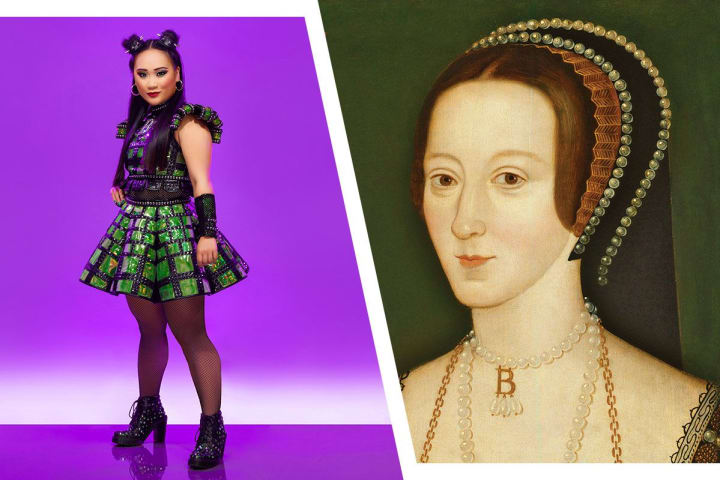
Anne is probably the most well known out of all of Henry’s wives. She was originally a lady-in-waiting for his first wife, Catherine of Aragon. She was then introduced to Henry through her sister, Mary, who was one of his mistresses at the time. From then on, Henry stopped a man from marrying Anne, and instead started pursuing her himself. In one of the king's letters, he wrote: "If you give yourself up, heart, body and soul to me, I will take you for my only mistress, rejecting from thought and affection all others save yourself, to serve only you." Boleyn rejected this offer, which took Henry by surprise. She made it clear she did not want to be a mistress, but a wife, and promised him that she could produce the son he so desperately wanted. This pushed him to find a way to get rid of Catherine. In the musical, Anne’s song talks about “green sleeves, her green sleeves.” This comes from the theory that King Henry wrote a song called Greensleeves for her. In all actuality, it wasn’t even for her, although it is true that Henry was very fond of music. When he wasn’t divorcing or having his wives put to death, Henry was known for composing and playing different instruments. Due to his many talents and his love for music, it’s not hard to believe the song would be written by him, but historians have actually dated the song Greensleeves to the Victorian Era, which took place long after King Henry was dead. It took six to seven years, but Henry was eventually able to divorce Catherine, and the new couple had a private ceremony where they were wed. Not long after she was crowned queen, Anne gave birth to a baby girl, whom we all know as Elizabeth I. The princess was celebrated, but after the miscarriage of their next child, who was a boy, the old issues began to drive a wedge between the couple. During her time as Queen, Anne Boleyn focused on helping the poor, and was known for her lavish style, which copied the French. However, she would never be liked by England for what had happened to Catherine. During this time, she became jealous of Henry's affairs, which put even more resentment and hostility in their marriage. After her next child, a male, was stillborn, Henry took matters into his hands to frame Anne for things she had not done. She was arrested and held in the tower of London. At her trial, she was found guilty of incest, witchcraft, adultery, and conspiracy against the king. Right after this trial, she was beheaded in a public execution.
For more information:
https://www.google.com/amp/s/amp.classicfm.com/discover-music/greensleeves-did-henry-viii-write-song/
Jane Seymour: Died
Married: 1 year (1536-1537)
Her Song: "Heart of Stone"
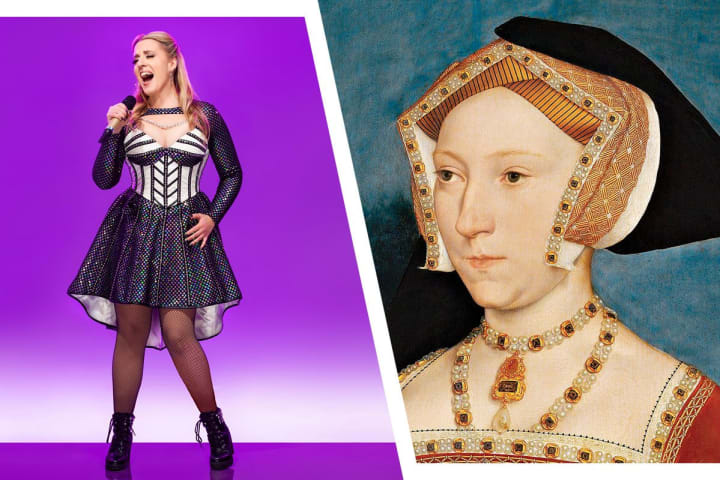
“The only one he truly loved . . .”
Rude. This can be argued. There is not much known about her. Most historians believe Henry only really loved Jane, since when she died she was the only wife buried next to him. It could, however, be argued that he only loved her because she gave him what he truly desired - although she paid with her life. The song she sings in the musical is “heart of stone,” where she talks about her love for the king and how she hopes her son becomes everything he is meant to be. It’s clear in the song that she is in love with Henry, and all through their marriage, she stands by him through everything. Not much is known of her one year of being Queen; only that she was a lady-in-waiting to both the first and second queens of England. It is widely speculated that she was not even crowned due to Henry wanting her to produce a son first, but this is just speculation.
For more information:
https://lazyhistorian.com/did-henry-viii-love-any-of-his-wives/
Anne of Cleves: Divorced
Married: 6 months (1540)
Her Song: "House of Heinrich, and Get Down"

Sadly, in her case it was misfortune that cost her the crown, but nonetheless she thrived later on in life due to her smart decisions. After time had passed from Jane, Henry needed a new wife, and his advisers suggested and pushed for an alliance to strengthen the empire. He wanted to align himself with Western Germany, since they had the same idealism of religion at the time, and had them send him two portraits of The Cleve sisters. From these pictures, Henry thought Anne was the prettier. She was sent for, and once she arrived in court, she was not enthused by Henry’s antics. (This was partly because she couldn’t speak English.) When Henry met Anne he was less than impressed, and felt jilted. He found Anne to be very ugly, and hated how he couldn’t communicate with her. But because he didn’t want to break an alliance with Germany, he went through with the marriage. Not long after they were married, Henry approached Anne and gave her the option to annul the marriage. It wasn’t a hard decision, as the other part was death. She agreed, and because of that Henry respected her, and gave her a generous salary with many properties, including the estate owned by the late Anne Boleyn’s family. Anne never went back home, and remained in England, never remarrying. Over time, Henry and Anne became good friends, so much so that she was seen as an honorary member of the King's family and was referred to as "the King's Beloved Sister". He often invited her to court and, out of gratitude for her not contesting the annulment, Henry decreed that she would be given precedence over all women in England, except his own wife and daughters. After the death of Catherine Howard, everyone wanted him to marry her again, but he refused. Anne disliked his next wife, Catherine Parr, but she did get along with Henry’s eldest daughter Mary, and even took part in her coronation. After Henry’s death, she only fell out of favour after being accused of being a part of a rebellion she had no part of. In recognition, she wasn’t put in jail, but also wasn’t allowed back at court. As a result, she just spent the rest of her life living quietly, travelling between the many properties she owned. Did Henry love her? Honestly, he just fell in love with her through a picture, and once he saw her in person, he was disappointed and began to search for a new wife (as well as a way out of the marriage, without starting a war.) She died years later of cancer, but was the one to outlive all of Henry’s wives, including Catherine Parr. Until this day, she is known as the kindest and most generous of his Queens.
For more information: https://www.britannica.com/biography/Anne-of-Cleves-queen-of-England
Catherine Howard: Beheaded
Married: 2 years (1540-1542)
Her Song: "All you wanna do"
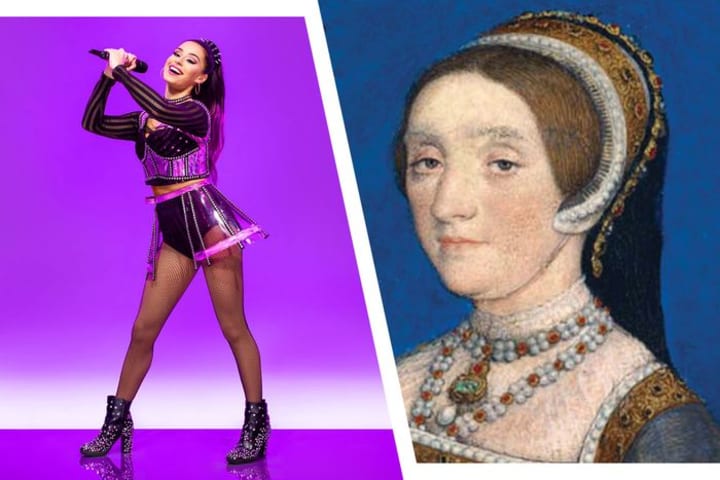
Catherine Howard did not have an easy upbringing. That was an understatement, seeing as she was one of ten children. Because of that, her family was poor, but still had a good upstanding name. Catherine was sent to live with her grandmother, the dowager duchess of Norfolk, and thus her family avoided responsibility for her upbringing. Although Catherine’s grandmother complained ceaselessly about the expense of supporting numerous grandchildren, she did provide a comfortable home. Catherine was raised in a type of dormitory at Lambeth Palace, crowded in with other young girls. The duchess’s household was not wealthy, though, and Catherine understandably chafed at her constricted lifestyle. She was known to be flirtatious and an emotional girl who rarely understood the consequences of her actions. Later in life, she made the mistake of continuing her girlish indiscretions as Queen. In the musical, Catherine sings a song called “All you Wanna Do,” where the lyrics couldn’t be more true - but with some twists. This song depicts her as a girl who goes around sleeping with various men willingly. And for some, they think she does, but at the same time, it’s obvious she has really been tricked into it. They each fiddled around with her innocence, and made her believe she was older and more mature than she really was. Hence the phrase, “I was 13 going on 30.” In the song, there are certain words and phrases that show Catherine’s true age during all this. She says things like: “enoughsies,” “play time’s over,” and “tell me I’m the fairest of the fair,” just to name a few, showing she is still young and innocent. The first man she mentions was Henry Mannox, who preyed upon her inexperience and innocence. Being her teacher, he used his position to his advantage to make her thing that everything was okay, when in all reality she had no clue what it meant or what was going on. The next man, Francis Dereham, did the same thing, only she was a little older and had a better understanding of relationships. From the accounts, it would seem he was tricking her into submission by praising her for the work she was doing, and asking her to come back. After a while she thought he would be different, and would love her and take care of her, but he didn’t. Finally, the last man that came into her life was King Henry himself. He fell in love with her due to not only her beauty, charm, and personality, but how she made him feel young. Henry was besotted with her, calling her his ‘Rose without a Thorn’ and showering her with gifts and public affection. The two spent a good 14 months together, and he was all but enamored with her, doting upon her and her family. It was also at this time, since Henry already had his heir, that he needed a spare. So with his new wives after Jane, he was trying again. Everything was all well and good, but the court was too much for Catherine and she began looking for a friend. Thomas Culpepper was around at the same time, and was also her cousin, so she appointed him as her secretary - and also slept with him. This can be debated; most say she was simply doing this because she was unhappy, but others think she was either forced or raped. Either way, it was said that after her marriage to the king, she and Culpepper had meetings in her room, although most believe these were only political. Either way, the king heard about it from his council, and at first could not believe it, refusing to consider the idea. Eventually he did believe it, though, and ordered for her and Thomas to be executed. When Catherine was taken into a holding cell, she spent the whole night practicing how to lay her head on the block so that it could be a clean cut. Nevertheless, an inexperienced axeman was chosen to execute her, and he lodged the axe in her back twice before getting her head. She was only 19, and was killed because she was “damaged goods”, resulting from both Henry Mannox and Francis Dereham grooming her in the beginning. Her story was truly the saddest of them all.
For more information: https://www.britannica.com/biography/Catherine-Howard and https://englishhistory.net/tudor/monarchs/catherine-howard/
Catherine Parr: Survived
Married: 4 years (1543-1547)
Her song: "I don't need you love"

The one who survived! Catherine was a daughter of Sir Thomas Parr of Kendall, an official of the royal household. She had been widowed twice, in marriages to Edward Borough and John Neville. Around this time (due to his age,) Henry gave up hope of having a “spare” in case something should happen to his son. As for Catherine, she played her cards right through her marriage to the king, although as the song says, she did not love Henry nor did she intend to love him. But if she wanted to live, she had to marry him, and so she did. Her song is a goodbye letter, but also tells about all of her own accomplishments. Catherine’s parents, Sir Thomas and Lady Parr were well-established loyal servants of the King and Queen - Thomas was an ambassador and trusted emissary of Henry VIII, and Lady Parr was one of Queen Katharine of Aragon's most favoured ladies in waiting. They later had two more children, leaving three total. It wouldn't be long until Catherine’s father died, and her mother was left to manage both estates and their offspring. As a result, Catherine certainly learned the standard curriculum of a well-born girl - reading, writing, French, needlework and other housewife’s skills. She may have learnt Latin at this period, and definitely studied it in more detail, together with Spanish and Italian, later in life. When it came time for her daughter to marry, Lady Parr took the matter seriously as she looked to marry her off to the most advantageous match. After a few flops, Katherine was married in 1529 to Edward Burgh, son of Sir Thomas Burgh of Gainsborough Hall, in Lincolnshire. Many people believed she was sent off to marry an old man but instead it was his son, who was just as mad as his father. Her husband was a big supporter of divorcing the queen from the king. He also became of little influence for his wife and her religious beliefs, due to his untimely death leaving her a widow before she even turned twenty-one. Once he died, Catherine was given very little to live on. Since she was only twenty, with no children, and her mother dead and siblings with their own lives, she went on to live with her cousin, who was another widow at Sizergh Castle in Kendal. She eventually married another man, who was older than her and already married twice before, with two children. They were married for many years but produced no children. Catherine then settled down with her new family, mainly at Lord Latimer's seat of Snape Castle in Yorkshire. The couple seem to have been fond of each other, and Latimer trusted her enough to leave her well provided for in his will, and guardian of his daughter. Latimer is generally described by Katherine’s biographers as a man of conservative religious outlook, unlikely to have encouraged any interest in reformist thought and sympathetic to the cause of the Pilgrimage of Grace. Catherine, however, hated that she would reside in the country. Her quiet life would become loud again, when not long after her marriage, the whole of the north of England was engulfed in the most wide-ranging and serious rebellion of the whole Tudor period. The Yorkshire contingent of the Pilgrimage laid siege to Snape Castle and forced Latimer to join its ranks. He took the Pilgrims’ oath, later protesting to Henry that it had been under duress and that his purpose was to try to bring the rebels to a more obedient frame of mind. Latimer then returned home, but then left Catherine and his children again in the following January to plead for forgiveness in person at Court. This was seen by the rebels as a betrayal, and they again laid siege to Snape Castle with Catherine and her step-children inside, to try to coerce Latimer to remain true to their cause. Many years later while traveling to court, whether it was due to stress or disease is unknown, Latimer too died, and Catherine was widowed again. She soon became a lady in waiting, a position which helped her look for and start courting other suitors. During this time, she was very much taken with the charms of the dashing Sir Thomas Seymour, brother of the late Queen Jane Seymour, who was described as handsome with a magnificent voice. However, Catherine was unable to accept Seymour’s proposals, as the eye of the King had fallen upon her. Before long, Henry was sending gifts and visiting her daily. By summer 1543 her fate was sealed, and she married him as his sixth wife. During the first year or two, it was clear that Henry doted on her, lavishing her with gifts of clothes and jewels as well as settling an impressive jointure on her. She was even soon pointed as regent as the king was going to be away for a while. Catherine lived up to his expectations, and showed herself a competent and sensible manager. It was also during this time that she became more religious. Due to her rise in the court, the king started to suspect she was trying to overthrow him and so because of this Catherine was warned to watch herself, and she slowly lessened her influence. This brought along a change in their relationship. From this time on, Catherine’s political influence seems to have diminished. Henry continued to cosset her, but she was careful to play the part of the obedient wife. Not too long after that, she was widowed again in 1547, with Henry’s death. She pursued a relationship with Sir Thomas Seymour, and even brought him a daughter into this world. Their match was a love match, and was happy for the most part. However Seymour did have his own problem of flirting and coming onto her step daughter, and they often fought about it. There are no reports of any illness with the two, and when Catherine went into labour in late August of 1548 there was no reason to expect anything but a happy outcome. Unfortunately, however, after the birth of a girl, named Mary, she contracted puerperal fever, and died on 5th September 1548. Thomas was not there at her funeral.
For more information: https://www.britannica.com/biography/Catherine-Parr https://tudortimes.co.uk/people/katherine-parr-life-story https://www.tudortimes.co.uk/people/katherine-parr-life-story/second-widowhood
Thank you for reading!

About the Creator
Keep reading
More stories from A.C. Richards and writers in Geeks and other communities.
Silver Screen Magic with Mae West
American actress and singer Mae West became a popular film actress during the Great Depression. She started entertaining in vaudeville, then performed on Broadway, and finally went to Hollywood. She signed up with Paramount Pictures and made her debut in the 1932 film “Night After Night.” She also starred in musicals, comedies, and crime dramas. The American Film Institute named her one of the best classic Hollywood actresses.
By Rasma Raisters8 days ago in Geeks
How to Watch Premier League?
The crown jewel of English football, Premier League soccer is back. The most- watched sports league in the world features 20 of UK’s best football clubs. Here are some of the ways you can watch and stream the 2025-26 season of Premier League. Don’t miss a match day.
By David Cook5 days ago in Geeks
How, Too
Many people wonder how, too. You are not alone, and I am an expert. I will teach you how, too! First, you need to remit a small application fee and fill out an application describing the nature of your financial situation and how often payments will be made, as this will have great bearing on how well I teach you how, too.
By Harper Lewis5 days ago in Fiction



Comments
There are no comments for this story
Be the first to respond and start the conversation.