
Movie Review: 'The Color Purple' is a Rousing Heart Filled Musical
Fantasia Barrino leads an incredible cast in the extraordinary musical adaptation, The Color Purple

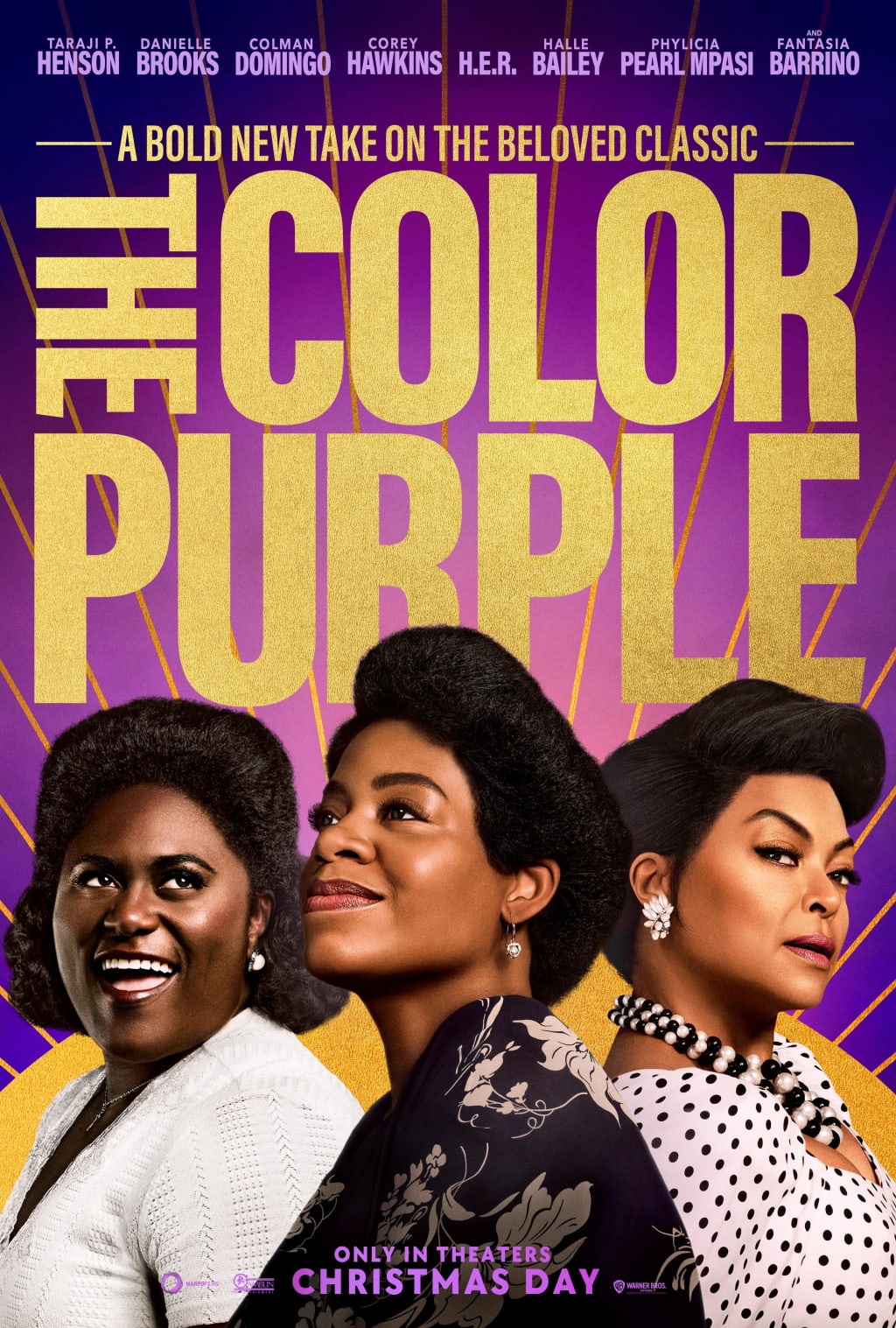
The Color Purple (2023)
Directed by Blitz Bazawule
Written by Marcus Gardley
Starring Fantasia Barrino, Taraji P. Henson, Colman Domingo, Danielle Brooks
Release Date December 25th, 2023
Published December 20th, 2023
The Good Lord Works in Mysterious Ways. That's what the opening song in the new musical adaptation of The Color Purple tells us. Oftentimes, people use this phrase to excuse or explain the seeming whims of the almighty God. When something unpredictable happens, god works in mysterious ways. The opening of the movie is setting us up for the notion of the unpredictable nature of fate. The fate that separates two loving sisters. And, perhaps, the same fate that will eventually reunite them. God works in mysterious ways and we can't know until we reach a conclusion, what God's intent was, what lesson God was imparting, and how the journey through God's various mysteries will help us learn, grow, change or merely adapt.
The mysterious ways of an unseen but always present God, linger throughout this faith filled adaptation of Alice Walker's novel and the Broadway musical that novel became in the early 2000s. God first must heap indignities upon our protagonist, Celie, as she begins a journey toward grace and transcendent joy. Among the horrors of her life is an abusive relationship her evil father which produces two pregnancies, and two children taken from their young mother by her cruel abuser.
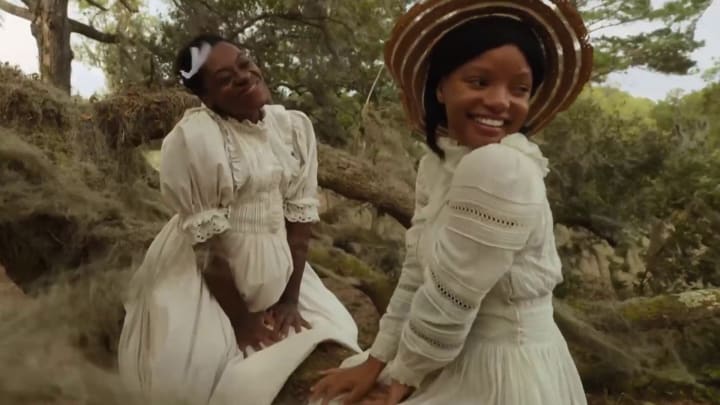
Oh I know, she be mine is the next song and here is where The Color Purple really starts to gain momentum. After having given birth, featuring a distracting cameo by Whoopi Goldberg, star of the Spielberg adaptation of The Color Purple, Celie sees a baby in her father's store. The baby has the same name as one of the babies that her father has forced her to immediately give up after their birth. This leads Celie to visualize a sequence in which she walks through a series of convicts breaking rocks before she walks into a gorgeous scene set in a small creek bed, clear, clean water, a small shimmering waterfall, and a series of women who are cleaning clothes in washtubs. Here she dreams and hopes that someday she will be reunited with the children she now believes are still alive, despite her father's cruelty.
The sequence is gorgeous, especially the dance sequence in front of the waterfall, spectacular visuals that are beautifully captured. Young Phylicia Pearl Mpasi, playing the young Celie that will eventually give way to Fantasia Barrino's adult Celie, sings beautifully. Her voice is superb. It's a standout sequence, a lovely fantasy and a moment of joyous escape for a character who will spend so many of the next years of her life imprisoned, first by her abusive father, and then by the husband she never asked for or wanted.
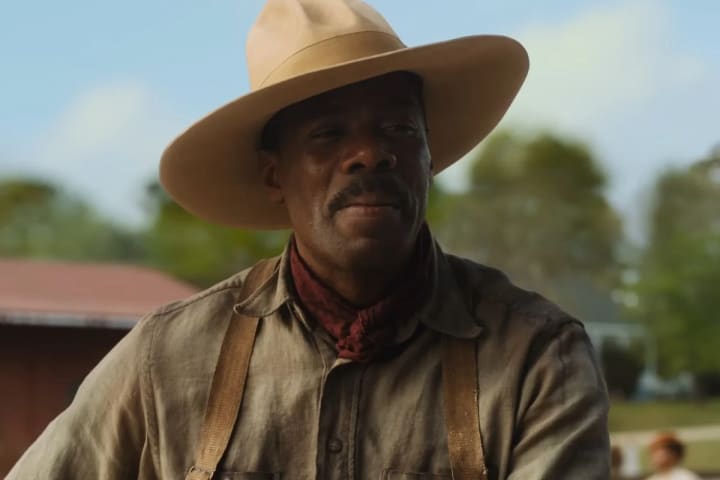
The husband is named Mister (Colman Domingo), a middle aged farmer, gambler, and degenerate. He's raising several kids from several different mothers and suffering from the woman who got away, the elusive Shug, played by Taraji P. Henson. Mister first asks to marry Celie's sister, Nettie (Halle Bailey), but their father tells Mister that Nettie is too valuable before negotiating a deal for Mister to marry Celie in exchange livestock and other considerations. The scene is emblematic of how black women, even in the post-slavery south, were still treated as a commodity rather than as a human being.
That said, as the negotiations between these horrible men takes place, director Blitiz Bazaluwe makes an important choice. His camera floats away from the men being awful to focus on Celie and Nettie, the inhumane giving way to the the more important human heart of the movie, two sisters who love and care for each other and who will carry each other's hearts through the years and incidents of this story. Celie is sold to Mister that day and is forced to leave immediately. She's placed into servitude, caring for Mister's children, keeping his filthy house, and being being abused.
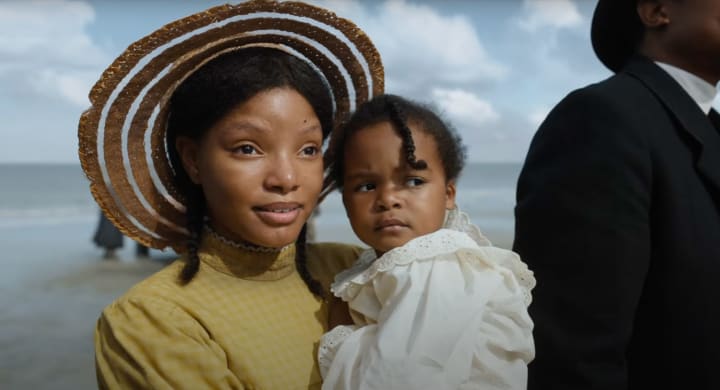
A moment of light peaks through when Nettie escapes from their father and comes to stay with Celie on Mister's farm. But the air of foreboding is obvious to us, if not to Celie and Nettie. After a couple of lovely days with the sisters together, Mister attempts to assault Nettie and throws her out when she refuses to submit to him. He declares that the sisters will never see each other again and sets about keeping them apart by keeping Nettie's letters to Celie from her. For a time, she won't even know if her little sister is alive or not.
The Color Purple uses several time jumps to move the story along from 1907 all the way through the late 1940s. The first big jump brings Fantasia Barrino to the forefront as Celie. Having spent over a decade being abused and belittled by Mister, Celie appears resigned to life as a Mister's property. This changes thanks to a pair of strong women who come storming into town. The first of these women is Sofia, played by Danielle Brooks of Orange is the New Black fame. Sofia comes barreling into the story as the would be wife of Mister's now grown son, Harpo (Corey Hawkins). The name Harpo is obviously a reference to the famed Marx Brothers character, years before he became famous.
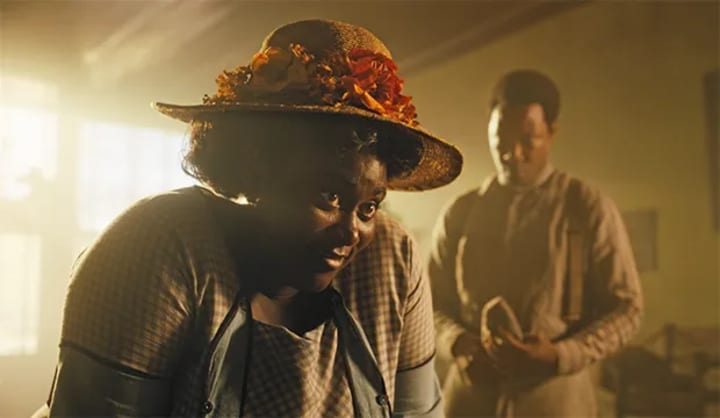
Sofia is pregnant with Harpo's child and the two want to be married, much to Mister's objection. The last thing a weak man like Mister wants in his life, or the life of his son, is a strong woman. Sofia and Harpo don't last long but Sofia remains a big part of this story, even as Harpo transitions the home he built for them into a swamp based juke joint. This change leads to the return of the much mythologized Shug who comes sashaying back into town to perform at Harpo's joint. Her first stop upon her uproarious return, met by another incredible song, is Mister's house where she's immediately given a place to stay and even Mister is kowtowing to her demands.
Shug however, could not care less about what Mister wants or does. She takes immediately to Celie and the two begin a tentative friendship that may be more than that. The film leans into a potential attraction between Celie and Shug but the mercurial Shug, as played by Henson, appears more interested in being desired by everyone she meets than being wanted by just one person. This is a character detail that isn't specifically mentioned, it's merely implied by Taraji P. Henson's incredible performance. Henson and Barrino spark remarkable chemistry, even as most of it is centered on Barrino worshipfully basking in Henson's star glow.
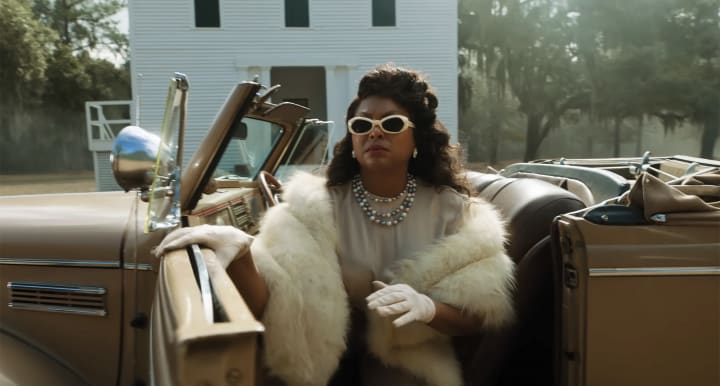
Don't get it twisted though, Barrino is not going to be fully overshadowed in The Color Purple. The journey of Celie is one of self discovery and coming into her own and building toward moments of grace. It's a journey that relies heavily on Barrino building the momentum of Celie's rebirth and the reclaiming of her power, the claiming of her place in the world. The film smartly allows this to build over the course of the movie while the powerhouse supporting cast often takes center stage to give Celie time to develop and emerge. When she does emerge, and Barrino is given the stage to unleash her spectacular, powerful voice, it's a moment of overwhelming catharsis and joy.
If I have a quibble with The Color Purple it is with the presentation of the musical sequences. It's a musical so you have to accept that people are occasionally going break into song. Some of these songs will further the plot, some of these songs will just introduce or further a character arc. The only minor issue is in presentation. The filmmakers present some of these musical sequences as daydreams or fantasies while others appear to bleed into reality, existing outside of the imagination of Celie as the main character. It's not a big deal to me, but I can definitely hear some complaints from those less inclined to the mechanics of a movie musical. I would have perhaps preferred the movie either lean into the idea that the music is just part of life in this universe or have the songs to be entirely from one character's imagination, but, again, it doesn't harm the movie too much for me.
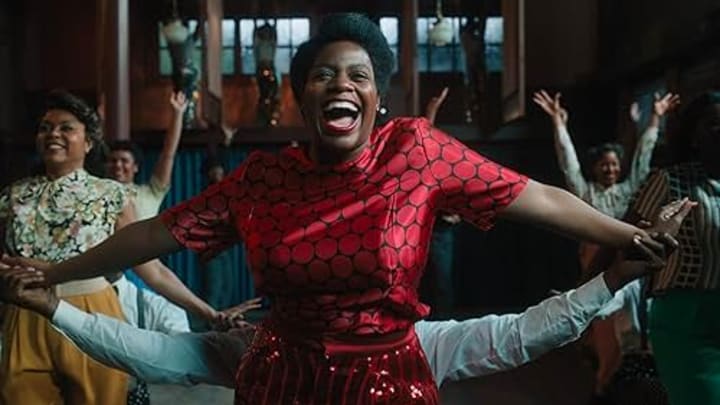
The Color Purple is such a powerhouse of a musical that I can't complain about it much. It's a deeply emotional film filled with pathos and empathy. It's a story of redemption, reclamation, and rebirth. It's also a story about family, both of the found kind and the one you're born into. It's a swirling magical musical that gains power and momentum as it goes on and moves from strength to strength, from one remarkable musical segment to the next. All the while, director Blitz Bazaluwe relies on his extraordinary cast to build these characters, give them depth and breadth, and his story is in great hands.
The Color Purple surrounds the relatively inexperienced leading lady, Barrino, with supporting players who can carry her as needed, not that she needs much help. Henson is the stand out for me, but Colman Domingo is right there with her. Domingo is among the best actors working today and that he can go from a role like the one he played in Rustin, a deeply sensitive and prickly gay civil rights icon, to being a menacing abuser seeking to atone for his sins, shows his remarkable range and capabilities. Corey Hawkins is the most underrated of the supporting players. Harpo is weak and often bullied but Hawkins invests him with character and fortitude. While the movie is about Celie finding herself, Harpo is also a character coming into his own, even as most of his growth is in the background.
The Color Purple builds to an emotional crescendo that few other films of 2023 can match. The final moments of The Color Purple are filled with tears and catharsis. We aren't surprised, there isn't much for suspense, but the staging of this ending is nevertheless extraordinary. Everything from the costumes, the music, and the remarkable outdoor set, is spot on. It's a glorious ending to a remarkable journey centered on a character who represents so much history in both a personal and historic fashion. The journey of Celie is representative of the journey of so many black women from the south in the early 20th century whose stories didn't turn into major motion pictures. The happy ending is merely symbolic but it represents hope, it represents the striving of so many whose sacrifices created the opportunity for a movie like The Color Purple to exist.

Find my archive of more than 20 years and nearly 2000 movie reviews at SeanattheMovies.blogspot.com. Find my modern review archive on my Vocal Profile, linked here. Follow me on Twitter at PodcastSean. Follow the archive blog on Twitter at SeanattheMovies. Listen to me talk about movies on the I Hate Critics Movie Review Podcast. If you have enjoyed what you have read, consider subscribing to my writing on Vocal. If you'd like to support my writing, you can do so by making a monthly pledge or by leaving a one-time tip. Thanks!
About the Creator
Sean Patrick
Hello, my name is Sean Patrick He/Him, and I am a film critic and podcast host for the I Hate Critics Movie Review Podcast I am a voting member of the Critics Choice Association, the group behind the annual Critics Choice Awards.
Keep reading
More stories from Sean Patrick and writers in Geeks and other communities.
Silver Screen Magic with Mae West
American actress and singer Mae West became a popular film actress during the Great Depression. She started entertaining in vaudeville, then performed on Broadway, and finally went to Hollywood. She signed up with Paramount Pictures and made her debut in the 1932 film “Night After Night.” She also starred in musicals, comedies, and crime dramas. The American Film Institute named her one of the best classic Hollywood actresses.
By Rasma Raisters6 days ago in Geeks
The Life of Chuck
Life of Chuck really assembled an interesting and wonderful team of creatives, to the point where I really don’t care what the movie is actually about. Mike Flanagan, Tom Hiddleston, Stephen King, Matthew Lillard, Karen Gillis, seriously this list is incredible. We even have Offerman doing a voiceover. So just based off of the list of people involved I knew I wanted to see this movie.
By Alexandrea Callaghan5 days ago in Geeks




Comments
There are no comments for this story
Be the first to respond and start the conversation.