
Movie Review: 'Materna'
I wish I could recommend Materna but it's far too frustrating.

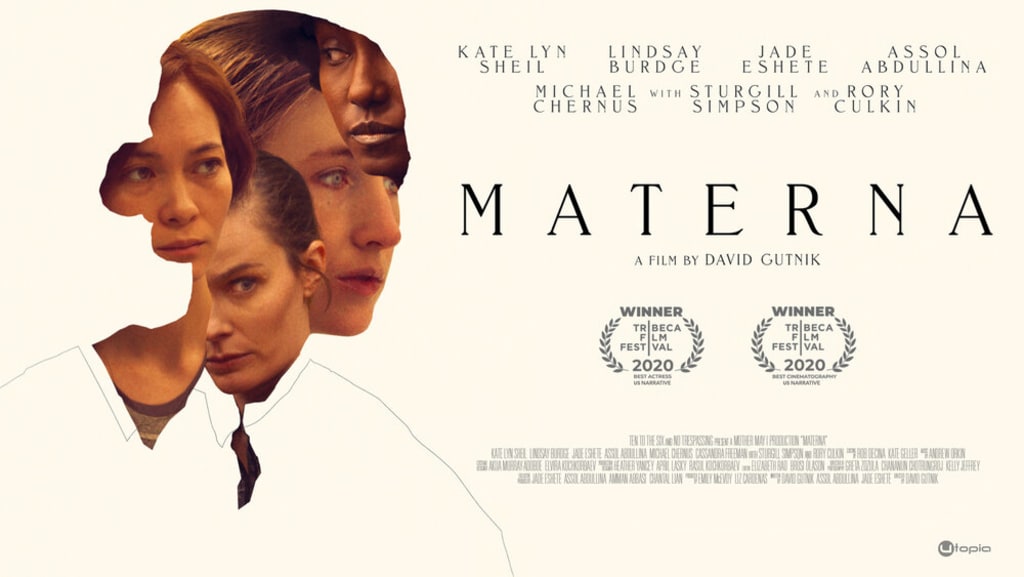
Materna has the look and feel of a very good movie. The images at play and elements of the stories being told are really strong and in my very soul I wish I could recommend Materna but sadly I can’t. The bad in this case outweighs the good in Materna far too often from the strange choice of including a sci-fi tinged story in a movie that contains no other element of the supernatural, to letting segments linger for too long, minor issues keep creeping up until you realize that the whole of Materna never congeals into a singular, united story.
Materna is broken into four individual stories about four women who end up in the same traumatic encounter aboard a subway train. An unnamed man, played by Sturgill Simpson, is slowly growing belligerent, becoming louder with each ensuing outburst. He’s directing his rage at one woman and then another and you can sense the pressure about to boil over, these sequences are tense and should be building to something important,

We are introduced to this very early in the film but the payoff is not until the end, after we’ve been introduced to four women who are riding on this subway car. Up first is Jean (Kate Lyn Sheil), a lonely woman who works from home in the field of virtual reality. We are fully introduced to Jean as she is wearing a full length motion capture suit and testing out the haptic technology, tech that allows you to recreate the sense of touch in a virtual environment.
As Jean investigates a glitch in her system we slowly realize that she is working on a full recreation of sex in a virtual environment with the haptic system recreating what appears to be a very realistic take on sex. We watch Jean enact a full on orgasm in this virtual environment until something frightening occurs and causes her to abandon her experiment. In her notes, we learn very little other than there is a glitch and it caused her to freeze and panic amid her virtual reality sexual encounter.

From there, I can’t be sure exactly what we are supposed to infer. Jean begins to experience what appears to be a pregnancy. Visual cues, such as morning sickness, strongly indicate that she’s been impregnated, but how she became pregnant is the question. As a conversation with her mother indicates, Jean doesn’t leave her apartment very often. She works from home and her daily routine, which marks the passage of time leading up to her being on the subway train at the center of the story, strongly indicates that she doesn’t go anywhere.
Are we to believe that the virtual reality encounter impregnated her? I would say no because nothing else in the movie indicates anything remotely supernatural. My guess, and that’s all I can do is guess, is that Jean was a victim of a sexual assault and that her VR experiment is some kind immersion therapy. The pregnancy is a result of what I am assuming is a sexual assault and this inference on my part is underlined by what happens at the end of Materna, which I will not spoil here.

Three other stories figure into Materna including the story of Mona (Jade Eshete), an actress struggling with an audition for a role that is forcing her to confront deep seated issues related to her mother. Another story is that of Ruth (Lindsey Burdge), a conservative mother troubled by her son’s recent encounter with an LGBTQ girl in his class and how her liberal brother, Gabe (Rory Culkin), is able to link the son’s troubles to her strident political stances.
The final story is both the most disconnected from the subway story and the most emotionally rich story of the four. Assol Abdullina plays Perizad, a woman who has just returned home to Kyrgyzstan following the death of her beloved Uncle, Rastam. Perizad has a hostile relationship with her mother and a slightly more connected relationship with her grandmother but she soon realizes that both are keeping something from her regarding her Uncle’s death.

This secret, which is slowly drawn out over the 25 minutes or so of this story, serves to underline how hiding trauma behind lies never works and, in fact, only serves to increase the trauma. These three women are fascinating and their fraught dynamic is filled with emotional detail and moments of catharsis in the form of both anger and tenderness. This story belongs in its own movie, it doesn’t need these other stories and it’s also the most disconnected from the other stories, especially the subway story.
Materna is frustrating because each of these stories have the potential to be great. The idea of exploring women’s relationships with their mothers and the idea of motherhood, is a solid subject for drama. Unfortunately the uniting element of this story is the weakest part. There are many thematic coincidences but these women never interact with each other, they are all defined by being at the mercy of the same man in the same moment, but this moment doesn’t unite them beyond this moment.

The structure of Materna is too loose and lacking in coherence. Each of these stories cries out to be its own movie. I can imagine a good movie coming from each of these stories and they would be richer and more engaging if we were able to spend more time with them. It’s frustrating to leave Jean’s story just as she is leaving her apartment for the first time. It’s frustrating to not spend more time with Perizad and her mother and grandmother. And it’s frustrating that the limited time renders Ruth as a political straw man, embodying facile conservative arguments in the most strident fashion until her pseudo moment of redemption.
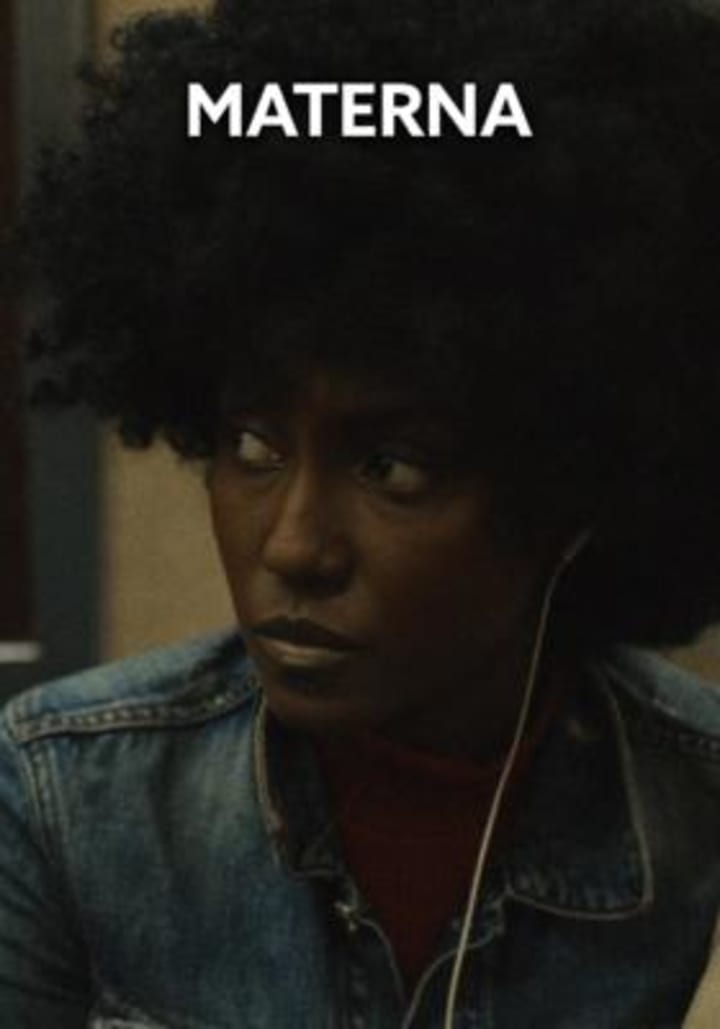
I especially wished we could have gotten more for Jade Eshete’s Mona. This is the kind of role that black actresses rarely get to play. She has no romance, she has no children, she is a young black woman who is struggling with her confidence and rallying in the face of the absence of her mother who, though she is not dead and is very much accessible to Mona, will only engage with her daughter if she returns to her faith, that of a Jehovah's Witness. There is so much that could be explored here and we end up only getting a small, unsatisfying piece of it.
Director David Gutnik is quite talented, Materna is a good looking movie. Sadly, the choice to truncate these stories and failure to unite them beyond the vague thematic unity of motherhood, renders what should be a great movie as something too maddening to be enriching. It should be a good thing that I wanted more of these stories but it quickly becomes frustrating when the richness of these characters and these performances are cut off in the middle of really saying something. It’s a frustration that causes Materna to be a movie experience that I admire in so many ways but that I cannot recommend.
Materna arrives for on-demand streaming rental on August 10th, 2021.
About the Creator
Sean Patrick
Hello, my name is Sean Patrick He/Him, and I am a film critic and podcast host for the I Hate Critics Movie Review Podcast I am a voting member of the Critics Choice Association, the group behind the annual Critics Choice Awards.
Keep reading
More stories from Sean Patrick and writers in Geeks and other communities.
Classic Horror Movie Review: 'House' 1977
House or Hausu has its origins in a strange place. According to legend, the film was dreamed up after executives at Toho, the company famed for creating Godzilla, had seen Jaws become a worldwide phenomenon and they wanted their own horror phenomenon. The executives tapped well known commercial director Nobuhiko Obayashi to develop the concept and after failing to find anyone inside the company to direct House, and after Obayashi used his commercial instincts to create a small cult around the movie before it had been made, Toho allowed Obayashi to bring his bizarre vision to life.
By Sean PatrickExclusive • 5 years ago
Silver Screen Magic with Mae West
American actress and singer Mae West became a popular film actress during the Great Depression. She started entertaining in vaudeville, then performed on Broadway, and finally went to Hollywood. She signed up with Paramount Pictures and made her debut in the 1932 film “Night After Night.” She also starred in musicals, comedies, and crime dramas. The American Film Institute named her one of the best classic Hollywood actresses.
By Rasma Raisters8 days ago in Geeks
After being accused of assaulting a ride-sharing driver, Kiefer Sutherland was arrested in Hollywood.
Following allegations that he "physically assaulted a ride-share driver and made criminal threats," Los Angeles police arrested veteran actor Kiefer Sutherland early Monday in Hollywood. The 59-year-old, who played President Tom Kirkman on "Designated Survivor" and Jack Bauer on "24," was taken into custody shortly after midnight following a call about an altercation with a driver.
By Raviha Imran7 days ago in Geeks
The Devil's Cut
“Comrade, finally you’re awake.” The voice was smooth, sensual. A flickering incandescent bar was all that lit the white, sterile room. All Vladimir remembered was everything going black. He tried to move his arms and found them strapped to the gurney.
By Matthew J. Fromm7 days ago in Fiction


Comments
There are no comments for this story
Be the first to respond and start the conversation.