
Movie Review: 'Bonjour Tristesse' Remake a Faded Copy of the Original
Bonjour Tristesse is lovely to look at, but fails to capture the sneaky genius of the original.

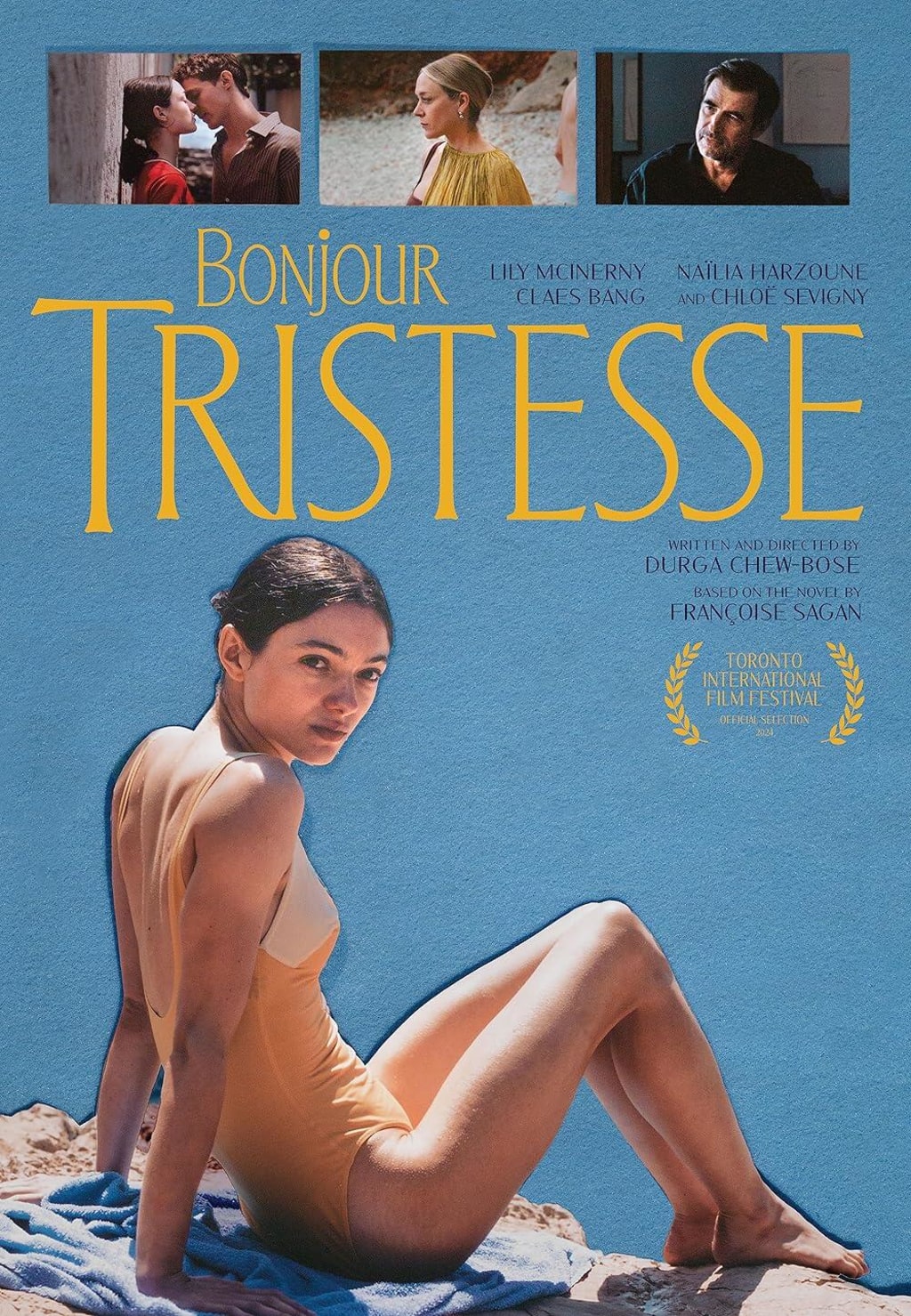
Bonjour Tristesse
Directed by: Durga Chew Bose
Written by: Durga Chew Bose, Françoise Sagan
Starring: Lily McInerny, Chloë Sevigny, Claes Bang
Release Date: May 2, 2025
Published: April 27, 2025
Review: Bonjour Tristesse (2025)
Bonjour Tristesse seduces the audience from its opening moments, offering some of the most breathtaking scenery ever captured on film. The lush cinematography by Maximillian Pittner floods the screen, setting the perfect backdrop for tales of young love and a seemingly idyllic family vacation. Beneath the sun-dappled surface, however, bubble darker emotions—jealousy, betrayal, and unresolved grief that quietly threaten to tear everything apart.
The film stars Lily McInerny as Cecile, the ultimate daddy’s girl. Her father, Raymond (Claes Bang), is a charismatic playboy, constantly cycling through girlfriends, perhaps as an unconscious reaction to the loss of Cecile’s mother—a grief that remains palpable. Cecile and Raymond are inseparable, often behaving more like best friends than parent and child. They even find ways to turn solitaire into a team sport.
Father and daughter are spending their summer on the French Riviera, accompanied by Raymond’s latest conquest, Elsa (Nailia Harzoune), a beautiful but somewhat vapid woman. Elsa struggles to find a place between Raymond and Cecile’s tight bond, included in Raymond’s affections but never truly part of the inner circle.
Everything shifts with the sudden arrival of Anne (Chloë Sevigny), a longtime family friend, Cecile’s godmother, and her late mother’s best friend. Raymond, neglecting to tell Elsa, invites Anne at the last minute, setting up an inevitable conflict. Elsa initially brushes it off but soon notices the stolen glances between Raymond and Anne. With Cecile’s mischievous nudging, Elsa is quietly pushed aside.
Soon after, Raymond and Anne announce their engagement, and Cecile’s world tilts. Anne brings a new, strict dynamic—expecting Cecile to study and behave, effectively threatening Cecile’s carefree existence. Feeling cornered, Cecile sets a scheme into motion to sabotage the relationship, aided by Elsa and her sometimes-boyfriend, Cyril.
Unfortunately, after a strong and vibrant first act, Bonjour Tristesse begins to lose its momentum. Despite a simmering setup of passions and betrayal, the film cools into detachment. The Riviera’s setting begs for sweaty, sexy intensity, but the performances remain too reserved, too languid. As the second and third acts unfold, I found my interest waning—even a tragic ending couldn’t fully reignite my investment in the story.
The standout element of Bonjour Tristesse remains its stunning cinematography. Maximillian Pittner’s camera captures the French Riviera with an artist’s eye, finding visual poetry even in the film’s quieter moments. His innovative framing keeps the narrative afloat, especially during the many sequences where characters simply slice fruit or stew silently in their emotions.
I don’t harbor deep disdain for Bonjour Tristesse—I just couldn’t bring myself to care much as the story wore on. By contrast, the 1958 Otto Preminger adaptation, starring Jean Seberg, pulsed with mischievous, youthful energy. Seberg’s Cecile radiates a raw, almost dangerous vitality, fully embracing the Jungian Electra Complex undertones of her character.
Lily McInerny, by comparison, is too reserved, too opaque to make this new adaptation come alive. While McInerny effectively portrays a teenage girl teetering between childhood insecurity and adult play-acting, the performance lacks the needed spark to truly anchor the film. These nuances are clearer in theory than in McInerny’s performance—you could glean as much from a well-edited trailer. McInerny’s portrayal is technically fine, but it misses the sharp, catty wit that Seberg brought to the role, particularly through her memorable voiceover.
Without that vital emotional charge, Bonjour Tristesse becomes little more than a postcard-pretty movie—beautiful but easily forgotten. And that’s a shame because there was real promise here. Chloë Sevigny channels the elegance of Deborah Kerr without veering into mimicry, while Claes Bang—who could have rivaled David Niven’s charm—mostly drifts through the film, rarely seizing the opportunity to energize his character.
Final Thoughts:
Bonjour Tristesse (2025) is visually stunning but emotionally distant. Despite a strong setup and a cast brimming with potential, the film ultimately feels as hollow as the luxurious backdrop it inhabits.
Find my archive of more than 24 years and over 2,700 movie reviews at SeanattheMovies.blogspot.com. Explore my modern review archive on my Vocal Profile, linked [here]. Follow me on Twitter at @PodcastSean and follow the archive blog at @SeanattheMovies. Join me on BlueSky [linked here]. Listen to me discuss movies on the I Hate Critics Movie Review Podcast.
If you’ve enjoyed this review, consider subscribing to my writing on Vocal. Support my work with a monthly pledge or a one-time tip—thank you!

About the Creator
Sean Patrick
Hello, my name is Sean Patrick He/Him, and I am a film critic and podcast host for the I Hate Critics Movie Review Podcast I am a voting member of the Critics Choice Association, the group behind the annual Critics Choice Awards.
Keep reading
More stories from Sean Patrick and writers in Geeks and other communities.
Silver Screen Magic with Mae West
American actress and singer Mae West became a popular film actress during the Great Depression. She started entertaining in vaudeville, then performed on Broadway, and finally went to Hollywood. She signed up with Paramount Pictures and made her debut in the 1932 film “Night After Night.” She also starred in musicals, comedies, and crime dramas. The American Film Institute named her one of the best classic Hollywood actresses.
By Rasma Raisters6 days ago in Geeks
Top 7 Oak Island Discoveries the Show Didn’t Air
The Curse of Oak Island has captivated audiences for over a decade, blending historical intrigue with reality TV drama. But what fans see on screen is only part of the story. Behind the edited episodes and dramatic voiceovers lies a treasure trove of discoveries that never made it to air — some due to time constraints, others possibly too speculative or controversial for mainstream broadcast.
By Rukka Nova3 days ago in Geeks
Wild Card Weekend Recap: What Happens Now?
I think I figured out why I love Wild Card Weekend so much. It's because it's the first playoff anything of the calendar year. The NFL season starts in the fall, and once upon a time, the champion was crowned either on or slightly before New Year's. The evolution of the NFL schedule has resulted in the playoffs starting just into the New Year, and currently, the final week of the season falls on the first weekend of the New Year, with Wild Card Weekend coming a week after that. So yes, chronologically, the NFL's Wild Card Weekend serves as the first playoff anything of the calendar year.
By Clyde E. Dawkins7 days ago in Unbalanced



Comments (1)
Read the book; have not seen any of the film versions. A very interesting take on this one...