
Mass and the films trying to make sense of senseless violence
Since the horror of Columbine, school shootings have become a US epidemic – and it's something many films have reckoned with, including stunning new drama Mass

n 20 April 1999 18-year-old Eric Harris and 17-year-old Dylan Klebold walked into their high school in Columbine, Colorado and, with one act of violence, changed America forever. Harris and Klebold's plan, which they had been working on for over a year, was to set off homemade bombs, but when those failed to detonate they instead walked through the halls and used the four guns they'd acquired to injure 24 people and kill 13 more before taking their own lives.
The scale of the incident, plus the fact that it occurred just at the beginning of a new era of rolling news, meant the world looked on, gripped in horror. The police, unable to figure out how to handle it, took hours to enter the school and much of the massacre unfolded live on television. Reporters spoke to students on air, while they were still barricaded in their classrooms. Then, just as soon as the incident was over, the debate about what happened, and why it happened, began – one that continues to this day. Was the root cause of Harris and Klebold's actions the easy accessibility of guns in the US, the bullying they had allegedly been subject to, or the violent videogames they played – or was it that they were psychopaths, as some experts subsequently concluded about Harris, at least? Harris and Klebold left behind preparation videos and manifestos to be pored over by those searching for an explanation, or a way to prevent such an atrocity happening again. But in the years since Columbine, there has been a continuous stream of mass shootings, at schools and elsewhere; 298 schools in America have now experienced shootings since Columbine, leaving hundreds dead and many more injured.
Story continues below
At the same time, there has been a range of films that have tried to make some kind of sense of these senseless, most horrifying atrocities – most horrifying, because of the way they shatter society's belief in the fundamental innocence of young people. These have varied in approach from Gus Van Sant's Palme d'Or-winning 2003 film Elephant, which methodically depicts a Columbine-like incident, moment by moment; to Lynne Ramsay's 2011 adaptation of bestselling novel We Need To Talk About Kevin, a stylised horror which explores a mother's relationship with her disturbed child, who goes on to commit a high-school massacre; and 2010's Beautiful Boy, a more straightforward drama about the parents of a teenaged shooter.
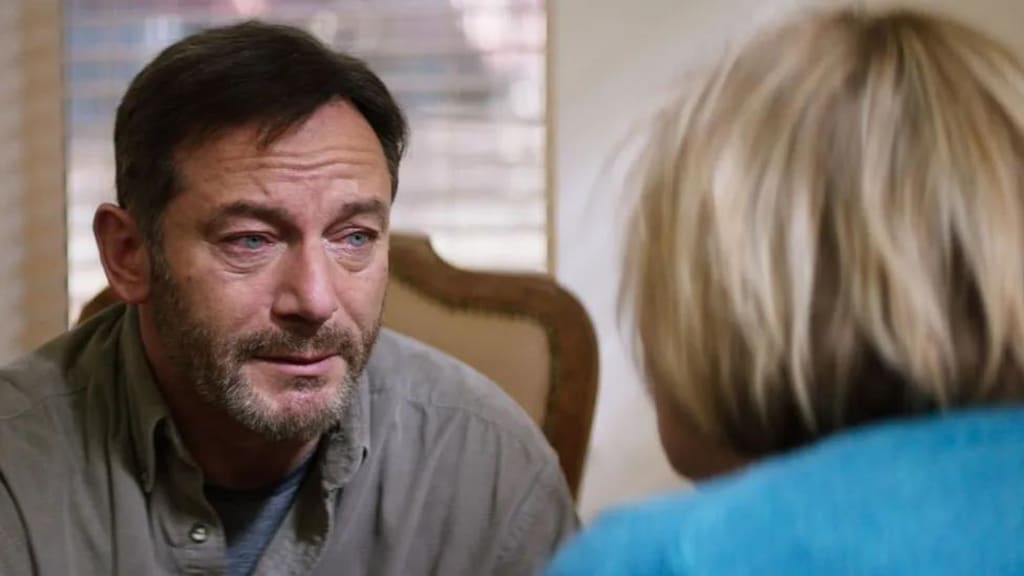
Now comes another powerful addition to this bleak sub-genre: US indie film Mass, which speaks simultaneously to two worst-case scenarios – that your child could be taken from you by a monster, and that your child could be the monster itself. A stunning four-handed chamber-piece, Mass is set six years after a school shooting, and focuses on the parents of one of the victims (Jason Isaacs and Martha Plimpton) as they try to comprehend the tragedy by meeting with the parents of the shooter (Ann Dowd and Reed Birney). The directorial debut of actor Fran Kranz, the film has won plaudits both for its moving dialogue and as of one of the best pieces of ensemble acting in recent memory. But it also powerfully captures something bigger than the situation at hand: the collective despair that still exists decades after Columbine in a country where, pre-pandemic, mass shootings were happening, on average, almost once a week. At the same time, Kranz hopes that Mass is still, paradoxically, a hopeful film for the humane way in which it honours the depths of pain and trauma these events cause. "It's easy to move on. We see these sorts of tragic events, the frequency of them, as headlines that have their cycle in the media. And then we kind of move on with our lives. But the point of Mass in many ways is to stay with it. You know, the film takes place six years later and the state of these parents, their grief, is in many ways unchanged."
The more time passes and my memories fade, the images in films I've watched feel closer to what I experienced now than the actual reality – Justine Peres Smith
Some know this trauma all-too-well – for Canadian writer and film critic Justine Peres Smith, these films have served as a way for her to process her own experiences as a survivor of the 2006 Dawson College Shooting in Montreal. In the years since, Peres Smith has turned to cinema and found its narrative beats and the sense of distance it offers have played into a more general, detached feeling about what she went through, as if it happened to someone else. "One of the strange things about memory is the images that you watch or that you experience, even if it's like watching what happened on television, almost start to override the experience itself. The more time passes and those memories kind of fade, the images I've watched feel closer to what I experienced now than the actual reality." Smith says she has found echoes of her experience in a number of films, including Elephant, We Need to Talk about Kevin, and Denis Villeneuve's 2009 Canadian film Polytechnique, a retelling of the 1989 massacre that killed 14 women at the École Polytechnique, again in Montreal.
The different approaches
Both Elephant and Polytechnique embody one particular approach to these horrific events which is to dispassionately re-enact them. They don't try to analyse what happened so much as confront just what it was that the victims went through, and find horror in the mundanity. Even all these years later Elephant, which is loosely based on the events of Columbine, is a difficult watch not only because of the cruelty of the gunmen but the naïveté of the victims; when the shooters begin to open fire, their schoolmates are torturously slow to react, losing vital time because they cannot comprehend just what is happening. Villeneuve's Polytechnique is similarly harrowing: one of its most uniquely unsettling elements is the way in which the college's brutalist architecture makes it feel like the victims are trapped within a concrete labyrinth. A less successful but similarly naturalistic and commentary-free approach was taken by 2002's Zero Day, which is presented as found footage from two teen shooters' video diaries as they count down to enacting a fictional massacre (which is eventually shown via security footage). The film provides no real reasons for the actions of "Andre" and "Cal" (who are styled to look just like Harris and Klebold), and thankfully doesn't tack on any over-simplification or invented traumatic event to provide motive. However lacking the directorial artistry of Elephant and Polytechnique, it also shows the limitations of dispassionate re-enactment, and ultimately feels like an empty endeavour.
Alongside these studiously unsentimental re-enactments, there have been some more salacious attempts to use school shootings and massacres as a plot point over the years – from films like Carrie and Heathers to the small-screen work of Ryan Murphy, who has featured school shooting incidents in both his TV series Glee and American Horror Story. However, Peres Smith is glad that these days the glib exploitation of the subject for dramatic effect seems to have dissipated. "I think the worst example was the school shooting episode of Glee [in which it transpired a gun had been accidentally set off by a student who had brought it into school to protect themselves]. That show is ridiculous but that episode is borderline offensive. I have so many issues with Ryan Murphy because he treats school shootings like pop culture. He's like 'I'm going to make a reference to Dario Argento and I'm going to make a reference to Columbine'." Pre-Columbine films like Carrie and Heathers may have felt able to be playful with the subject because it wasn't a regular occurrence; if they were made today, though, they might leave a nastier taste in the mouth.
And then there have been the films that have somehow tried to "explain" the phenomenon of school shootings, directly addressing what they see as potential causes. Chief among these was Michael Moore's 2002 blockbuster documentary Bowling for Columbine, which sought to comprehend what caused the massacre by examining the prevalence of gun violence in the US. The film broke box office records for a documentary and won a plethora of awards, including an Oscar, which Moore received by giving a famously incendiary acceptance speech attacking George Bush and the Iraq War. In retrospect though, Peres Smith is unimpressed by the film's insight, "What Michael Moore was trying to argue that it's a culture of violence [that causes these events]. I think that's an oversimplification." And while Bowling for Columbine proposed solutions to the gun-violence epidemic, campaigning for tighter gun controls, the inaction that followed in the US made it feel increasingly futile – not least after the Sandy Hook school massacre in 2012, that left 20 children aged six and seven dead, when US President Barack Obama was unable to push through even the tamest of gun control legislation, a moment he later described as "the saddest day of my presidency."
This movie came from fear for my child and, and fear for my country and anxiety about the culture. I certainly wasn't interested in depicting violence – Fran Kranz
A slightly less simplistic analytical approach was taken by Matt Johnson's The Dirties, a 2013 found footage film about two bullied high-schoolers who, inspired by their favourite pop culture, including Quentin Tarantino and Christopher Nolan movies, make their own films about storming into their high school and shooting the boys who torment them. However where one of the pair is creating a cathartic fantasy to help them cope with young adulthood, it slowly transpires that the other is considering making their films a reality. For Peres Smith, the strength of Johnson's film is that he doesn't in any way present causes for this kind of violence so much as an exploration of the "conditions that allow it to happen,": "a lot of it is [to do with] male rage," she says. "There are women who have also done this but it's obvious that this is a [problem of] young male rage, and probably a young white male rage would be more accurate."
Addressing the search for answers
If culture has inevitably looked for scapegoats to explain the unexplainable, then Ramsay's We Need To Talk About Kevin viscerally imagines what it is like to be the scapegoat. Tilda Swinton's Eva (Kevin's mother) is depicted as a social pariah, rounded on by angry neighbours who blame her for her son's actions; meanwhile in flashbacks, looking at their dysfunctional parent-child relationship, the film tempts the audience, too, to ponder Eva's possible complicity. "She comes to represent within the film what people have said about movies, video games, and rock music as a cause of the violence in our culture," says critic Marshall Shaffer. "Through the mother of the monster, we can experience so many of the moral conflicts and the knots that Americans tie themselves up in around the shootings, around nature versus nurture and how culpable we [all] are." Ramsay doesn't offer any obvious answers as to why the horrific event occurs and the film, and Kevin himself, have purposeful ambiguity. For example, something changes in Kevin when Eva throws him against a wall and breaks his arm – but whether it's a traumatic event that festers within him, or a triumphant moment for him, in providing him with ammunition with which to manipulate his mother, is up for debate. "She gives you evidence to support whatever [theory] you want [as to why Kevin does what he does]," says Shaffer. "And it is a litmus test for the viewer and to some extent proves just how difficult it is to solve this problem because there are so many determinants and you can see it and approach it however you want.
More recent films that have touched on the issue of school shootings include the bold, brilliant 2018 drama Vox Lux, in which the pop-star protagonist is a shooting survivor, and 2020 teen satire Spontaneous, which uses the metaphor of a school where the students start to spontaneously explode. Both, in different ways, explore the trauma that follows those who live through mass shootings, and the survivors' remorse they live with. Mass, which Kranz says is not inspired by any single real-life event ("I drew from so many different aspects and details of shootings that I'd read about, just at schools, and found aspects in all that felt truthful to the situation that was conjuring up inside of me") also focuses on the indelible consequences of such events: six years on, the characters are not just devastated but also exhausted by pain. There is some sense of hope for the characters to heal and forgive and find joy in the future, but the film purposely offers no easy answers or solutions.
Indeed, their attempts to gain control over what's happened are shown to be deficient: the male characters, in particular, know the events inside out, effortlessly reeling off times and locations. "They think if they know exactly what happened, they'll have an understanding of it and then it cannot affect them emotionally," says Kranz. "That proves to be a fallacy in some ways, and there's still a large element of their grief and anger that they haven't necessarily exercised." In this way, the film seems to offer a meta-commentary on the films that came before it, suggesting that recreating events, poring over the specifics and focusing on the details of gunshots and adolescent school reports, won't offer any real insight into these tragedies. For his part, when Kranz first conceived of Mass, he wasn't interested in making a film about mass shootings that showed any of the violence. "This movie came from fear for my child and, and fear for my country and anxiety about the culture. I certainly wasn't interested in depicting violence. I didn't want to just observe – I wanted to offer something else."
What Mass does offer is a conversation, even if the answers never quite satisfy the person asking the questions. What happened in the shooter's childhood? What did the school miss? Where could the police or his parents have intervened? Mass doesn’t blame Richard and Linda (Birney and Dowd) for what their son did but it doesn't shy away from how much they still blame themselves. Linda appears on the edge of tears throughout; Dowd plays her as a woman almost doubled over in pain. Meanwhile Birney explicitly spells out what Dowd embodies. "I regret everything," Richard admits, "The worst outcome imaginable happened. Any change I could have done could have resulted in a different outcome. I regret everything."
Above and beyond its characters' meaningful but ultimately impossible search for answers, Mass offers the chance to confront loss. It ends on a moment of absolute silence, where the camera leaves the room and stares out over empty fields, a scene that Kranz wanted to use to reflect upon America's collective grief. "I was looking for an image that could [come from] 40 out of 50 states and felt distinctly American. There is forgotten survey-tape, the field is dead grass with discarded water wheels, There's an emptiness to it. It's a landscape for grief. It changes over time but you never really get away from grief. By the end of the film, there's the hope that these characters can live with this grief more easily – there's possibility in the landscape for forgiveness and reconciliation, and to heal despite unimaginable tragedy".
About the Creator
Sue Torres
Is there any other reason to live to change the world?
Keep reading
More stories from Sue Torres and writers in Geeks and other communities.
Why Jennifer Lopez is Hollywood's most underestimated star
Sing the lyric: "Don't be fooled by the rocks that I got" to any millennial, and chances are they'll pipe back: "I'm still, I'm still, Jenny From The Block". Twenty years on from its release in September 2002, Jennifer Lopez's song Jenny from the Block is still just as infectious an earworm, and has pulled in 162 million views on YouTube and counting.
By Sue Torres3 years ago in Geeks
Silver Screen Magic with Mae West
American actress and singer Mae West became a popular film actress during the Great Depression. She started entertaining in vaudeville, then performed on Broadway, and finally went to Hollywood. She signed up with Paramount Pictures and made her debut in the 1932 film “Night After Night.” She also starred in musicals, comedies, and crime dramas. The American Film Institute named her one of the best classic Hollywood actresses.
By Rasma Raisters5 days ago in Geeks



Comments
There are no comments for this story
Be the first to respond and start the conversation.