

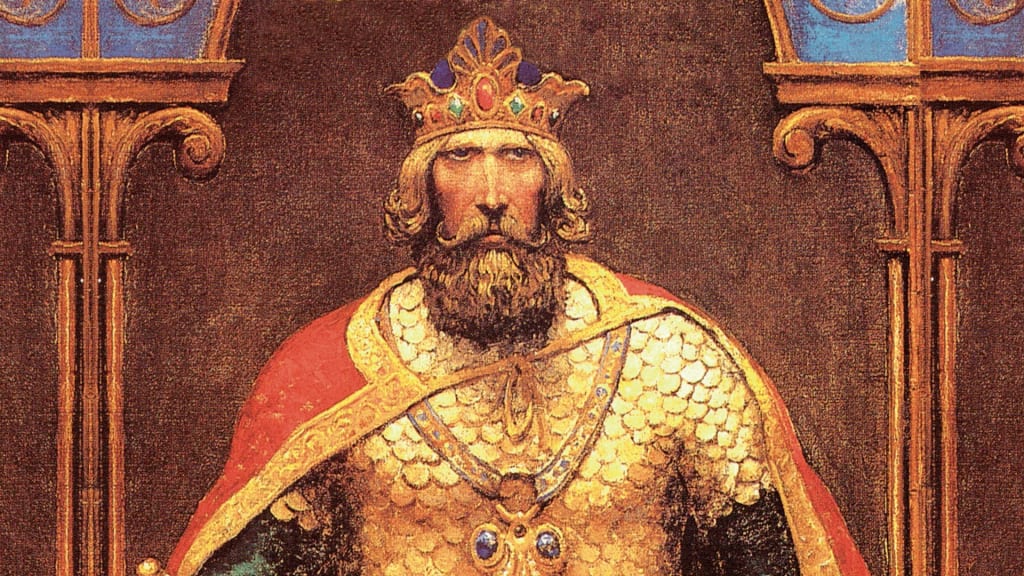
King Arthur is a legendary figure from British folklore, often depicted as a noble and just king who led the Knights of the Round Table. According to the tales, Arthur was the son of Uther Pendragon and was secretly raised by Sir Ector. His true identity was revealed when he successfully drew the sword Excalibur from a stone, a feat that proved his right to rule. Arthur's reign is marked by battles to defend Britain from invaders, particularly the Saxons. His story is filled with themes of chivalry, loyalty, and honour, with many characters, such as his knights Lancelot, Percival, and Gawain, playing central roles in the narratives. Arthur's tragic end comes with betrayal, mainly through the affair between his queen, Guinevere, and his knight, Lancelot, and the rebellion of his illegitimate son, Mordred.
The earliest references to King Arthur date back to the 6th century, though the stories as we know them were largely shaped in the Middle Ages, particularly through works like Geoffrey of Monmouth's Historia Regum Britanniae (1136) and Sir Thomas Malory's Le Morte d'Arthur (1485). These stories were used to symbolise the ideals of knighthood, chivalry, and the quest for justice. The tales of King Arthur reflect the medieval preoccupation with honour, the role of the king as a protector, and the complex relationships between loyalty and betrayal. The depiction of Camelot as an idealised kingdom underscores the importance of unity and the noble pursuit of a better society, which resonated with contemporary ideas of governance and social order.
Plot
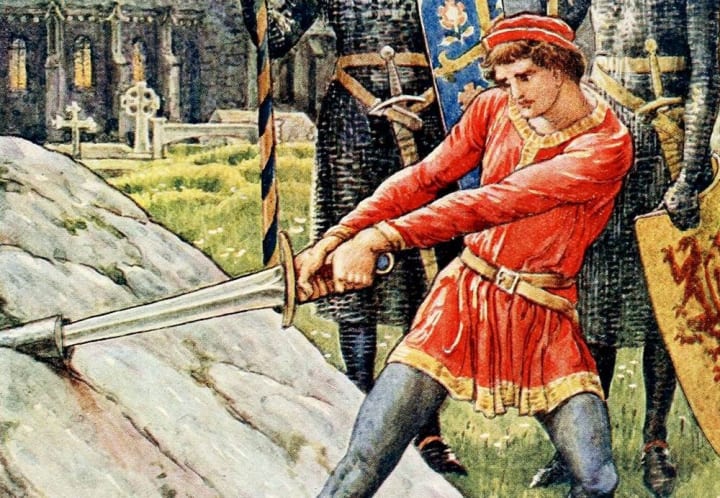
The story of King Arthur is one of the most enduring and iconic narratives in Western literature, yet its origins and evolution are far from straightforward. Arthur’s transformation from a regional hero to a legendary figure of national importance can be understood through a combination of historical, cultural, and literary factors that spanned centuries.
The earliest references to King Arthur appear in the 6th century, notably in the writings of Welsh historians such as Nennius in Historia Brittonum and Annales Cambriae, though they are scant and often ambiguous. These early accounts describe Arthur as a warrior, leading Britons against Saxon invaders, rather than a king. The name Arthur itself may derive from a Celtic or Romano-British root meaning "bear," suggesting the figure’s symbolic connection to strength and leadership. These early stories were primarily focused on Arthur’s military prowess, framing him as a heroic figure of local significance rather than the central figure in an entire mythos.
Arthur’s transformation into a folk legend and, later, a king of mythic stature, began with the medieval development of the Matter of Britain, a literary tradition which encompasses the stories, legends, and romances surrounding Arthur and his knights. This transformation was largely driven by Geoffrey of Monmouth’s Historia Regum Britanniae (1136), a work that gave shape to the more recognisable aspects of Arthur’s story. Geoffrey's account not only elevated Arthur to the role of a king but also introduced the notion of his divine right to rule, setting the stage for future iterations of the myth. Geoffrey’s Arthur is a heroic king, who, through both personal strength and divine intervention, consolidates power and drives out invaders, founding an idealised kingdom, Camelot.
The subsequent rise of chivalric romance in the 12th and 13th centuries, particularly through the works of French poets such as Chrétien de Troyes, further expanded the scope of Arthur’s legend. Chrétien’s Perceval and the tales of the Holy Grail introduced mystical elements and a quest-based framework, shifting Arthur’s story from a purely martial one to one with spiritual and moral dimensions. The Knights of the Round Table, with their ideals of chivalry, loyalty, and honour, became central to the Arthurian legend, embodying the virtues of medieval knighthood. This focus on chivalric values is reflective of the feudal society in which these tales were written, where loyalty to one's lord and the pursuit of justice were paramount.
However, it wasn’t until Sir Thomas Malory’s Le Morte d’Arthur (1485) that the legend took its final shape, combining many of the previous literary threads into a single, coherent narrative. Malory's work emphasised the complex relationships between Arthur, his knights, and his queen, Guinevere, underscoring themes of betrayal, love, and the fragility of idealism. His portrayal of Arthur as a tragic figure who falls from grace due to personal flaws and the disloyalty of those closest to him adds a layer of psychological depth that was not present in earlier accounts. Malory’s Arthur, whose ideal kingdom disintegrates due to internal strife, resonates with the uncertainties of his own time, when England was experiencing political turmoil and shifting allegiances.
As Arthur’s legend was passed down through centuries, it became a tool of cultural identity. The idea of Camelot, a utopian kingdom where justice and honour reign supreme, provided a powerful symbol for the British people, particularly during times of political instability or national crisis. In the Middle Ages, when monarchies sought to solidify their authority, the figure of Arthur was often invoked to reinforce ideals of kingship and the divine right of rulers. During the Tudor period, Henry VII even made symbolic claims to Arthur’s legacy, naming his son Prince Arthur and aligning his reign with the legendary king's image of a just ruler.
The folk legend of King Arthur was thus not merely a fantastical tale but a vehicle for reinforcing the values of the time. In the early stages, Arthur’s stories served as a reminder of the importance of martial prowess and leadership in the face of external threats. As the narrative evolved, it became increasingly concerned with issues of internal loyalty, honour, and the moral failings that come with power. The medieval tales of Arthur reflected a society deeply engaged in questions of governance, justice, and personal virtue, and the depiction of Arthur as an idealised king was a reflection of the aspirations and anxieties of the times.
Into the Theories
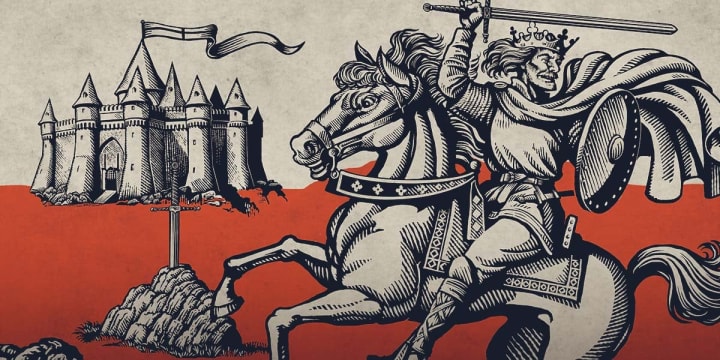
The Historical Warrior Theory
One of the most widely accepted theories is that King Arthur was based on a real historical figure, possibly a warrior chieftain or military leader who fought against invading Saxons in the 5th or 6th centuries. This theory suggests that Arthur was a prominent figure in the post-Roman British landscape, a time when the Roman Empire had collapsed, and local Celtic leaders struggled to defend Britain against external threats. This theory is supported by the earliest references to Arthur in texts such as Historia Brittonum, written by the Welsh monk Nennius in the 9th century, which describes him as a great warrior leading British forces in twelve battles against the Saxons.
In this interpretation, Arthur would have been a regional hero who, through his martial prowess, earned legendary status over time. While the romanticised version of Arthur presented in later medieval works (such as Le Morte d'Arthur) may exaggerate certain aspects of his life, there may still be a kernel of historical truth to the idea that Arthur was a charismatic and capable leader who became a symbol of resistance against foreign invaders. The theory is further bolstered by the persistence of Arthurian legends in Welsh, Cornish, and Breton traditions, which could suggest that the stories were based on a real historical figure whose deeds were celebrated and passed down through oral tradition.
However, this theory has its critics, as there is no direct archaeological evidence of Arthur or any corroborating contemporary accounts. The lack of historical documentation and the blending of mythical elements in later versions of Arthur's story complicate the identification of a specific historical figure.
The Celtic Mythological Theory
Another popular theory is that King Arthur is not based on a single historical figure but rather represents a synthesis of various Celtic myths and heroes. In this theory, Arthur is seen as a mythological archetype, drawing on elements of older Celtic folklore, gods, and legendary kings. In pre-Christian Celtic traditions, gods and legendary figures often served as cultural heroes who symbolised the virtues of strength, leadership, and heroism. Arthur may have been conceived as an idealised leader who embodies these attributes, transcending any specific individual to become a symbol of the unity and strength of the Celtic people.
This theory suggests that Arthur is a composite figure, created by combining different mythic figures and motifs. For example, some elements of Arthur’s story, such as his supernatural birth, magical sword Excalibur, and the mysterious and otherworldly nature of the island of Avalon, have parallels with older Celtic and Gaelic myths. The story of Arthur drawing the sword from the stone, for instance, mirrors the Celtic motif of a hero being chosen or ‘marked’ by divine intervention, akin to the legends of the Irish kingship rituals. The Arthurian tale also contains themes of the hero’s journey, which is a common motif in Celtic mythology.
Arthur’s connection with the supernatural and his ties to the Otherworld (represented by Avalon) also suggest that his story may have been influenced by religious beliefs in the Celtic pantheon. As a symbol of the heroic ideal, Arthur could have been crafted as a mythological figure to inspire and unite the Celtic tribes in their resistance against Roman and later Anglo-Saxon invasions. This interpretation of Arthur as a mythological or semi-divine figure aligns with the medieval Christianisation of Arthur, where he evolves into a king chosen by God, yet still retains traces of his pre-Christian, heroic roots.
The Literary Creation Theory
A third theory posits that King Arthur is largely a literary creation, shaped by the medieval writers who transformed existing folklore into the grand epic we recognise today. According to this view, the Arthurian legend is not based on a historical figure or mythological hero but is instead a product of the medieval chivalric tradition, which sought to create an idealised image of kingship and knighthood. This theory argues that the Arthurian legend evolved over time as different writers contributed their own interpretations of Arthur, blending elements of romance, mythology, and historical fiction.
Geoffrey of Monmouth’s Historia Regum Britanniae (1136) is often cited as the key text that transformed Arthur into a king of epic proportions, inventing elements such as the sword in the stone and the character of Merlin. Sir Thomas Malory’s Le Morte d'Arthur (1485) further developed the story, adding complexity to Arthur’s relationships with his knights, Guinevere, and Lancelot. These works were heavily influenced by the ideals of chivalry, which emphasised honour, loyalty, and bravery, and they reflected the values and concerns of the time, particularly in relation to kingship, warfare, and social order.
In this context, Arthur can be seen as a symbolic figure representing the perfect monarch, leading a utopian kingdom (Camelot) where justice and chivalry prevail. The Arthurian stories provided a moral framework for readers, illustrating the virtues of knighthood while also exploring the dangers of betrayal, corruption, and human frailty. Thus, Arthur’s legendary status could have emerged not from historical reality but from the aspirations of medieval writers and their audiences, who sought to create a timeless myth to inspire ideals of nobility and honour.
Why It's Shifty
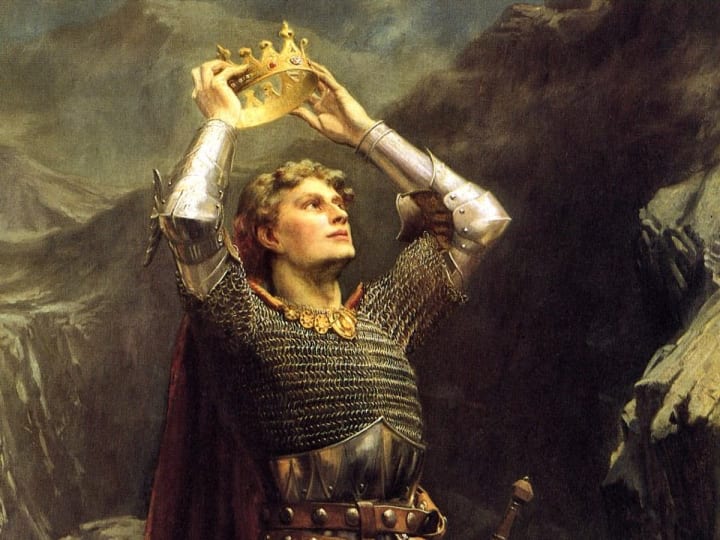
The theory of King Arthur’s historical existence is controversial primarily due to the lack of concrete evidence to support his existence as a real figure. While there are numerous references to Arthur in medieval texts, such as Historia Brittonum by Nennius and Geoffrey of Monmouth’s Historia Regum Britanniae, these works were written centuries after the time Arthur is believed to have lived. The absence of contemporary documentation or archaeological evidence makes it difficult to verify any historical facts regarding Arthur's life, leading to debates about whether he was a real person or purely a legendary figure.
On top of this, many of the accounts of Arthur are infused with mythological elements, such as his supernatural birth, the magical sword Excalibur, and the otherworldly realm of Avalon. These fantastical elements complicate the notion of Arthur as a historical figure and suggest that he may have evolved from folklore or pre-existing mythic traditions, rather than being rooted in historical reality. The blending of history with myth in the Arthurian legends further obscures any factual basis, as later writers often embellished the stories to reflect the chivalric ideals of their own times.
Also, the discrepancies in various accounts of Arthur’s life and deeds, ranging from his role as a warrior to a king, and from his battles against Saxons to his more mystical role in the Grail quests, fuel the ongoing controversy. Thus, Arthur’s historical authenticity remains elusive, leaving scholars to disagree on whether he is a mythic hero, a historical leader, or a mixture of both.
Conclusion
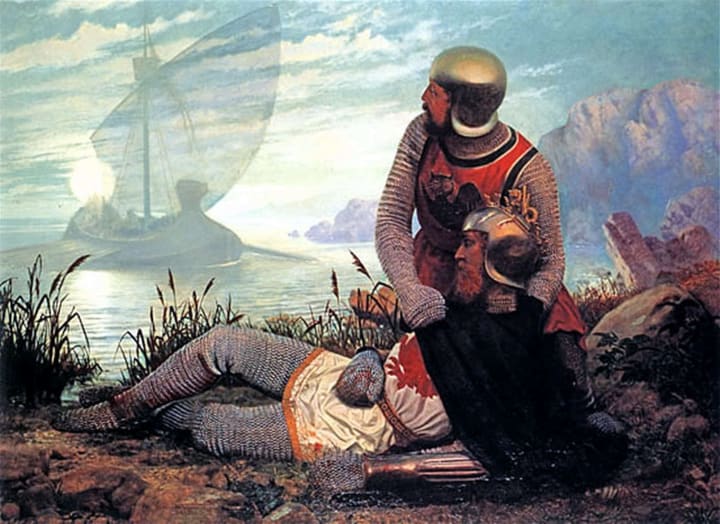
King Arthur’s true identity remains a mystery, with evidence pointing to him possibly being a historical figure, a mythic creation, or a blend of both. Some scholars argue he was likely a 5th or 6th-century warrior, leading Britons against Saxon invaders, while others see him as a symbol of Celtic heroism or a literary invention. The lack of concrete evidence leaves room for interpretation, and Arthur’s legend, enriched with mythological and romantic elements, continues to captivate. Ultimately, whether Arthur was a real king or a figure of folklore is a question that invites both historical investigation and imaginative exploration.
Next Week: What is Bibliomancy?
About the Creator
Annie Kapur
I am:
🙋🏽♀️ Annie
📚 Avid Reader
📝 Reviewer and Commentator
🎓 Post-Grad Millennial (M.A)
***
I have:
📖 280K+ reads on Vocal
🫶🏼 Love for reading & research
🦋/X @AnnieWithBooks
***
🏡 UK
Keep reading
More stories from Annie Kapur and writers in Geeks and other communities.
What's In a Reading Experience?
When I talk about ‘reading experiences’ I’m not just talking about the way in which we experience literature when reading it. A ‘reading experience’ also refers to the fact that some books stay with us. We may remember the experience of reading it at the time and then, as if taken back in time, relive that experience or at least, wish to relive it.
By Annie Kapur10 months ago in Geeks
Marvel Zombie
The last entry into our 2025 superhero projects catalogue is Marvel Zombies. This was a show that was anticipated by absolutely no one and it disappeared from the public consciousness as quickly as it was released. There was nothing special about the project that made it a must see, or a must remember. In fact if anything it's a must forget.
By Alexandrea Callaghan28 days ago in Geeks
Sabrina Carpenter To Appear In Her First-Ever Super Bowl Ad
Sabrina Carpenter will appear in her first-ever Super Bowl advertisement during the big game in early February. Carpenter is featured in a Pringles campaign, to be aired during Super Bowl LX on February 8.
By Dena Falken Esq4 days ago in Geeks




Comments
There are no comments for this story
Be the first to respond and start the conversation.