
"Interview with the Vampire" by Anne Rice
A Reading Experience (Pt.14)

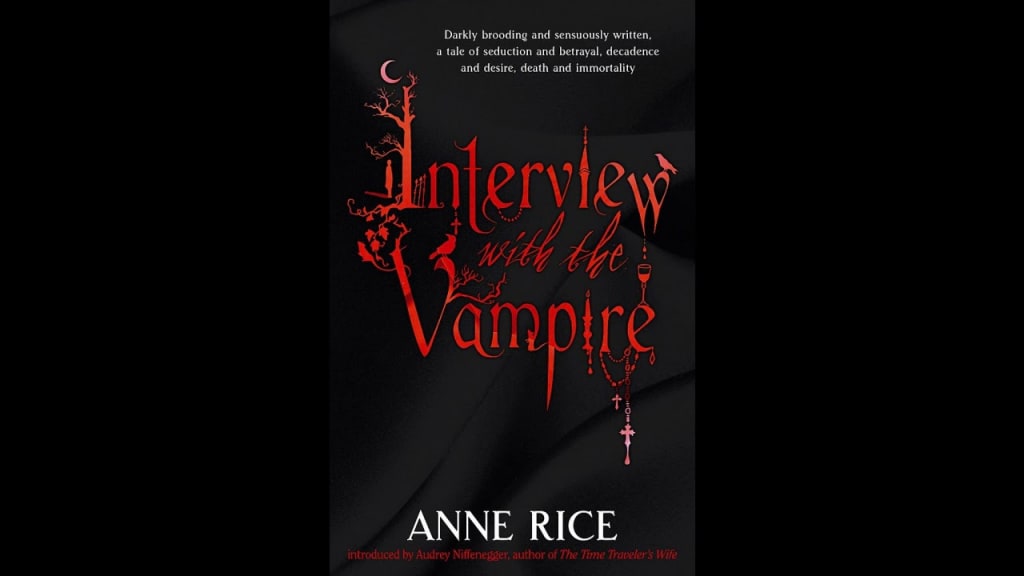
It has been just about twelve years since I first read “Interview with the Vampire” by Anne Rice and what a great year it was. I became so obsessed with the Vampire Chronicles series that I began to draw comic strips dedicated to depicting the storyline of each of them. I drew out each character in some sort of manga style and used the dialogue from the book and yes, I began with Daniel and Louis finding each other in that San Francisco apartment and Daniel having the living shite scared out of him. “I am flesh and blood but not human…” God I love that part because you get all excited that it is really about to go down for the next series of over ten novels. The way in which I discovered it was through the film. I hadn’t actually seen the film but I had heard that it was good and I knew there was a book to it and so I wanted to read the book first. By the time I read the book, I put off seeing the film and “Queen of the Damned” until I had finished the series. Back then only up to “Blood Canticle” was out and I had to wait ages for the next books. This first book in the series changed my entire perception of what vampire fiction could be and that modern fiction could also be beautifully written in a style that was both provocative and suggestive.
My favourite character will always be Lestat de Lioncourt - the main character of the entire series. The one thing you should know is that the entire series is the story of Lestat. Lestat’s greatest quality is his Byronic charm. He has this almost enchanting nature in which he is all Byronic and all Shakespearean Tragic Hero at the same time. It is as if he has just stepped out of the French Revolution as one of the great heroes of old. His language and his mannerisms echo back to the royalist times of France and yet, he has almost this modern sensuality about him which makes the reader sympathise with him and side with him even when we know what he is doing is wrong and thoughtless, selfish and counterproductive. The main fault of Lestat’s character is that he is expects submissiveness towards his autocracy of vampiric rule and Louis, the fledgling, just is not ready for that. Ultimately, Louis does not wish for the lifestyle that Lestat is attempting to force on to him and we can see this best in the fact that Louis refuses to take human life for the sake of food at first. It is when Claudia enters the picture that we see that Lestat wishes for exactly the same thing out of her. But unlike Louis, Claudia has a rebellious streak and seeks to dethrone the prince of darkness. It is Lestat’s fault of the want for this autocracy in vampirism that ultimately sees his initial downfall through the rebellion of Claudia against him. Lestat seems to represent that idea that once he was the most elevated of vampires and even though he was constantly transgressing, he still expected to be respected in the same way. He represents this redemption which constantly comes round to him each time he does something either considered to be immoral or in the least, questionable in motive.

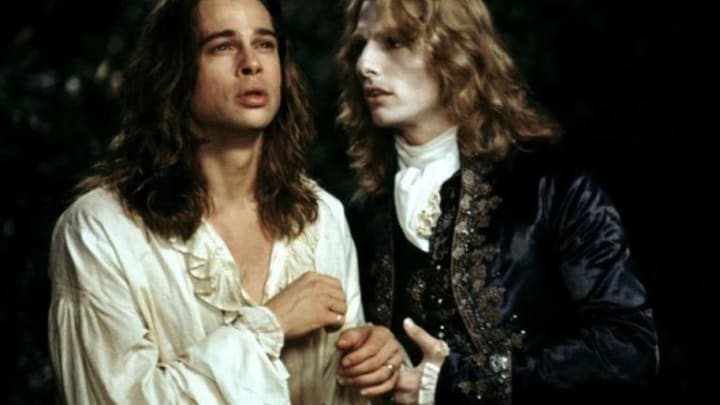
A key theme in the book “Interview with the Vampire” is definitely youth and beauty and this comes directly from the Romantic Era and the Byronic heroes of old in which this quality seems to be more respected than anything else. In this text, it entails the respect that Lestat receives and also explains the extreme reaction that Daniel has to seeing Louis in the San Francisco apartment when the light turns on. Another aspect of this theme can be seen in the way the characters are described. Very much the vampires are described as being pale, almost shimmering or glowing, their hair is wistful like a Romantic Era painting and their voices are substantially upper middle class like the rich Byronic Heroes like Victor Frankenstein and Don Juan. There is something almost overtly sexual about the way the vampires are described - sexual but not romantic in a ‘love’ sense. It is Romantic in the sense of the era, the youth and beauty of the paleness, the gothic ability, the structure of their strong, slim figures and the very attention that is paid to detail seems to be to display them as the most beautiful things on earth. They are so beautiful that apparently even humans are not able to see that much beauty with their own eyesight. It is a limitation of our species to which there is only one solution. Youth and beauty as a theme is used because the reader recognises it as the association to the older, more Romantic styles of character and so, for the characters to come from this period would not seem odd or strange because they do, in fact, match up to their time period historically. It would’ve been very important to establish this because if it wasn’t established then they could just be passed off as odd. Later on in the series, Armand is historically produced as a rather Medieval character and so, this does a good job of explaining why he is the way he is. For Lestat, Louis and Claudia especially, it is very important to make sure there is a good foundation to explain their overt almost over the top style of sensuality, sexuality and their over-interest in love and passion whilst remaining in style, gothic and beautiful. It helps the reader, who is a human, to understand the characters. It is almost as if Anne Rice is explaining to us that there are limits to our own understandings because we are not vampires.
This book means an awful lot to me. I remember this entire series’ cast being my friends when I really didn’t have any. I grew up with near to no friends and so Lestat, Louis, Claudia, Armand and the rest of them became my friends, my confidantes and I began to draw them and sketch them. I wrote side-stories about them. I wrote a story about how Louis was actually searching secretly for a way to turn back into a human. I wrote a story about what may have happened if Claudia didn’t die and there were many more. I’m not saying they were any good but you will only see them when I’m dead. It impacted my later reading experiences because it was because of these books that I discovered my beloved Lord Byron, whom I became so incredibly obsessed with for many many years to the point that I covered my notebooks in lines from his extensive poetry collection. Fun fact, in my second year of university, a man who worked in the archives of a place I had made a museum video for showed me a handwritten letter by Byron and let me handle it. I burst into tears in the centre of the room. I began to cry in the middle of all of my friends and though it was embarrassing at the time. It was the most emotional experience of my life. I can only hand the beginning of that to “Interview with the Vampire” by Anne Rice. It would’ve never started that ball rolling.
I would say that the reason I think that more people should read this book is because in about fifty years or so, this book will prove to be an important, iconic experience of modern literature echoing the days of old at its best. It is read by people today not only because it isn’t that old but also because it was one of the first novels of the 20th century to explore the Byronic hero in such incriminating detail. Every side from the sensual, the sexual, the repressive, to autocratic, the romantic, the violent, the often immoral and the almost criminal. Each side is explored in such incredible descriptive detail that you fail to take your eyes away from it out of fear of missing a key essential reason as to why they are the way they are. Upon my next re-read of this book I would like to pay more attention to these angles and especially the significance of the ending to the book. It is quite a horrific and often impulsive ending that I feel is one of the best written endings of the 20th century to any novel.
“Evil is a point of view. We are immortal. And what we have before us are the rich feasts that conscience cannot appreciate and mortal men cannot know without regret. God kills, and so shall we; indiscriminately He takes the richest and the poorest, and so shall we; for no creatures under God are as we are, none so like Him as ourselves, dark angels not confined to the stinking limits of hell but wandering His earth and all its kingdoms.”
"Interview with the Vampire" by Anne Rice
About the Creator
Annie Kapur
I am:
🙋🏽♀️ Annie
📚 Avid Reader
📝 Reviewer and Commentator
🎓 Post-Grad Millennial (M.A)
***
I have:
📖 280K+ reads on Vocal
🫶🏼 Love for reading & research
🦋/X @AnnieWithBooks
***
🏡 UK
Keep reading
More stories from Annie Kapur and writers in Geeks and other communities.
“Lotte in Weimar” by Thomas Mann
Thomas Mann’s “Lotte in Weimar” is often considered to be one of his many masterpieces and in my opinion it is Mann’s greatest novel. There are many key factors that one has to concern themselves with when looking at this statement of ‘masterpiece’ though and what makes Thomas Mann’s work a ‘masterpiece’. It is both artistic and well-constructed. It is character-driven and context dependent. But, context dependent as it may be, it is transcendent of its times, moving into our own and into the future with ease of access and applicable to the situations that will always concern humans - love, death, time and influence. When we have a look at this character-driven narrative, at first we believe that it is Lotte herself that is driving this narrative forwards with her focus on her want for her old life, whereas it is actually Goethe who drives the narrative with his aspect of celebrity though he does not appear physically for quite some time in the novel. Lotte is a woman of her time but she is also a woman who requires control of her own future, it is a question of whether she actually gets this because she is famed as the woman who is constantly associated with Goethe. The image of women and womanhood in the novel is a strange one because we have so many varying personalities. First of all, we have the personality of the self-driven woman who is Adele, the new and true-blooded Weimar woman. Then we have the opposing side which is basically Lotte - the woman who wishes herself to be self-driven but constantly finds herself hanging on to her past. There is little for Lotte in her future except returning to this past in order to confront it and the reader will always know that this is something that drives her. Her self-drive does not come from feigning a modernisation of herself as a woman, but rather treating herself as having an individual story in which certain plot points require editing, revisiting, revising and confronting in her autobiography and saga of romance.
By Annie Kapur6 years ago in Geeks
Silver Screen Magic with Mae West
American actress and singer Mae West became a popular film actress during the Great Depression. She started entertaining in vaudeville, then performed on Broadway, and finally went to Hollywood. She signed up with Paramount Pictures and made her debut in the 1932 film “Night After Night.” She also starred in musicals, comedies, and crime dramas. The American Film Institute named her one of the best classic Hollywood actresses.
By Rasma Raisters7 days ago in Geeks
How to Succeed at the Benson Directory®
Congratulations and welcome to the Benson Directory® employee #22391! As our newest call handler, you will have the privilege of speaking with dozens of unique and interesting people on a daily basis as well as the opportunity to earn bonuses for high performance. Contained within this handbook you will find a set of ease to follow instructions designed to help you settle in to your new role and begin paving the way to success.
By S. A. Crawford4 days ago in Fiction



Comments
There are no comments for this story
Be the first to respond and start the conversation.