
Human Bandwidth Crisis
the Glitchy Feedback Loop of Anxiety and Technology

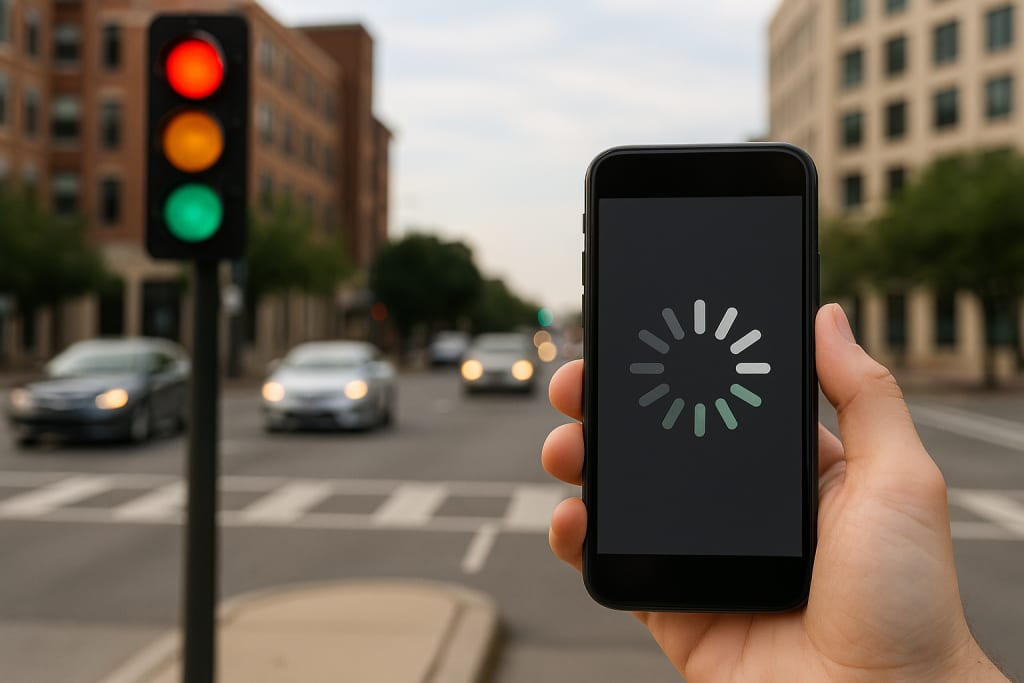
Across the continental United States, synchronized slowdowns are being recorded in two parallel systems: human motor behavior and digital network performance. The symptoms appear ordinary at first glance — drivers idling through green lights, app interfaces hesitating, signals buffering — yet the frequency and simultaneity indicate a broader malfunction.
As the field investigator for this report, my own background includes a master’s degree in criminology, with specific concentration in research and crime statistics and how they interact and crossover with human behavior. The discipline blends elements of forensic sociology, forensic psychology, and criminological analysis, providing a framework for interpreting large-scale behavioral anomalies through measurable data rather than speculation. That perspective informs every observation presented here.
The evidence points to a shared feedback loop: rising collective anxiety reflected back through the very infrastructure people rely on to navigate daily life. The grid is not failing on its own. It is responding to us.
Field Observations
Between early-morning and early-evening hours, intersections across multiple states reveal extended response lags after signal changes. The national average delay, once under two seconds, now exceeds three and a half. Eye movement tracking suggests cognitive fatigue rather than defiance or distraction. Drivers appear present but not processing — a phenomenon consistent with partial dissociation and sensory overload.
Simultaneously, users across regions report mobile apps and internet services behaving as if under strain despite normal server health. Throughput declines without mechanical failure. Latency spikes coincide with peak commuting hours, mirroring the human flow of stress and movement. Each tap, refresh, and location ping adds weight to an already saturated system, creating mechanical hesitation that resembles the human kind.
Analysis
This convergence represents a bi-directional feedback loop between psychological load and technological capacity. As human anxiety levels climb, screen time and multitasking behaviors increase. Every unnecessary refresh becomes another micro-request to servers, producing small but measurable slowdowns. When those slowdowns occur, they reinforce user frustration and drive further overuse.
On the road, the same loop manifests through delayed reaction, reduced confidence, and overcompensation by alert drivers. The system’s harmony breaks not from aggression but from hesitation. The once-predictable rhythm of traffic flow now resembles digital lag — start, stop, buffer, retry.
Environmental conditions act as silent accelerants. Humidity, barometric swings, and solar interference affect both human physiology and electromagnetic transmission. The overlap blurs the line between biological fatigue and infrastructural instability. Each system is reading and amplifying the other.
Behavioral Markers
Consistent indicators include slowed perception of time, fragmented situational awareness, elevated restlessness when feedback is delayed, and an increase in impulsive corrections. These behaviors parallel neural patterns seen in trauma exposure, overstimulation, and chronic uncertainty.
From a forensic standpoint, the pattern qualifies as environmental contagion — not a viral agent but a transmission of tension through shared interfaces. Humans feed it with divided focus; machines return it as friction. The loop sustains itself until one side stabilizes.
Interpretation
The data do not point to a technological collapse but to a behavioral one rendered visible through technology. The grid behaves like a nervous system because it is an extension of ours. When large populations operate under stress, their tools inherit the same volatility.
This is not philosophy; it is systems evidence. Network diagnostics, traffic analytics, and biometric data each confirm synchronized hesitation across unrelated platforms. The digital lag mirrors the psychological lag. Both are symptoms of an attention economy pushed past human limits.
Conclusion
What is presenting as random glitching is a national pulse check. Every buffering icon and stalled intersection marks the same condition: collective overload. Until cognitive stability improves, machines will continue to display our unrest in measurable form.
The grid is a reflection of its operators. When we restore presence, precision, and patience, the systems built to serve us will recalibrate automatically.
Sources That Don’t Suck
- National Highway Traffic Safety Administration — Distracted Driving Data 2023–2025
- AAA Foundation for Traffic Safety — Cognitive Load and Attention Metrics
- Stanford University — Multitasking and Neural Switching Research
- University of Michigan Transportation Institute — Driver Stress and Performance Reports
- Pew Research Center — Digital Fatigue and Screen Behavior Trends
About the Creator
Dr. Mozelle Martin
Behavioral analyst and investigative writer examining how people, institutions, and narratives behave under pressure—and what remains when systems fail.
Keep reading
More stories from Dr. Mozelle Martin and writers in Geeks and other communities.
The Politics of Playing Dress-Up
Well, to start off I'd like to say a happy world book day to all who celebrate. I know I haven't really posted anything on my socials about it but I'm not a jubilant kind of person. I lay low most of the time. Let's start off with a popular anecdote from the vaults...
By Annie Kapur6 days ago in Geeks
Guard Your Battery
Why are some people so attractive just by standing there? It’s not because they are "likable," but because they don’t need everyone to like them. I realized later that truly charismatic people allow themselves to be criticized, but they never criticize themselves. They never try to please the world; instead, the world stops to watch them.
By Emily Chan - Life and love sharing7 days ago in Poets



Comments