
How American Pop Was Made: Ralph Bakshi, Rotoscoping, and the Music That Kept It Off Video Until 1998
Ralph Bakshi’s American Pop (1981) fused rotoscoped animation with a sweeping soundtrack of American music. But complicated music rights kept the cult classic off home video until 1998. Here’s the story of its making, its director, and its legacy.

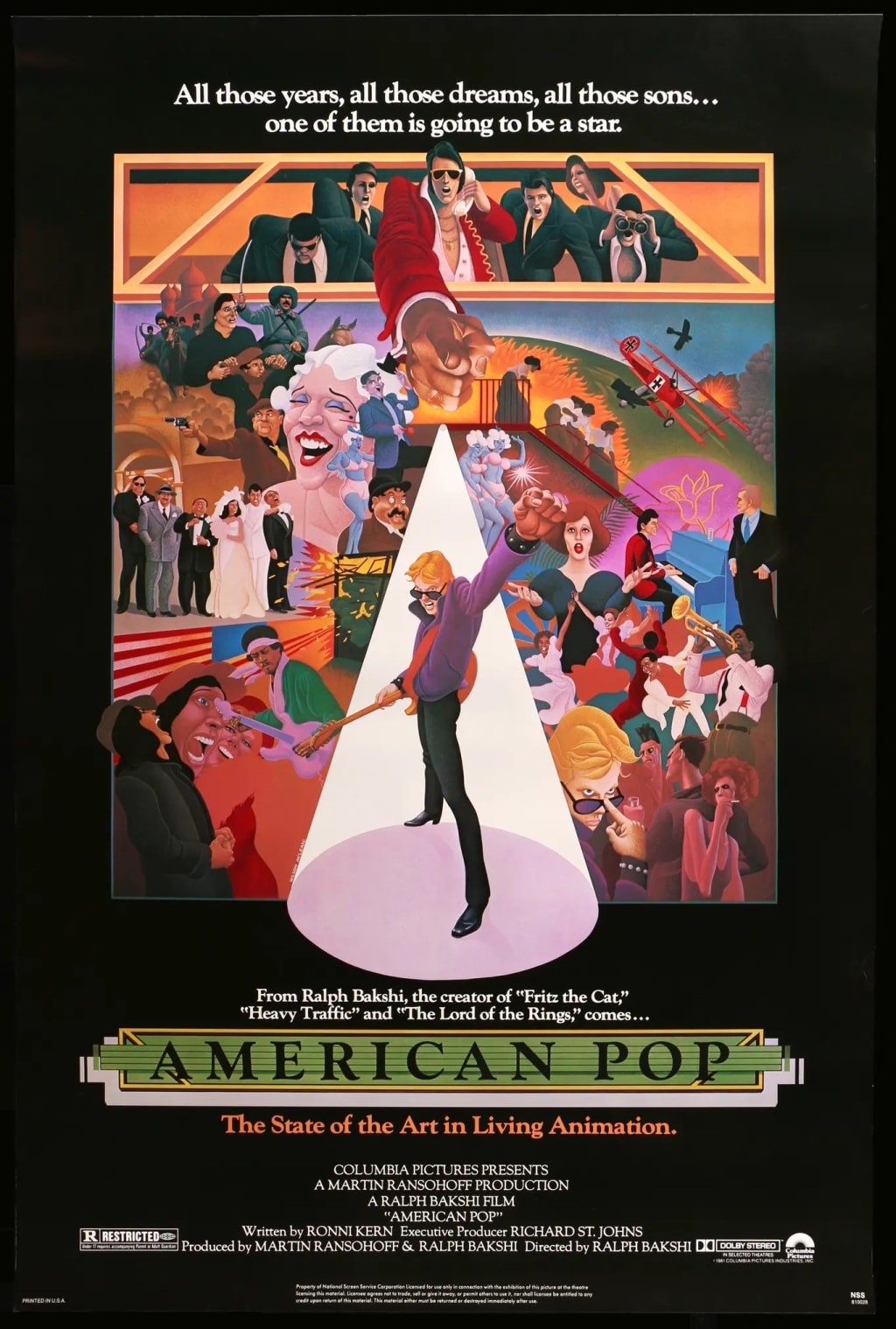
Rotoscoping: Tracing Life Into Frame
The 1981 animated feature American Pop remains one of Ralph Bakshi’s boldest and most unusual experiments. While mainstream animation in the early 1980s leaned toward family entertainment, Bakshi was chasing something very different: an animated epic that captured the sweep of American music across four generations.
To achieve this, Bakshi relied heavily on rotoscoping, the technique of tracing live-action footage frame by frame to capture naturalistic human movement. The process required actors to perform scenes in costume on live sets, often with minimal props. The footage was then projected frame by frame for artists to trace, adding stylization and blending the characters into painted backdrops.
The result is movement that feels uncannily real yet still animated — a blend of documentary intimacy and dreamlike stylization. Musical performances in particular come alive because the rotoscoped figures carry the weight and timing of actual musicians. Bakshi had experimented with this in The Lord of the Rings (1978), but in American Pop the method becomes the foundation of the entire film.
⸻
Ralph Bakshi: From Brooklyn to the Big Screen
By the time he began American Pop, Ralph Bakshi was already infamous as animation’s iconoclast. Born in 1938 and raised in Brooklyn, Bakshi entered the industry at Terrytoons before breaking away to create a string of adult-oriented animated features.
Films like Fritz the Cat (1972), Heavy Traffic (1973), and Wizards (1977) proved that animation could tackle mature themes, urban grit, and social commentary. Bakshi wasn’t afraid of mixing art forms — from underground comics to fine art painting — and he often employed unconventional voice actors and improvisation to create a rawer texture than Hollywood usually allowed.
American Pop was an ambitious culmination of that philosophy. Rather than focusing on one story, Bakshi wanted to explore how music — from vaudeville and jazz to rock ’n’ roll, folk, and punk — flowed through generations of American immigrants. The rotoscoping technique allowed him to stage everything from smoky club ballads to psychedelic rock concerts, while his collage-like editing fused animation, live-action inserts, archival footage, and painted environments.
⸻
The Soundtrack That Made the Movie — and Then Trapped It
If rotoscoping gave American Pop its body, the soundtrack gave it a soul. Bakshi secured rights to dozens of iconic songs that mapped the evolution of American music. Bob Dylan, Jimi Hendrix, Janis Joplin, The Doors, and Pat Benatar are just a few of the artists whose music grounds the film in real history.
But this triumph also created the movie’s biggest obstacle. When Bakshi and Columbia Pictures cleared music rights in the late 1970s, contracts were designed for theatrical release only. No one in that era imagined that home video — VHS and later DVD — would become the dominant format for film distribution.
As a result, when audiences began collecting movies on tape in the 1980s and 1990s, American Pop remained absent. Each song required renegotiation for new formats, and the legal and financial hurdles were steep. The film became a kind of ghost: talked about by animation buffs and music fans, occasionally revived in midnight screenings, but inaccessible to most viewers.
It wasn’t until 1998, nearly 17 years after its theatrical release, that Columbia/TriStar finally secured rights for a VHS and DVD release. By then, the movie had earned cult status among those who had seen it in theaters, and its delayed home-video debut only added to its mystique.
⸻
Why American Pop Still Matters
More than forty years after its release, American Pop stands as a singular achievement in American animation. Few films have so boldly fused technique, music, and generational storytelling. The rotoscoping provides an expressive realism rarely seen in animation; the soundtrack binds the story to lived cultural history; and Bakshi’s outsider sensibility ensures the film never feels like a sanitized studio product.
The delay in home-video release may have cost American Pop mainstream recognition, but it also cemented its reputation as a cult classic — discovered, shared, and debated by animation historians, music fans, and collectors.
In today’s streaming era, when music licensing still shapes what films and shows make it online, American Pop feels prophetic. Its struggles remind us that art doesn’t exist in a vacuum — it lives and dies by the contracts, technologies, and cultural shifts that surround it.
Ralph Bakshi once said he wanted to make films that felt alive, messy, and real. With American Pop, he succeeded, creating an animated time capsule that still resonates, even if it took nearly two decades to find its way into people’s living rooms.
About the Creator
Movies of the 80s
We love the 1980s. Everything on this page is all about movies of the 1980s. Starting in 1980 and working our way the decade, we are preserving the stories and movies of the greatest decade, the 80s. https://www.youtube.com/@Moviesofthe80s
Keep reading
More stories from Movies of the 80s and writers in Geeks and other communities.
Sphinx (1981) — Inside the $10M Disaster That Bombed at the Box Office
A Costly Gamble in the Desert In 1981, director Franklin J. Schaffner — the Academy Award–winning filmmaker behind Patton — turned to pulp adventure with Sphinx. Adapted from Robin Cook’s bestselling novel, the film seemed poised to cash in on the public’s appetite for archaeological thrillers. Instead, it became one of Hollywood’s most memorable flops.
By Movies of the 80s4 months ago in Geeks
Silver Screen Magic with Mae West
American actress and singer Mae West became a popular film actress during the Great Depression. She started entertaining in vaudeville, then performed on Broadway, and finally went to Hollywood. She signed up with Paramount Pictures and made her debut in the 1932 film “Night After Night.” She also starred in musicals, comedies, and crime dramas. The American Film Institute named her one of the best classic Hollywood actresses.
By Rasma Raisters5 days ago in Geeks
How Lakshya hit the bullseye with The Ba***ds of Bollywood
Lakshya has no qualms admitting that he is a boring guy off set with not much happening around him. “The only fun that I have is when I prepare for characters and shoot,” says the actor, who goes only by his first name. “In the last few days, I have been trying to discover the psyche of the character I am playing. That is the exciting part for me… when I have to play a different person and live a character,” he tells Forbes India in the middle of a hectic 12-hour film shoot.
By Dena Falken Esq6 days ago in Geeks


Comments
There are no comments for this story
Be the first to respond and start the conversation.