
Growing Out of Die Hard 2
I used to love Die Hard 2 then I actually grew up.

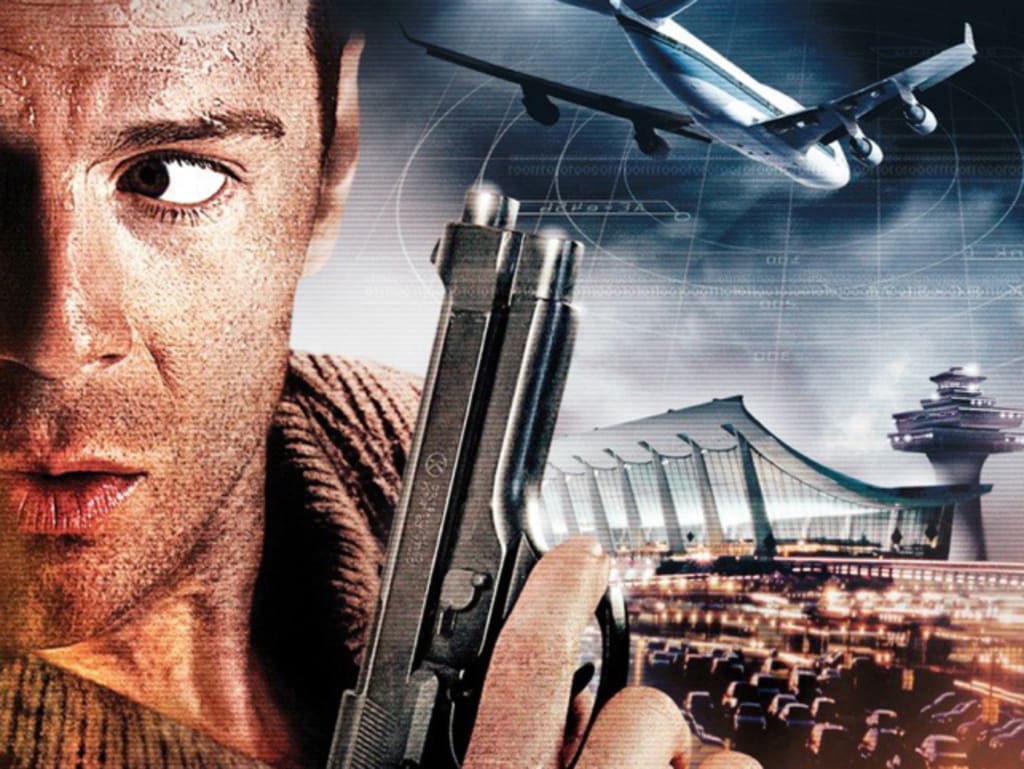
Die Hard 2 is weird. Why make a sequel to Die Hard? How is the audience expected to believe that Bruce Willis’s John McClane would find himself in the midst of yet another terrorist plot with worldwide implications. That’s not exactly a regular occurrence for someone we assume is an NYPD Detective. Right off the bat, the movie is stretching credulity. Then the movie begins and we are slapped in the face with some of the more awkward opening scenes of a major action franchise.
Die Hard 2 opens with John McClane rushing out of an airport to confront a Washington D.C beat cop named Vito (Robert Costanzo) who is giving John a ticket and towing the car that John has borrowed from his disapproving mother in law. John pleads with the cop not to tow the car and informs the beat cop that he himself is a cop, from the LAPD. This is an exposition dump. Director Renny Harlin is using this moment as a device to inform us about John’s life in the years since Nakatomi Towers.
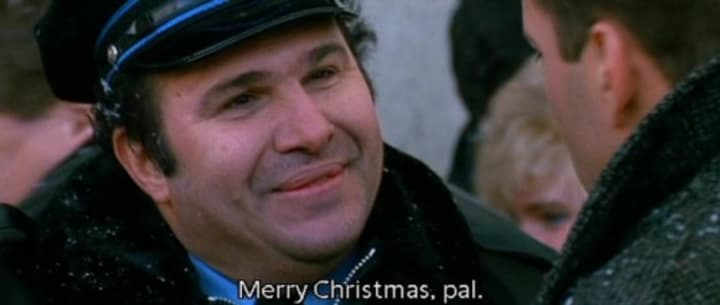
Like most expository dialogue, it’s clunky and calls attention to itself. It also doesn’t show our hero, John McClaine, in the kindest light. It makes John look like a jerk. He’s parked illegally and he knows it. He tries to use his privileged position as a cop to get himself out of this situation that he’s created for himself. If you think about it, he’s doing a version of 'don’t you know who I am?' The kind of move we associate with jerky celebrities.
The awkwardness doesn’t end there however. John heads back into the airport seeking to answer a page from his wife, Holly (Bonnie Bedelia), the reason he’s at the airport. Holly is flying into Washington D.C where John is waiting for her with the kids. He’s there to pick her up. On his trip to find a phone, John vaguely overhears a television broadcast with a great deal more exposition.
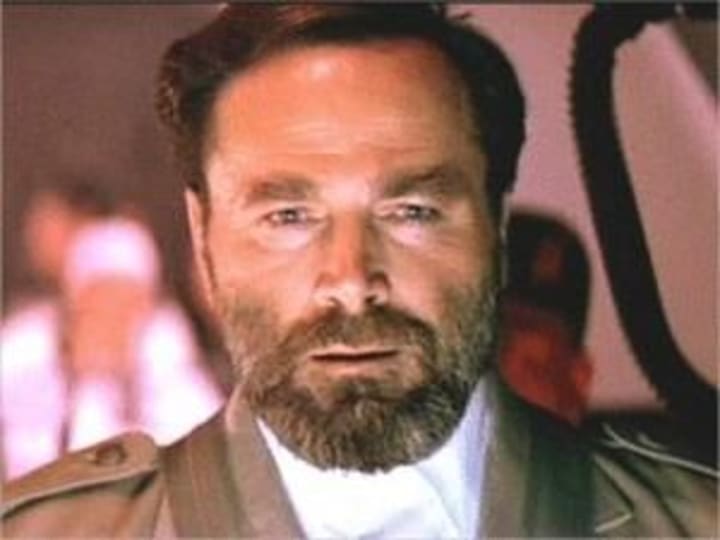
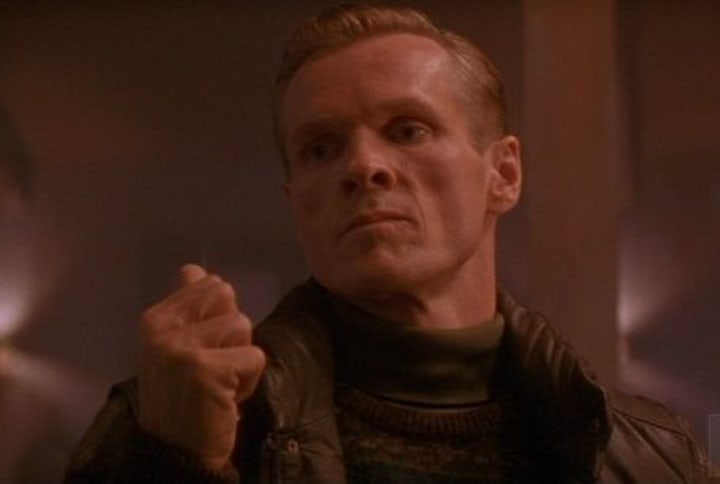
A former dictator and ally to America General Esperanza (Franco Nero) is being transferred to America to face charges for narcotics charges. He's Manuel Noriega, just go with it. The General's plane is coming to this same airport. The television news report is used to transport the action from McClane in the airport to our antagonist Colonel Stuart (William Sadler) in his hotel room. As Stuart is listening to the same news report on TV, he’s doing some sort of naked tai-chi thing. Why is he nude? I don’t know, he just is and we are just left to awkwardly observe that fact.
According to a copy of the script I found online, Stuart is described as half-naked. This leaves one to wonder if actor William Sadler decided he preferred to do the scene in the nude or if this was a directorial suggestion. Why is he nude at all? Why does this even happen? Mainly because the TV is doing most of the work in establishing how dangerous Esperanza was, how he used to be an American ally and showing that Esperanza and Stuart were connected, Stuart is glimpsed shaking Esperanza’s hand in archival footage.
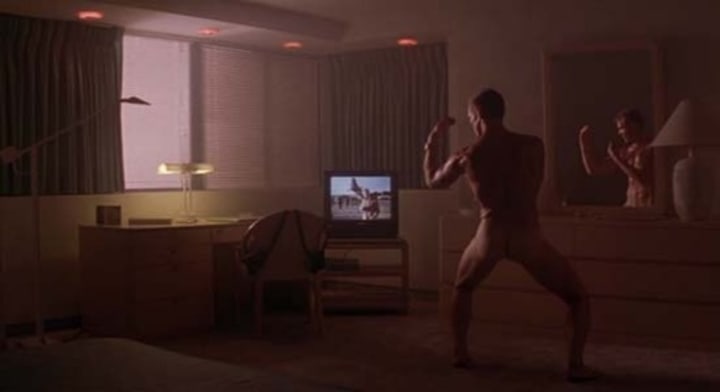
Apparently, screenwriters Steven E De Souza and Doug Richardson were looking for something for the character could be doing that would be more interesting than just watching TV and naked tai-chi was their choice. The scene ends on an even more odd note as Stuart begins to choose his clothing for the day but as he does this, he tires of watching the news and in a lithe and playful move he quickly reaches for the remote, spins his body 360 degrees to his knees, to a shooting position, with the television remote as a gun and shuts off the TV. Why? Because it was more interesting than just turning off the TV.
This is just the first few minutes of Die Hard 2. I was so fixated on how awkward and odd these moments were that I paused the movie 9 minutes in, just so I could note everything about these moments that struck me. From here the movie settles into a relatively normal action movie with familiar beats and it's really much more boring than these opening moments which are bad but in a very interesting way.
The opening scenes of Die Hard 2 also tell us absolutely nothing about what is to come in Die Hard 2. Now you may disagree and say that it has introduced the premise, as awkwardly as possible, but it has done that. And that’s kind of true. Except that these opening minutes fail to set up any kind of theme or meaning. Nothing that happens in these opening minutes has any pay off for later in the movie except for Vito the cop. Vito the cop, director Renny Harlin chooses to use Vito the cop later in the movie to pay off what I believe he thinks is a joke but it’s really not.
I have spent far too much time pondering the meaning behind Vito the cop in Die Hard 2. He’s there at the beginning to give John McClane a parking ticket. He returns later and says Merry Christmas as John abandons the idea of enlisting his help to stop what John believes is a potential hijacking about to take place and then, at the very end of the action, Vito returns and is revealed as the brother of Lorenzo, a character played by Dennis Franz.
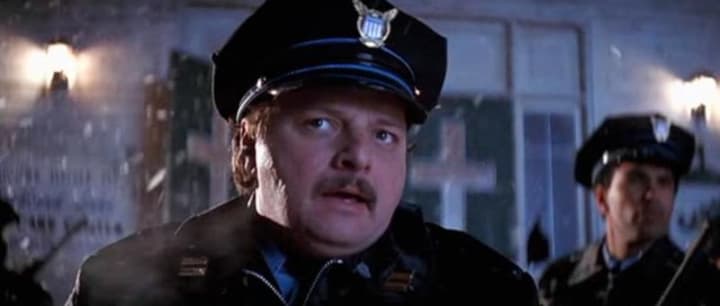
Why? I have no idea? I have been playing in my mind trying to figure if Vito is some kind of Zelig like character who was in the background of the movie throughout but he’s not. He’s in three scenes and I have described all of them. Dennis Franz plays the Chief of the Airport police in Die Hard 2. He fills the Paul Gleason role from Die Hard, the clueless, blowhard, authority figure who makes every wrong decision while constantly ignoring McClane’s advice when he isn’t yelling at McClane. He has no other function other than for us to recall how much we hated Gleason in the original.
Revealing that Vito is Lorenzo’s brother changes absolutely nothing. Why is this here? Why does this exist? Why did Renny Harlin insist that Vito must return and have a pay off? The nake tai-chi scene never comes back. William Sadler remains fully clothed through the remainder of Die Hard 2. He also never playfully makes use of a television remote control throughout the rest of the movie. In fact, he’s never playful again in the movie.
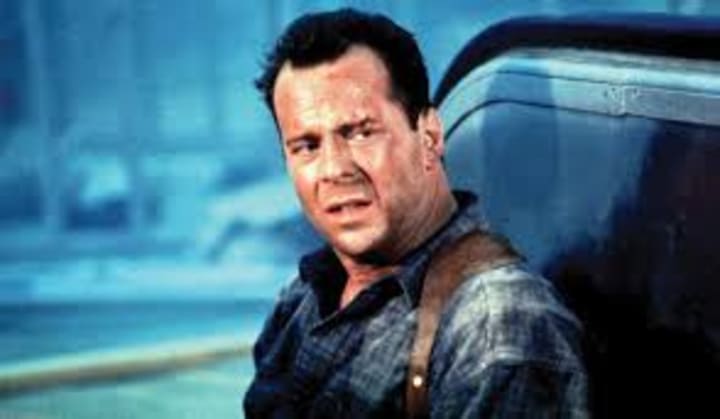
All of this has shunted John McClane into the background for me and strangely, I don’t feel like McClane ever really comes to the fore in Die Hard 2. Unlike the original, where John feels achingly authentic in his basic decency and every-man ingenuity. This John McClain is rather listless and unimpressed with the fact that he’s found himself in the midst of the second terrorist incident in his life. Most of us don’t even get one of those experiences, John’s blase about this having impossibly happened for the second time.
Instead of being witty and self-deprecating as he was in the original, Willis appears frustrated in a not all that interesting way. Somehow, this is already a rote experience for John McClane. John, rather grimly, goes through the motions of trying to rescue a group of planes that are being held in the air by Stuart’s terrorists who’ve hijacked the whole airport and killed the power to the landing strips needed to land the planes, including the plane carrying his beloved Holly.
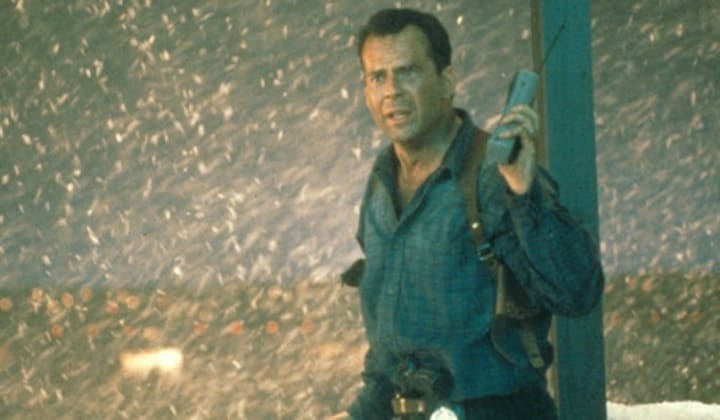
So, McClane resignedly sets about his heroic acts. What is John McClane’s arc? Not this again? Is that really the compelling arc? John McClane is not changed at all from the start of the movie until the end. He exhibits no new traits. He does pretty much everything he did in the first movie, minus the charm, but this time he’s outside in the snow and there are more bad guys. John McClane has been through this before and while he is a little more out of his element, that’s not a character arc.
When you really think about it, there is only one character in Die Hard 2 with a genuine arc. The true Zelig of Die Hard 2, reporter Sam Coleman played by Sheila McCarthy. McCarthy is the one character who keeps popping up throughout the movie. She’s in many scenes and in those scenes has flashes of wit and smarts. She’s a savvy reporter who recognizes McClane and senses the story unfolding. She’s ambitious and will do anything to get the story.
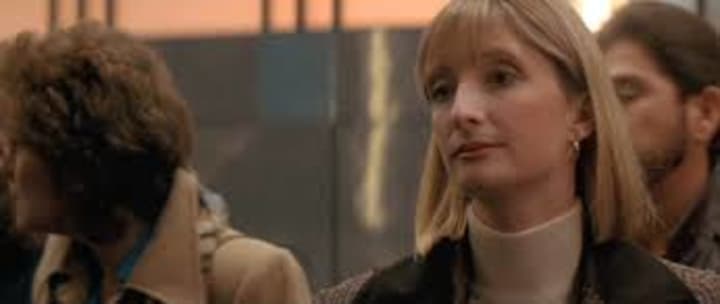
By the end, she’s actually physically involved in the story as she uses her news station helicopter to get John McClane onto the plane carrying the bad guys. This is a bit beyond the journalistic ethic. In fact, you could argue she’s gone well beyond ethics in pursuit of this story. But, then, at the end, when she has the perfect ending to her story, seeing her hero McClane romantically reunited with his beloved Holly, Sam makes the choice to turn the camera away. It’s not much growth but it’s growth. She's eschewed her instinct of anything for a good story in favor of basic human decency and it is the only demonstrable arc of any character in Die Hard 2.
Why is that? Why is this random reporter character the one person who seems to take something away from all that takes place in Die Hard 2? Why should we care that she even has an arc? I’m not sure but she’s the only character introduced in the first 5 minutes of the movie, when the story is being established, and we are being reintroduced to the world of Die Hard, who goes on to learn something and change.
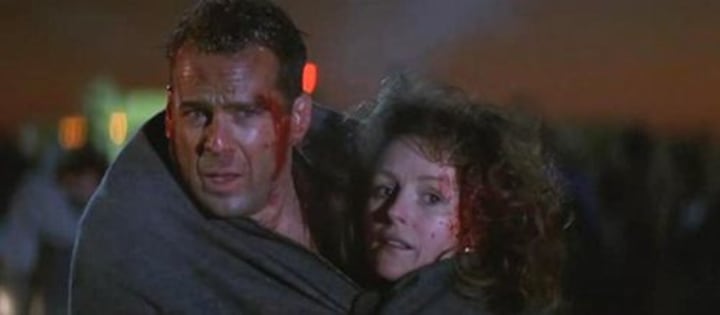
Now, if you’ve somehow read to this point in this ludicrous ramble, you are probably still thinking that I am missing the point. Die Hard 2 isn’t about traditional film-making or story. Die Hard 2 is intended as simpleminded spectacle and to ask it to uphold a standard of storytelling or film-making is folly. My response to that, dear reader, is that if the spectacle had been at all worth writing about, I wouldn’t be so caught up in Vito the cop, naked tai chi and Sam Coleman, the arcing reporter.
Die Hard 2 is such a low rent effort that my attention was taken elsewhere. I was thinking of peripheral nonsense and not giving a single damn about the bullets being shunted in all directions, the ludicrous machinations of the plot or the risible notion that one man could find himself in this kind of situation for the second time.
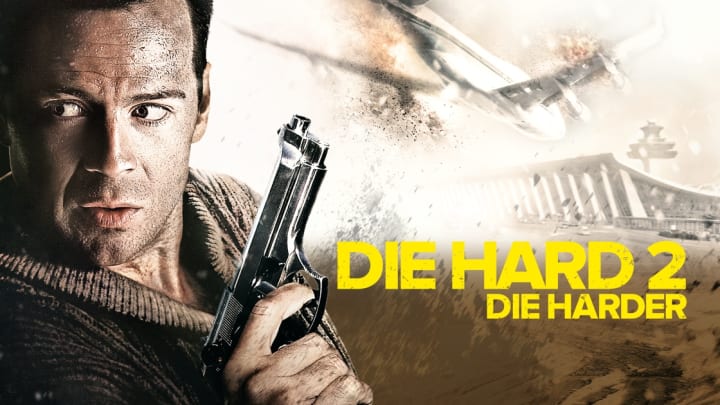
I mean, if John McClane is not going to be apoplectic over his own lot in life, why should I be interested either? As played by Bruce Willis, McClane doesn’t appear all that surprised or annoyed that he’s somehow in the midst of a second, major international incident. Perhaps he knows it also won’t be the last. Maybe he has fatigue from a future he somehow has already glimpsed. I know I have that fatigue but I’ve actually seen his future, what’s his excuse?
About the Creator
Sean Patrick
Hello, my name is Sean Patrick He/Him, and I am a film critic and podcast host for the I Hate Critics Movie Review Podcast I am a voting member of the Critics Choice Association, the group behind the annual Critics Choice Awards.
Keep reading
More stories from Sean Patrick and writers in Geeks and other communities.
Movie Review: 'Phantom Thread'
Phantom Thread is incredible. I’m not surprised by this; P.T Anderson has proven to be one of the most remarkable and consistently inventive directors of his era. Nothing surprises me about P.T Anderson crafting an incredible film. What did catch me off guard was the strange and fascinating way in which Phantom Thread is incredible. There is no predicting where this study of obsession and genius is headed.
By Sean PatrickExclusive • 8 years ago
Silver Screen Magic with Mae West
American actress and singer Mae West became a popular film actress during the Great Depression. She started entertaining in vaudeville, then performed on Broadway, and finally went to Hollywood. She signed up with Paramount Pictures and made her debut in the 1932 film “Night After Night.” She also starred in musicals, comedies, and crime dramas. The American Film Institute named her one of the best classic Hollywood actresses.
By Rasma Raisters6 days ago in Geeks
Top 7 Oak Island Discoveries the Show Didn’t Air
The Curse of Oak Island has captivated audiences for over a decade, blending historical intrigue with reality TV drama. But what fans see on screen is only part of the story. Behind the edited episodes and dramatic voiceovers lies a treasure trove of discoveries that never made it to air — some due to time constraints, others possibly too speculative or controversial for mainstream broadcast.
By Rukka Nova3 days ago in Geeks


Comments
There are no comments for this story
Be the first to respond and start the conversation.