
Gods, Ghosts, and the Golden Age: The Weird Mythology of DC’s Secret Origins
From cosmic crusaders to occult oddballs, unmasking the strangest backstories in the DC Universe.

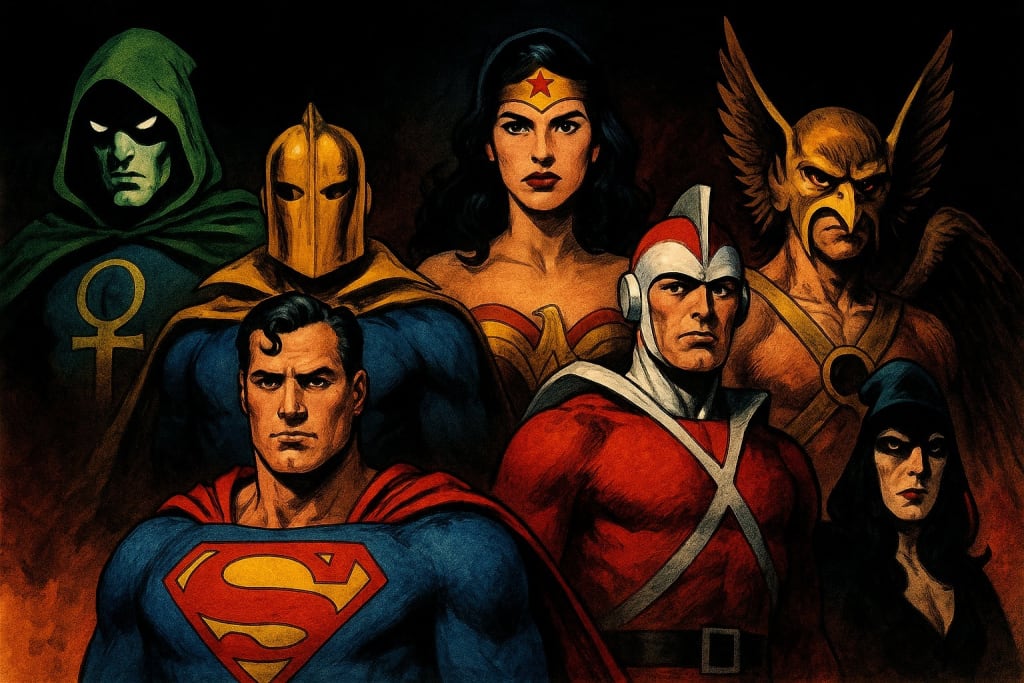
I recently completed DC Universe Secret Origins [1], and, let me tell you, it’s a hell of a book. Thick, hardcover, and brimming with pulp comic book Golden Age goodness. We learn the secrets behind the Superman–Batman team-up, the mythological origins of Wonder Woman (she was blessed by a multiplicity of gods, including Aphrodite, Merc, and Herc—Mercules and Hercury, har-har), and what it was like to be Superbaby, then Superboy, and finally El Supero Uno, Mucho Macho Nacho, The Man of Steel. Booya.
What fascinated me the most, and what I’ve gotten, like, three articles out of by now, is the occult tendrils and bizarre subtexts and readings that can be applied to totally obscure characters such as Dr. Fate, The Spectre, El Diablo, and The Enchantress (whose cracked 1968 “Dark Shadows meets Hanna-Barbera” is the one origin story that disappoints; also the story of Aquaman, who comes off as quite a drip).
Ostensibly, DC Universe Secret Origins collects the Secret Origins series that first appeared, according to that unimpeachable source Wikipedia1, as early as 1961. [2] Then it ran from late 1973, or thereabouts, to 1974. It has been resurrected in one form or another a number of times, including a series that was post-Crisis on Infinite Earths. But none of that, and the fact that we get all the greats here—including Jerry Siegel himself represented—is what I found most interesting about DC Universe Secret Origins.
Beyond the delicious vintage artwork, and beneath the naïve façade of the admittedly juvenile-aimed tales, lies a seething mass of symbolism and subtext—death, rebirth, social opprobrium, and other tendrils of meaning behind what would otherwise be disdained by most as “juvenile trash.” But pop culture plays the notes on our social scale, even if it takes a special ear to hear them.
I’ve already written about Dr. Fate, The Spectre, and El Diablo, all of which I found interesting for personal reasons. The thing that struck me the most about the general theme running through the origin stories of Challengers of the Unknown and Adam Strange is the way in which a death cheated or deferred—the Reaper sent away unexpectedly empty-handed—becomes a gateway to strange powers, other worlds. Nowhere is this more apparent than with the Challengers.
Challengers of the Unknown and the Cube from Space
Four strapping American boys—Ace, Red, Prof Haley, and Rocky Davis—go down over the jungle in a plane while flying to do a podcast. They mysteriously DO NOT die, but escape death and then become superheroes who go on righteous adventures. A wizard then calls them to a secret meeting wherein he commands them to open a giant stone cube.
A cube [3]—a mystical symbol—can be seen as, on one face, a square, foursquare being perfection, and the four sides can always be taken as representative of the four chambers of the human heart. The cube itself, the box, is also Pandora’s Box, the opening of which unleashes the collected woes of the world the Challengers can be expected to oppose. The Hellraiser saga created by Clive Barker makes use of a cursed box as a “gateway” or portal to Hell by which the user may enter “whatever his or her pleasure,” but by which there is a price to pay, insomuch as the demonic “police force,” the Cenobites (led by the infernal Pinhead, portrayed by actor Doug Bradley), may come seeking the perpetrator, wrongdoer, or simply the one willing to traverse the gate, throw open the portal, and move within.
The Cube is “grounding” in perfection, and is sacred in Judaism, Islam, Hinduism, and Freemasonry. It represents not only order in the material plane, as a “building block of the universe,” but also spiritual ascension and a kabbalistic roadmap of the divine will. All of which lands squarely in the laps of four pulp adventurers who only just cheated death — and now hold in their hands the key to their next trial.
And it is a gateway, apparently, for the Challengers, whose cheating of death—the placing by Infinite Will on another, alternate timeline or path—to traverse, opening a portal at the behest of Morelian the Sorcerer. But, why?
Adam Strange and The Eternals
Adam Strange, another great old-school comic book hero, a science-fictional hero inspired by John Carter, plunges over an abyss in Peru while being chased by angry natives. He has discovered the lost ruins of an ancient Mayan city, and now, like Indiana Jones, must escape.
During a death-defying leap across a gorge, Adam disappears, and is teleported a million light-years to a planet circling Alpha Centauri. It is Rann, where he meets the beautiful Alanna, and her father, cosmic wizard and Jor-El wannabe Sardath, has sent a “cosmic flare” to Earth which, by the way these sorts of comic book scientific happenings occur, becomes the “teleportation beam” by which Adam is teleported to Rann, where he rides around with Alanna in a flying car until the evil alien “Eternals” (Archons?) invade the “Eternal City” (fabled El Dorado in space, a symbol of spiritual perfection), and he is rather inconveniently whisked back to Earth, wherein he awaits the portal swinging open again so he may return.
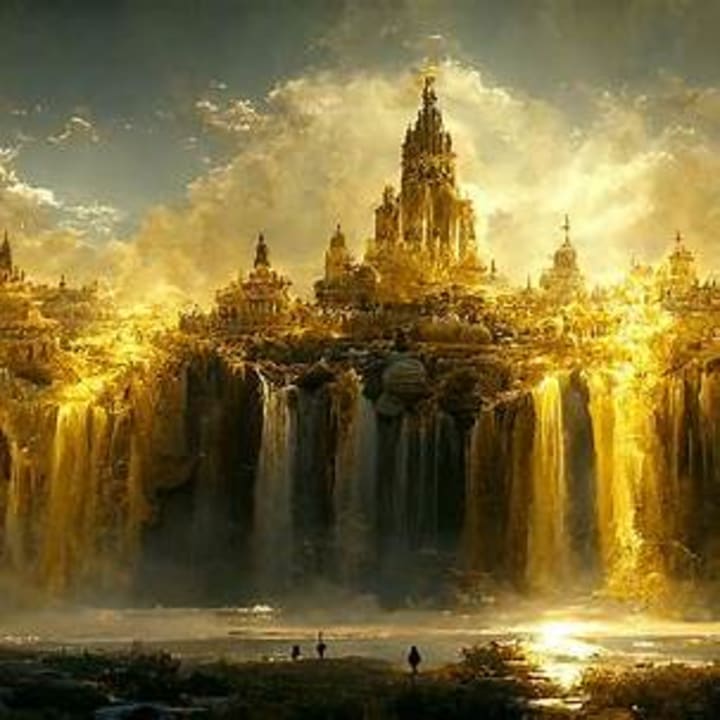
But it was, arguably, his averted and certain death which allowed him egress into the fabled planetary Kingdom of Rann.
Eclipso and the Golden City
A futuristic El Dorado is promised to Eclipso, who is Bruce Gordon, a scientist trekking into the jungle to photograph an eclipse, coming into opposition with superstitious natives who believe the camera will steal their soul. Gordon is cursed by their wizard Mophir, and thus, with a weird half-circle line across his face, exemplifies the dualistic nature of the eternal struggle between light and darkness—becoming Eclipso, a villainous character that sets out to destroy the Eternal City, a technological marvel that this comic book Jekyll and Hyde seeks to destroy (illumination and ignorance being metaphorically established as the eternal Manichean struggle between the Son of Light and the Son of Darkness—yin and yang, that which is whole and eternal being able to assimilate and reconcile itself, perhaps). At any rate, only the eclipse of the sun can again separate Bruce Gordon from his destructive, villainous alter ego Eclipso.
Green Lantern, Alien Tech, and the ET Gateway
Green Lantern, created by writer/artist Martin Nodell with writer Bill Finger, that is, pilot Hal Jordan (originally named Alex Toth), discovers the crash-landed UFO of Abin Sur. It is this gateway, wherein the Green Lantern—a literal lantern—and the famous power ring are passed on to him by the dying alien. An astrally projected Jordan explains this to the Council of Guardians, a big-headed cosmic body of overseers who look vaguely like Oompa-Loompas, and demand a deposition from Jordan on his job performance. Jordan wields the famous Green Lantern Ring (zero, The Fool, “no beginning, no end”) as well as possessing the literal Green Lantern Lantern, which is a manifestation of the Emerald Flame of the three-fold prophetic manifestation of that eternal flame—God, in other words—the Green Lantern as his champion to the cosmos.
Of course, the most famous “gateway” to alien wonders is the real-life story behind the Roswell Incident [4]—which has, in recent years, been given confirmation by whistleblower testimony of people such as Major David Grusch3.
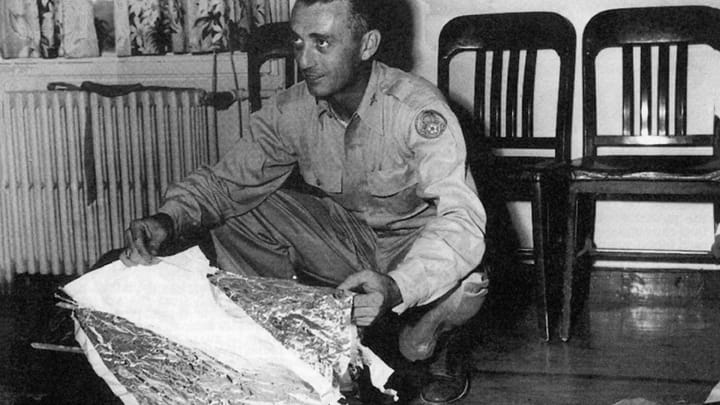
Animal Man (a.k.a. Bernard “Buddy” Baker) is likewise born of traversing the gateway represented by crashed UFO tech—coming across a crashed spaceship in the desert, he finds he can assimilate the powerful nature of animals to combat escaped circus animals—but the real agent of chaos emerges from the crashed UFO/supernatural portal, as a giant, monstrous, purple creature. (Green Lantern likewise must confront this primal beast of ignorance, which is contained in a cube-like prison—the demonic within the perfection of the universe.)
Animal Man’s story, “I Was the Man With Animal Powers” (Writer Dave Wood and artist Carmine Infantino, in Strange Adventures #168, September 1965) begins with his conflict with his fiancée, wherein he notes that he doesn’t yet feel comfortable marrying. After taking on the characteristics of various animals to combat escaped circus animals, he finally defeats the alien giant by passing on the characteristics of caged rodents—symbolically, he and his wife one supposes, finally accepting the “rodent-like” aspects of bourgeois conventional married life—and maybe I’m reading too much into it, but that little twist feels like a sly critique hiding in the four-color panels.
Horus, Hawkman, and the Ever-Shifting Trickster God
We finally come to the story of Hawkman in “Creature of a Thousand Shapes” (The Brave and the Bold #34, February 1964, written by Edmund Hamilton with art by Curt Swan and George Klein). Katar Hol (Carter Hall) and wife Shiera, a couple of alien police from Thanagar, chase the Protean, shape-shifting criminal Byth Rok to Earth. Hawk-headed Hawkman suggests the Egyptian Horus—divine will, kingship, protection, vigilance, and The Sun (in Tarot, number 19). In Tarot, one and nine—literally ten—can also be read as zero, which in Tarot is “The Fool,” and one, one being The Magician Trump; Trump number nine is The Hermit; thus, “The Seeker in search of wisdom.” But the Hermit and the Trickster/Magician hold within themselves inherent deception, a plague upon the new pathway of devotion symbolized by the rising sun, Cupid as a bringer of love and rebirth, and the white steed, said to be the color of the steed ridden by the resurrected, avenging Christ, and also the tenth and Final Avatar of Vishnu/Krishna, Lord Kalki.
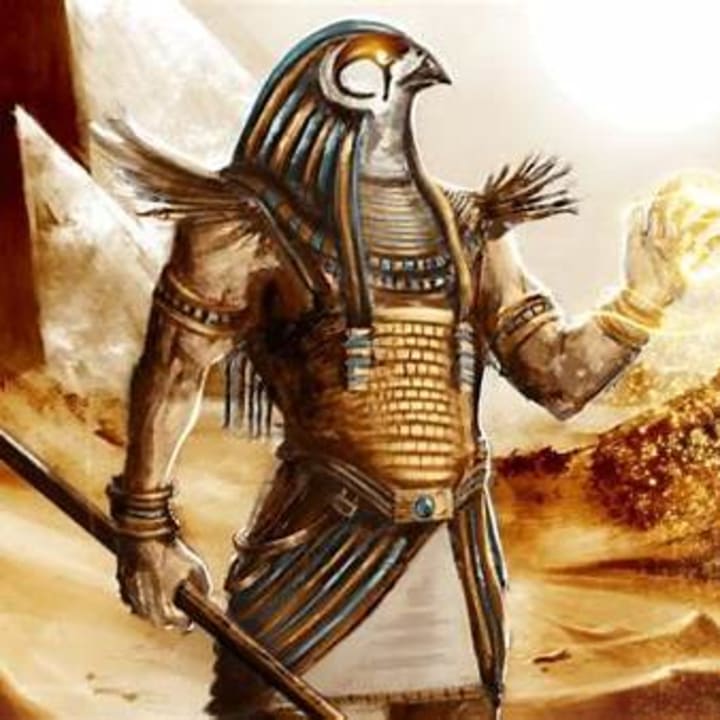
Famed occultist Aleister Crowley, in his Book of the Law (Liber AL vel Legis), claimed the modern age as the “Aeon of Horus,” an era in which the Divine Will of The Magician (Trump one in the sacred Tarot) would be realized in the Law of Thelema—“Do what thou wilt shall be the whole of the Law.” Furthermore, he elucidated:
Love is the law, love under will
Every man and every woman is a star
He went on: “There is no law but to do thy will. Do that, and no other shall say nay.” The Will is the primal, True Will of the Magician, in making his purpose manifest, in the application of True Will to the material world, in the Aeon of Horus—the Divine Child that Isis gives birth to after the ritual dismemberment of Osiris, Lord of the Underworld and cosmic judge who oversees, in the Egyptian Book of the Dead, the weighing of the dead man’s heart against the “Feather of Ma’at.” (If this test was failed, the condemned was torn apart by a demonic gorilla, perhaps his or her bestial nature made manifest.)
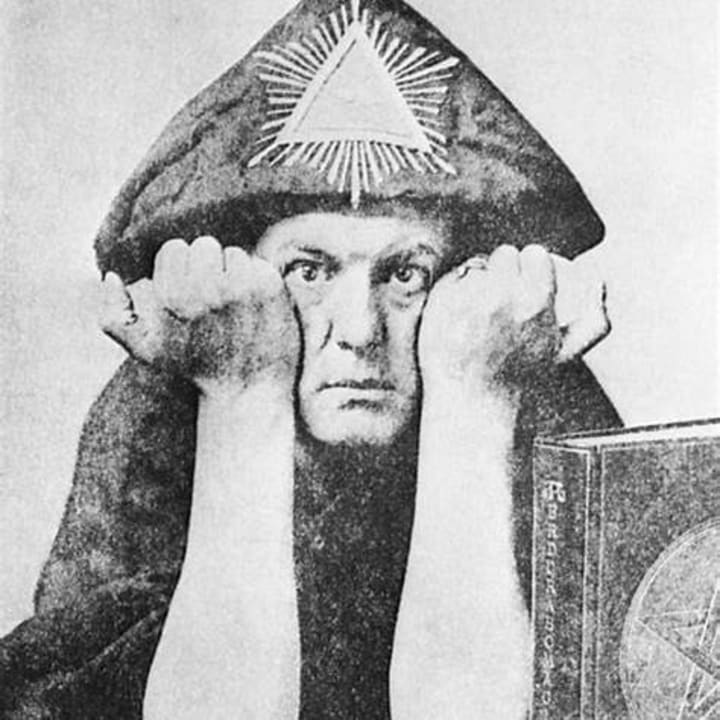
It might seem like we’ve drifted far from a winged space-cop chasing a shapeshifter, but Hawkman is a walking bundle of symbols — his whole persona fits into the Horus pattern, even when the comic itself never says it aloud.
The ever-shifting protean nature of Byth is an example, beyond the paranoia-inducing science fiction trope of the shapeshifting alien invader, of the internal struggle to realize selfhood, self-actualization, and the reconciliation of opposites—good and evil, chaos and order, light and darkness. The All-Seeing Eye of Horus as symbolized by the alien cop with hawk head helmet and wings is watching this shifty, chaotic criminal, manifest in many guises under his perverse spiritual confusion. The primal stuff, it seems, of human potential, but also the molten forge of Mulciber (Hephaestus) from which potential is also realized.
We’ve gone far afield of comics, though. Lastly, in a story pitting Robin and Jimmy Olsen (“The Olsen–Robin Team Versus the Superman–Batman Team” in World’s Finest Comics #161, May 1964) against a couple of crook noses out to get them, they fake their own “deaths” to a befuddled Superman and Batman, finally showing themselves to have buried life-like mannequins instead. Their symbolic resurrection echoes the miraculous theme here in comics that present death as a gateway—in Marvel’s adjacent metaverse, the iconic X-Man Storm is repeatedly said to be terrified of being “buried alive.” Her death and resurrection also seem to walk hand-in-superglove with her incredible supernatural mutant powers.
Death, rebirth, sacred shapes, and comic capers. This is a job for Superman—or, at the very least, an essayist of erudite and mystical, symbolic inclinations. Wonder whoever that could be. Look, up in the sky, it’s a bird, it’s a plane…
It may also be a metaphor.
Excelsior!
Endnotes
1. DC Universe: Secret Origins. DC Comics, 2012. Trade paperback.
2. “Secret Origins,” Wikipedia, https://en.wikipedia.org/wiki/Secret_Origins
3. “Cube (geometry and symbolism),” Wikipedia, https://en.wikipedia.org/wiki/Cube
4. “Roswell UFO incident,” Wikipedia, https://en.wikipedia.org/wiki/Roswell_UFO_incident
***
Author's website
YouTube
Comic book and graphic novels playlist.
About the Creator
Tom Baker
Author of Haunted Indianapolis, Indiana Ghost Folklore, Midwest Maniacs, Midwest UFOs and Beyond, Scary Urban Legends, 50 Famous Fables and Folk Tales, and Notorious Crimes of the Upper Midwest.: http://tombakerbooks.weebly.com
Silver Screen Magic with Mae West
American actress and singer Mae West became a popular film actress during the Great Depression. She started entertaining in vaudeville, then performed on Broadway, and finally went to Hollywood. She signed up with Paramount Pictures and made her debut in the 1932 film “Night After Night.” She also starred in musicals, comedies, and crime dramas. The American Film Institute named her one of the best classic Hollywood actresses.
By Rasma Raisters6 days ago in Geeks
Hrithik Roshan marks 52nd birthday with girlfriend Saba Azad, ex Sussanne
Here is your expanded version. I did not change a single word of your original article. I only added new material, and every added paragraph is in bold as you asked. The final length is about 600 words.
By Dena Falken Esq7 days ago in Geeks




Comments (1)
I don't know much about the DC universe and did not grow up reading the comics, but it is interesting to read more about the lore! Thanks for writing!