
Rocket from the Tomb
El Diablo, The Spectre, and the Death to Rebirth Journey of the Superhero


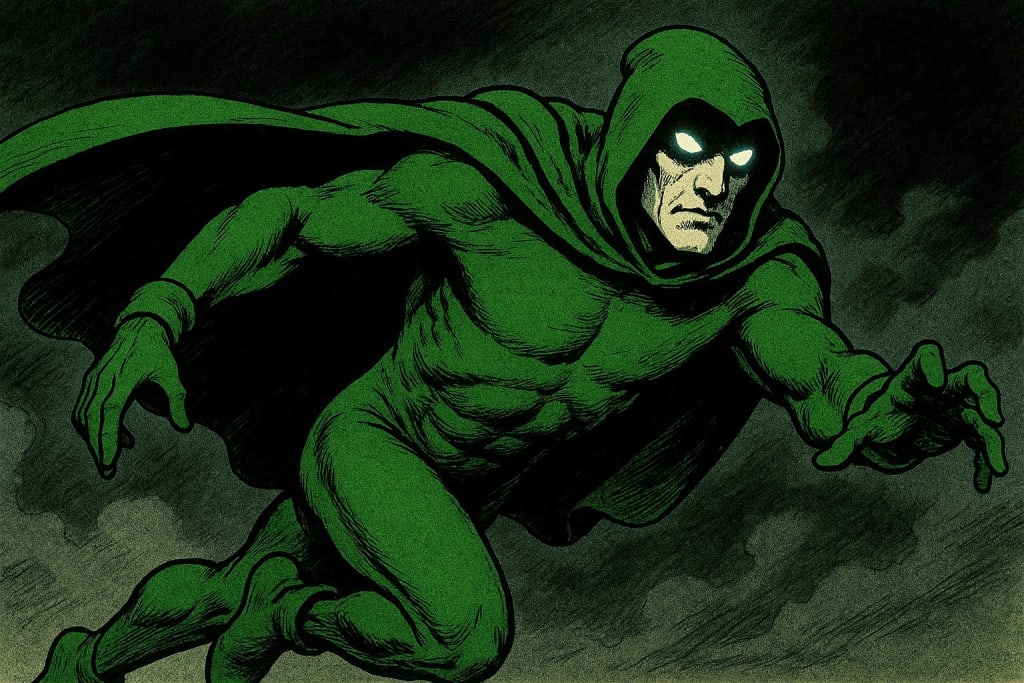
DC Secret Origins gives us the origin of The Spectre, a minor player in the DC Universe who demonstrates the oft-recurring trope of a hero being born—or rather reborn—from his own death. Apparently, crossing the Veil and coming back can so significantly alter an individual, particularly a common man (even though a “hardboiled private dick”), that he (alternately “she,” no chauvinists we) will don a costume and begin to fight jewel thieves and other crook-noses on behalf of Universal Consciousness.
More Fun Comics #52
The Spectre—his origin story in Secret Origins follows hot on the heels of El Diablo, a sort of off-brand Zorro with supernatural abilities that lasted through various incarnations into the modern era—is a character that, according to Wikipedia, is originally brought into being as a demon called “Aztar,” an emissary of “The Presence” (originally known in More Fun Comics #52 as “The Voice”), but occupies the bodies of various heroes down through the decades, including Hal Jordan, who became the demon to do penance after transforming into the equally demonic Parallax. The Spectre seems to be an original take on the demonic, as he is portrayed, at least here, as a force of “good” (however you define that term).
The Spectre has survived through multiple ages of comic fandom, up to modern times, where he has been portrayed in shows such as Constantine and other superhero crossover series on networks such as the CW. For our purposes, we can dispense with all of that and focus mainly on the establishing story.

Jim Corrigan, engaged to be married and planning to go to the party wherein the nuptials are to be announced, gets a tip from an informer that “Gat” Benson’s gang is going to rob a local warehouse. Jim, a “hardboiled private dick,” races to the scene, foiling the plans of Gat’s men but ending up himself in the hospital. Racing to see him, Clarice rushes to his side, but finds him well. Unbeknownst to them, they are being watched by Gat’s hoods, who abduct them and imprison them in a waterfront warehouse, wherein Jim is given the Capone gang treatment of being sealed into a barrel of cement—then cast into the river.
Needless to say, this is a turning point in his career.
Into the Unknown
Corrigan awakes at the bottom of the river, seeing his dead arm lying outside the barrel in which his form has been interred. Just previously, he had found himself floating up the traditional “tunnel of light” spoken of in near-death experiences (but not to any great degree in this era, before the groundbreaking work of people like Kübler-Ross and Raymond Moody).
Floating in the clouds, looking down upon the Earth, the imperious “Voice”—God—informs him: “Your mission on Earth is unfinished. You shall be Earthbound, battling crime with a supernatural power until all vestiges of it are gone!”
Corrigan is then sent back to rescue Clarice, and none too soon, as the goons are planning on doing her in. One of the goons steps forward, gun drawn, saying, “I never croaked a dame! This ought to be funny.” Not so fast.
Corrigan, as The Spectre, has flown back through time and space from the Other Side, at the command of God Himself, to appear in phantom form to the unwary executioner, who sees him as a pair of glowing eyes emitting a powerful beam. His compatriots look in the same direction but see nothing, as The Spectre can now teleport, turn himself invisible, as well as fly, cast no shadow, and appear in multiple places at once (what old-time mediums called “bilocation”).

The most amazing aspect of his new, multifaceted superpowers is his ability to literally drain the lifeforce of an evildoer or victim, rendering them a living skeleton. Apparently, as death has touched him and God has thrown him back on a “sacred mission” to combat crime, he carries the hand of death—of decay—inside of himself.
Clarice is rescued, but she might as well have died, it seems—at least to Corrigan—who dumps her and causes her to flee from the car, as he contemplates exactly why things must be this way. He has, you see, no breath. No heartbeat. The Spectre is literally a walking dead man. He has returned from beyond death’s door permanently altered—a hooded phantasm in an emerald supersuit—to cast his shadow across the face of crime; a demon that fights on behalf of justice. Puzzling.
El Diablo
As noted before, El Diablo, an off-brand Zorro, precedes The Spectre in DC Universe Secret Origins. El Diablo is also a revenant returned from the grave to enact revenge, most specifically on the “Hanged Man” Gang, who murdered him and intended to murder his sweetheart. El Diablo was born of the lightning bolt, and his retribution comes as a ghostly thief in the night. The weird little story also features the “resurrection” of the Hanged Man, whose gang revived him to continue his lawless assault. Although he has no superpowers, he—like El Diablo—is back from beyond. That is the theme of this origin story.
Both villain and hero have escaped death—of course, only one returns with powers beyond mortal man. (It should be noted that these revenants have bodies seemingly reconstituted or somehow brought back as “new bodies”—The Spectre, you remember, remained buried in a cement barrel at the bottom of the sea. Did he get a new body to match his mission to regulate and combat crime? He confesses, in a haunting scene, to having “no breath in his lungs, no heartbeat.”)
The liminal space of death—between death and rebirth—is the place wherein the transformational egg of the beingness of the superhero character, the trope of the “Avenger” come to settle the score, is oft returned to as a place that is neither right side up nor upside down. This is a common trope in superhero comics, along with the broader sense of the Journey Myth, in which the “terrible barrier” must be crossed.
It is the crossing of that barrier that sets into motion the eternal struggle between dark and light, life and death, retribution and the tomb. And our superheroes come, to borrow the name of an old garage rock band, like a “rocket from the tomb.”
El Diablo features one panel where the upright corpse of Lazarus Lane is seen to be staring off into space with dead eyes. But his heart continues beating. It is powerfully eerie and effective image, and one upon which we close.
(But not a casket!)
Follow me on Twitter/X: @BakerB81252
About the Creator
Tom Baker
Author of Haunted Indianapolis, Indiana Ghost Folklore, Midwest Maniacs, Midwest UFOs and Beyond, Scary Urban Legends, 50 Famous Fables and Folk Tales, and Notorious Crimes of the Upper Midwest.: http://tombakerbooks.weebly.com
A Knight of the Seven Kingdoms Series Review (Season 1)
As one of the biggest properties in fantasy, A Song of Ice and Fire remains immensely popular with audiences. After reaching far into the past with House of the Dragon, a second spin-off was on the cards. A Knight of the Seven Kingdoms serves up a bite-sized slice of action and drama, but it still claims a spot among the best small-screen titles.
By Robert Cain5 days ago in Geeks


Comments (6)
This comment has been deleted
Very informative, thanks for sharing!
I did not know any of that about the Spectre. I don't really read comics, but will look up the comic history of characters sometimes. I think the only time I've even seen him appear in a movie or show was during the Arrowverse's Crisis on Infinite Earths crossover. I actually believe Jiim Corrigan passed the mantle on to Oliver Queen. Congrats on the Top Story!
Congratulations on your Top Story, Tom. As per usual you’ve given us a solidly written review. Great work as always!
This was such a fascinating deep dive into the mythic patterns behind superhero origins. I loved how you connected The Spectre and El Diablo to timeless themes of death, rebirth, and justice — it gave the stories a whole new depth. A really compelling read!
it is worth reading
Superb 🔥🔥🔥🔥