
Classic Movie Review: There's More to 'Tommy Boy' Than Meets the Eye
Tommy Boy is more than just Fat Guy in a Little Coat if you care to look deeper at a Chris Farley comedy.


Tommy Boy
Directed by Peter Segal
Written by Bonnie Turner, Terry Turner
Starring Chris Farley, David Spade, Brian Dennehy
Release Date March 31st, 1995
Published April 1st, 2025
Tommy Boy is now 30 years old and watching it again with wizened eyes, I noticed something about Tommy Boy that I’d never noticed before. Tommy Boy contains, almost unintentionally, a concept that I am calling ‘Utopian Capitalism.’ What is Utopian Capitalism? It’s the kind of capitalism that we were sold in school, a notion of capitalism where profits are important, but not as important as helping people keep their jobs. Callahan Auto, the fictional auto parts company at the heart of the plot, is an American company with many employees and is saved by Tommy through hard work and a dedication to people before profits.
Tommy Callahan (Chris Farley) is the dopey scion of a multi-millionaire businessman, Big Tom Callahan (Brian Dennehy). Big Tom has run a great company funded by his ability to sell people on the quality of the products made in his Ohio plant. When Big Tom dies, the company falls into Tommy’s hands and to say that he’s not ready for this responsibility is a grave understatement. Tommy spent seven years trying to graduate from Marquette University and his major appears to have been being as drunk as humanly possible.
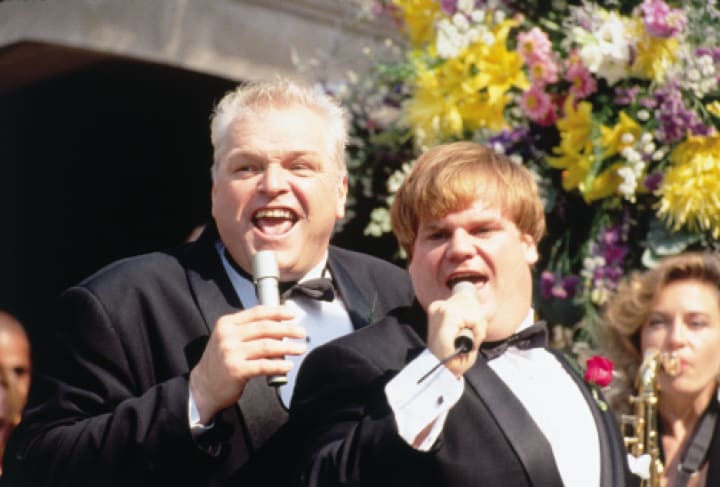
Now, with the weight of the entire business and its hundreds of employees on his shoulders, Tommy has to go on the road and convince businesses to sell his company’s parts. He’s joined by Richard (David Spade), one of his dad’s closest advisors, and a former schoolmate of Tommy. Richard is an expert in how parts are made but he has no people skills. Tommy has no skills, little charm, and is like a bull in a china shop in every interaction with a business owner. How can he possibly keep the company from being taken over by Zelinsky Auto, a large corporation that just wants the Callahan name brand and plans to shutter the plant and fire the employees.
Naturally, because Tommy Boy needs a false crisis, a false dawn, a real crisis, and a real dawn, we know that the false crisis will be Tommy struggling to learn how to sell and failing miserably. Then, the false dawn will be Tommy becoming a good salesman and seeming to save the company. The real crisis will then be that Rob Lowe’s bad guy character will bumble into a way to disrupt Tommy’s success. This then leads to the real dawn where Tommy, Richard, and Tommy’s love interest, Michelle (Julie Warner), find a way to save the company while exposing the villainous Rob Lowe and his partner played by Bo Derek.
It’s all very predictable, straight out of the screenwriting handbook. Robert McKee would be very proud of how his mediocre boiling down of storytelling to a series of beats has been applied in the creation of yet another easy to follow plot that mirrors every other underdog protagonist story in history. And yet, Tommy Boy has one weird, left field notion of how to reach a resolution that involves keeping an American auto manufacturing business open. At a time when corporate greed and automation were decimating the very jobs that Tommy Boy values, this movie defies modern capitalism with an uplifting notion of saving an American manufacturing company and its employees.
Tommy Boy has a wild notion that a nepo-baby like Tommy, raised in privilege, given seven years to screw off in college before coming home to a high paying desk job, despite demonstrating no capabilities whatsoever, is also going to be a benevolent, self-sacrificing good guy. This is a utopian version of capitalism because, generally speaking, this doesn’t happen. Generally speaking, the Tommy’s of the world would immediately liquidate their company so that they could buy a sports team or a series of yachts. In Utopian Capitalism, the owner of a company isn’t worried about profits, he’s worried about keeping his employees in their well paying union jobs.
In Utopian Capitalism, those with the means to start companies do so as a way to enrich themselves but also because they have pride in creating quality products. These utopian capitalists care about their community and the people who live there. They know the names of their employees, have personal relationships with them, and work to keep them employed, engaged and well paid enough to spend weekends at their kids ballgames and recitals. Profits are important, but can be sacrificed, to a point, let’s not get crazy, to make sure that local charities, churches and hospitals are able to provide needed services via donations.
In modern American capitalism growth in profits by any means necessary is the ethos. This means automation. This means driving other companies out of business. It means abandoning American cities because a foreign country has cheaper labor that can be exploited. Wall Street financiers fire American workers for no reason other than their salary is a line on a spreadsheet. In modern capitalism, Callahan Auto gets shuttered immediately, the parts are made in Southeast Asia, and Dan Akroyd’s Mr. Zelinsky uses the money that would have gone to pay Callahan employees to buy a third yacht or a fourth summer home.
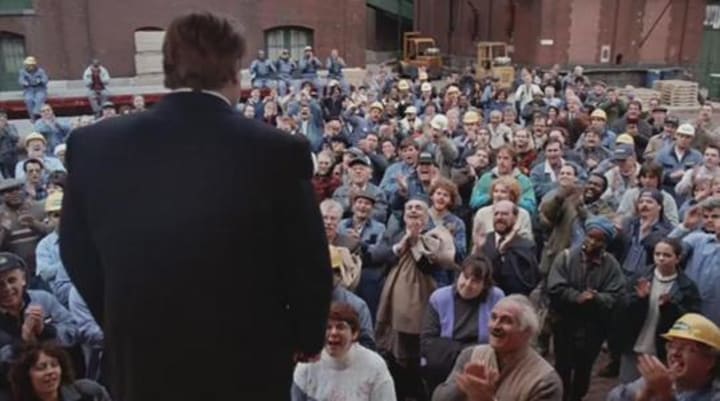
Tommy Boy is undoubtedly a silly comedy where the predominant joke is that Chris Farley is overweight and falls down a lot. But deep inside the movie is a big beating heart for the kind of America that Wall Street has slaughtered in the 30 years since Tommy Boy was released. Wall Street decimated main street companies like the fictional Callahan Auto to squeeze a few more dollars up to the people who already have more money than they will ever need. All the while, the government stood by, pretending to empathize with people being put out of their well paying jobs while laughing it up with lobbyists who line their pockets with cash to look the other way while they rob the very workers that the legislators pretend that they care about.
Tommy Boy may be silly but deep down inside is a genuine empathy for the American worker whom the film celebrates as a family, a community, and a diverse group of hard working people deeply connected to one another via their jobs, families, and friendships. A company like the fictional Callahan Auto living on and thriving is something that should have been an American ideal. It’s the kind of utopian capitalism that we were all promised. We were promised that if the best people made the best product, competition would allow them to thrive. Good employees would progress through the ranks with raises and more responsibilities but everyone would have a good paying job to help them raise a family, as long as they were willing to put in the work for it.
Modern capitalism has curdled into a bitter, furious pursuit of money by any means necessary. Producing quality products means less than making a product barely functional enough to make a profit. We no longer pursue making the best things, we are now driven to make a buck no matter how we make it. We have an economy of hucksters and con artists, each trying to one up each other while stealing from those of us who long to simply play by the rules we were promised, raise our families and have enough work and pay to have a home, a community, and good friends.
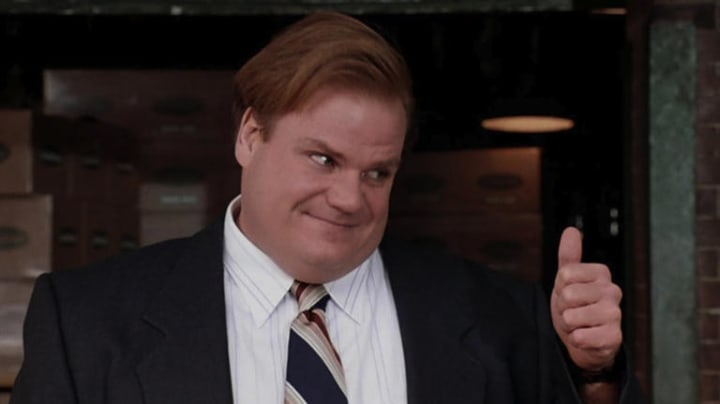
I love Tommy Boy for this reason, more than any other. Don’t get me wrong, I also miss Chris Farley and I adore his teddy bear like qualities. But what I truly love about Tommy Boy is the naive and wonderful belief that fighting for our small town businesses, our friends, our families, our employees, is more important than profits, stock prices, or any other grifter notion of modern capitalism. Tommy Boy may thrive on being about a big lovable doofus who falls down, but the true magic of Tommy Boy comes in the heart that Chris Farley brings to Tommy, a big loving, empathetic heart that sacrifices everything he has for the people he cares about.
Tommy wins the day in the end and keeps his company and all of his employees. At the end of Tommy Boy, Tommy’s big heroic speech promises that his employees will always have a job with him and he will do everything he can to keep them employed and their community alive. Laugh all you want at 'Fat Guy in a Little Coat,' but I love Tommy Boy for it’s heart, and it’s utopian idea of capitalism, hiding in plain sight amid the fat jokes and broad physical comedy. Tommy Boy was the last place that I was looking for a heartwarming message about rescuing America from the grifters and con artists of modern capitalism but here we are. I now fully believe that we need more Tommy Callahan’s and fewer Elon Musk’s in the world.
Find my archive of more than 24 years and more than 2000 movie reviews at SeanattheMovies.blogspot.com. Find my modern review archive on my Vocal Profile, linked here. Follow me on Twitter at PodcastSean. Follow the archive blog on Twitter at SeanattheMovies. Also, join me on BlueSky, linked here. Listen to me talk about movies on the I Hate Critics Movie Review Podcast. If you have enjoyed what you have read, consider subscribing to my writing on Vocal. If you’d like to support my writing, you can do so by making a monthly pledge or by leaving a one time tip. Thanks!
About the Creator
Sean Patrick
Hello, my name is Sean Patrick He/Him, and I am a film critic and podcast host for the I Hate Critics Movie Review Podcast I am a voting member of the Critics Choice Association, the group behind the annual Critics Choice Awards.
Keep reading
More stories from Sean Patrick and writers in Geeks and other communities.
Silver Screen Magic with Mae West
American actress and singer Mae West became a popular film actress during the Great Depression. She started entertaining in vaudeville, then performed on Broadway, and finally went to Hollywood. She signed up with Paramount Pictures and made her debut in the 1932 film “Night After Night.” She also starred in musicals, comedies, and crime dramas. The American Film Institute named her one of the best classic Hollywood actresses.
By Rasma Raisters6 days ago in Geeks
Tamer Hassan
Tamer Hassan is a name that carries weight in British film, television, and even popular culture beyond the screen. Known for his tough-guy roles and unmistakable presence, Hassan has built a career that reflects resilience, reinvention, and a deep connection to family. In recent years, public curiosity around him has also grown because of his daughter, Belle Hassan, who rose to fame on Love Island. This combination of cinematic grit and reality TV visibility has introduced Tamer Hassan to a whole new generation of audiences. Early Life and Path to Acting Before becoming a familiar face in crime dramas and action films, Tamer Hassan lived a life far removed from movie sets. Born in London, he grew up in a working-class environment where discipline and survival were everyday lessons. In his early adulthood, Hassan was involved in professional boxing and worked as a bouncer, experiences that later influenced the authenticity he brought to his on-screen roles. Unlike many actors who follow a traditional drama school route, Hassan’s entry into acting was unconventional. His natural intensity, real-life toughness, and commanding voice caught the attention of casting directors looking for realism rather than polish. This background helped him stand out in an industry often saturated with similar profiles. Career Highlights and Acting Style Tamer Hassan is best known for portraying hardened characters—gangsters, enforcers, and morally complex figures who live on the edge. Films such as Layer Cake, The Business, Kick-Ass, and Batman Begins allowed him to showcase his ability to bring depth to characters that could otherwise feel one-dimensional. His performances often balance menace with vulnerability, making his roles memorable even when screen time is limited. On television, Hassan has appeared in popular British series including EastEnders, Silent Witness, and Game of Thrones. These roles further cemented his reputation as a reliable character actor who elevates every project he joins. Rather than chasing leading-man status, Hassan has built a steady career by embracing roles that feel authentic to his life experience. Life Beyond the Camera While his on-screen persona is often intimidating, those close to him describe a different side of Tamer Hassan. Family plays a central role in his life, and this became especially visible when his daughter entered the public eye. Many viewers who searched online for “belle hassan dad” or “who is belle’s dad Love Island” were surprised to discover the connection between the reality TV contestant and the seasoned actor. This curiosity wasn’t just gossip-driven. It reflected genuine interest in how two people from the same family could navigate fame in such different ways—one through gritty cinema and the other through modern reality television. Belle Hassan and Public Curiosity Belle Hassan appeared on Love Island in 2019 and quickly became known for her strong personality and emotional honesty. As her popularity grew, so did questions like “who is Belle from Love Island’s dad” and “who is Belle Hassan dad”. The answer consistently led back to Tamer Hassan. Unlike some celebrity parents who actively leverage their status, Hassan remained largely in the background during Belle’s time on the show. This approach earned respect from fans who appreciated that Belle’s journey felt independent rather than manufactured. Searches such as “Love Island Belle dad” or “belles dad Love Island” often revealed interviews where Hassan expressed pride in his daughter while emphasizing that her success was her own. A Father-Daughter Dynamic in the Public Eye The relationship between Tamer Hassan and his daughter added an interesting layer to public discussions. People asking “who is Belle’s dad from Love Island” often expected a flashy celebrity figure, but instead found a grounded actor who values privacy and hard work. Hassan has spoken openly about wanting to protect his children from the harsher sides of fame while still supporting their ambitions. This balance resonated with many parents watching from the sidelines, especially those navigating social media-driven celebrity culture. In that sense, Hassan’s role as a father became just as compelling as his roles on screen. Legacy and Cultural Impact Tamer Hassan’s career is a reminder that success in entertainment doesn’t follow a single path. His journey from boxing gyms and nightclubs to major film sets reflects determination and adaptability. At the same time, his association with Love Island through Belle Hassan has expanded his relevance beyond traditional film audiences. For some, he is the actor known for intense performances; for others, he is simply the answer to “who is Belle from Love Island dad.” Both identities coexist, and together they paint a fuller picture of a man who has lived multiple lives within one. Final Thoughts Tamer Hassan stands as a unique figure in British popular culture. His work ethic, authenticity, and commitment to family have shaped a career that continues to evolve. Whether recognized for his film roles or through questions about who is Belle Hassan dad, Hassan remains a compelling example of how personal history and professional life can intersect without losing integrity.
By Saboor Brohi 3 days ago in Geeks


Comments (1)
Loved your musings on today's oligarchic capitalism and utopian capitalism, Sean. I've never seen the movie but am inclined to watch now.