
Classic Movie Review: Is Steven Spielberg's 'A.I' Bad Actually?
Movies don't change you do, and I have changed enough to see A.I Artificial Intelligence for the shallow artifice that it truly is.

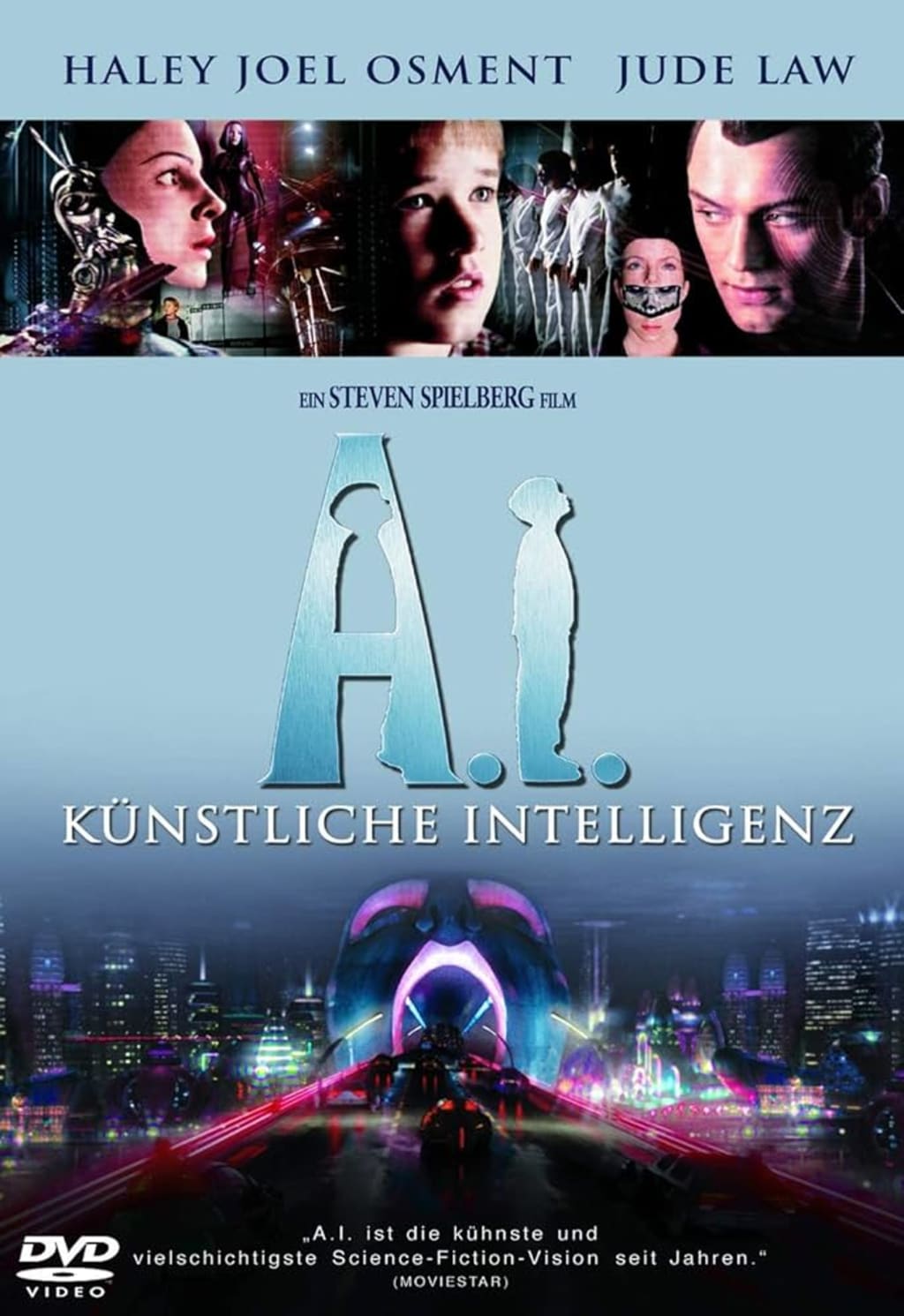
A.I Artificial Intelligence
Directed by Steven Spielberg
Written by Brian Aldis, Ian Watson, Steven Spielberg
Starring Haley Joel Osment, Frances O’Connor, Jude Law, William Hurt
Release Date June 29th, 2001
Published February 5th, 2025
Movies don’t change, you do. A few years back I wrote about the 30th anniversary of Dirty Dancing. I had always been dismissive of Dirty Dancing, foolishly viewing it as a movie for girls who wanted to ogle Patrick Swayze’s swiveling hips. Today, I understand how shallow that reading is, while also being old enough and mature enough to understand that there is nothing wrong with having feelings about an attractive person’s swiveling hips and ripply muscles. The erotic appeal of Dirty Dancing is an asset, not a liability. But that's a topic for another Dirty Dancing essay that I should write.
The sweaty, sexy, heavy breathing aspects of Dirty Dancing are the inviting surface covering the simmering politics and polemical deconstruction of 80s era America, stealthily hiding in the heart of Dirty Dancing. Director Emile Ardolino uses pop culture signifiers to deconstruct the myth of Reagan’s notion of America, one of repression and a pining for the good old days of the 1950s when women and minorities had fewer rights and weren’t trying to forcefully change the patriarchal society. It’s all there in the detailed and ingenious subtext of Dirty Dancing. And it took me 30 years to see it.
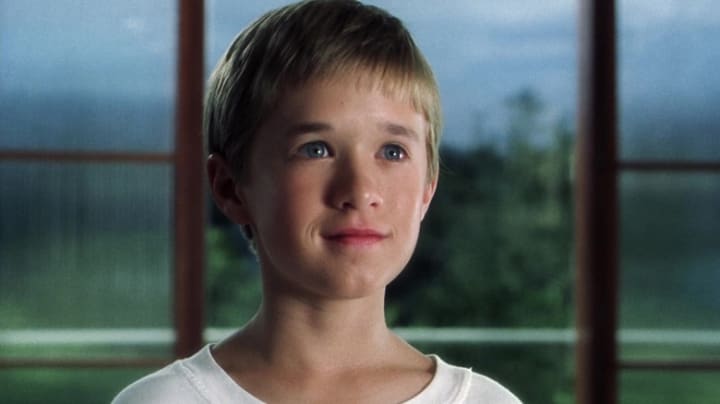
That’s a rather roundabout and admittedly odd way for me to arrive at a review of Steven Spielberg’s 2001 sci-fi blockbuster, A.I Artificial Intelligence. But I promise, I have a point. Spielberg’s A.I was hailed by me as a masterpiece when it was released. It was Spielberg combining his magical, nostalgic whimsy with a dark and tortured story first written by his late friend, and fellow director, Stanley Kubrick. The style of the film is overwhelming and your heart can’t help but melt for the doe-eyed innocence of Haley Joel Osment.
But I am not the same person who held A.I Artificial Intelligence in such high regard in 2001. Experience and maturity have reshaped the way I see the world and the way I watch movies. In 2001, I was a rookie film critic, fresh from having built his very own film school curriculum from textbooks at libraries and the films available to me at my job at a video store. I was under the delusion that I was an edgy intellectual ready to challenge the staid opinions of veteran film critics with my hot takes and recently earned credibility loaned to me by textbooks and my fellow edgy twenty-somethings with similar eagerness to prove that they knew better than their stodgy old peers.
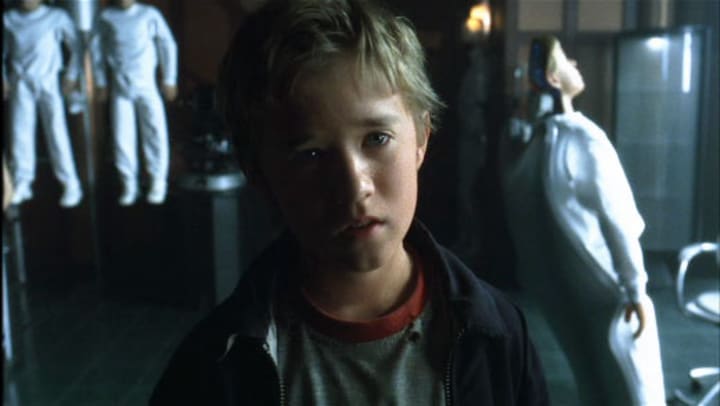
Why I would then think that lavishing praise on the most mainstream of mainstream science fiction, from the single most mainstream filmmaker on the planet, was edgy? I have no idea. This week I watched A.I Artificial Intelligence for the first time in more than 20 years and what I found was a movie of remarkable construction with nothing beneath it. My experience and age has caused me to see a film that I once believed an untouchable masterpiece as little more than a deeply flawed product of Spielberg’s love for a late friend, one he hadn’t fully fleshed out or considered.
A.I Artificial Intelligence stars Haley Joel Osment as David, a robot boy of extraordinary capabilities. David is given as a gift from Henry (Sam Robards) to his wife, Monica (Frances O’Connor). The couple has a son but he’s been in a coma for some time and doesn’t appear to have a chance to live much longer. In the hope of helping Monica recover from her despair, Henry acquires David from the company where he works as an engineer. David is the first of his kind, a child robot. If Monica chooses, he can be emotionally bonded to her and will become her child.
She eventually does accept David as her own but circumstances arise that cause her to reject David when her real son, Martin (Jake Thomas), miraculously emerges from his coma. Monica is supposed to return David to the company to be destroyed, as her rejecting him after he has bonded with her as his mother, means he will never be able to pair with another family. Monica can’t bring herself to have David destroyed so she abandons him in a forest and tells him to run away and stay alive.
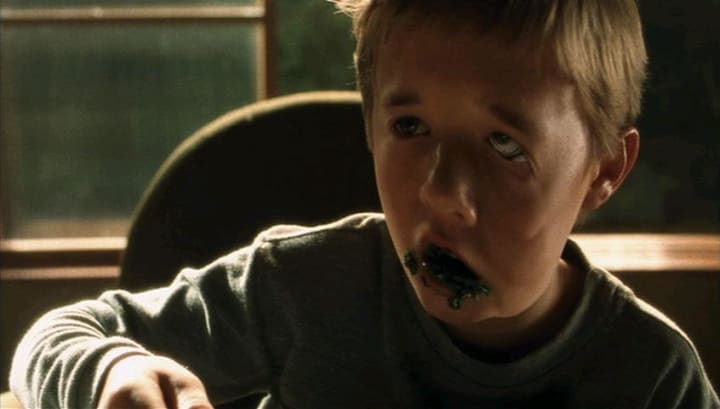
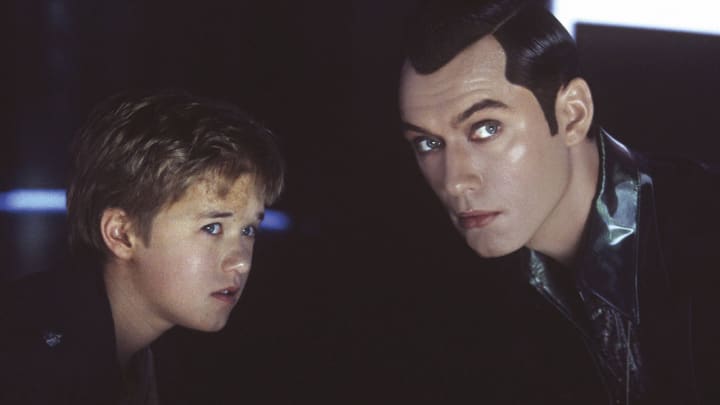
A confused David believes that Monica rejected him because he’s not a real boy. But, based on a fairy tale she’d read to him, Pinocchio, he believes he can become a real boy if he finds the legendary Blue Fairy and makes a wish. Thus begins an adventure that will soon be joined by a fellow robot, Gigolo Joe (Jude Law), who is on the run from the police after being framed for a murder. Joe is a sex worker robot who tells David that he can romance the Blue Fairy for him and convince the fairy to give David his wish.
And it was around the time that Joe was introduced where the dam broke on my feelings about A.I Artificial Intelligence. By this point, I was trying to give the movie time to start being the movie I remembered. Instead, what was dawning on me was a movie of extraordinary unintentional cruelty and mean spiritedness. David is just a robot but we also know him as the adorable but deeply haunted kid who saw dead people in The Sixth Sense. He looks like the most adorable, innocent child on the planet and the film is repeatedly, unendingly cruel to him.
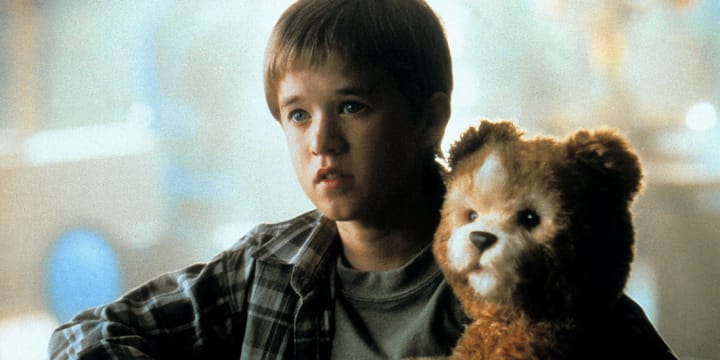
And why? It doesn’t seem necessary. It doesn’t add anything to the story for the film to repeatedly rug pull this poor, innocent robot child. I get the impression that Steven Spielberg feels that he is crafting a modern day, sci-fi, Sullivan’s Travels but with a child robot protagonist, but what he sees as adventure, I see as a series of needless cruelties visited upon a figure that is both human and non-human. He may be a simulacrum but he’s also Haley Joel Osment and it’s not fun to watch him be treated with unending and ultimately pointless cruelty. David doesn't understand cruelty. But he does hurt and yearn and seek a logical space to overcome his hurt and cure his yearning and this is incredibly sad to watch and in no way entertaining.
This is no more apparent than in the bizarre and pointless ‘Flesh Fair’ sequence. A group of damaged robots is seen scavenging other dead robots for parts when a moon shaped hot air balloon appears on the horizon. Inside, a bellowing Brendan Gleeson shouts commands to unseen hordes to capture the robots. His evil purpose is to destroy the robots in front of a crowd that is baying for simulated blood. They hate robots, they see them as replacing humans and watching Gleeson’s minions rip them apart in elaborate displays of destruction is satisfying for these people.
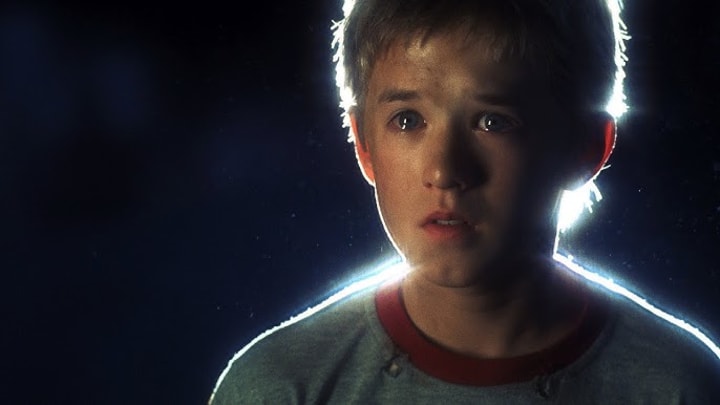
Satisfying until it’s David’s turn. Then, suddenly, all they see is a child. In the same way we are invited to see David as a child, the flesh fair audience sees him that way and demands that he be released. A riot ensues and David is able to escape alongside Gigolo Joe (Jude Law) whom he happens to just grab hold of and not let go of. Joe listens to David’s story and being a naive robot himself, he buys into the Blue Fairy and promises David that he knows a way to find her. And off they go, the sex worker and his kid best friend, off to the big city.
Spielberg as a storyteller has failed to consider the details of presenting this Flesh Fair idea. The first misstep is that bizarre, moon shaped hot air balloon, an entirely impractical idea that gets sillier the more you think about it. At some point, this evil impresario had to have someone build him a hot air balloon with a magnetic cage attached to it for catching robots. Why the moon? Why a hot air balloon? This is the future, this guy could not find a more practical way to be evil? It’s a needless and distracting detail of a kind that a filmmaking veteran like Spielberg should know better than to create.
Why is it called a Flesh Fair? These are robots, they don’t have ‘flesh.’ Flesh Fair sounds like a Motley Crue record, not a sequence in a Steven Spielberg movie. It’s a sequence that is desperately undercooked. For one thing, if the flesh fair is intended as an allegory for the ugliness of racism, something that it clumsily resembles, it's a really problematic allegory. The robots killed for sport at the Flesh Fair are portrayed as damaged and broken rathan than simply different from the people who are persecuting them. Other races are not damaged or broken and it is poor semiotics to allow such an ill-considered comparison to be so visible.
The crowd and the people enacting the cruelty for entertainment at the Flesh Fair are shown to be motivated by how robots are replacing them in the workforce and in other aspects of society and if this doesn't ring a bell, you might want to look into 'The Great Replacement Theory.' I want to believe that Steven Spielberg isn't exploiting racist theory to create a cynical, shallow obstacle for his robot movie, but it's hard to ignore. At the very least, it is remarkably shallow and clumsy. It's also a clear indication of how little consideration was given to what this sequence symbolizes.
This is emblematic of so much of A.I Artificial Intelligence. For instance, Gigolo Joe. Why is he a sex worker? Nothing against sex workers, sex work is work, but what does Joe being a sex worker add to the story of A.I? Why is he framed for murder? What does that have to do with the story of a boy re-enacting the myth of Pinocchio while longing for the love of a mother? Joe’s status as a sex worker wanted for a murder that he did not commit has nothing to do with the main story of the film and could be removed entirely without affecting the plot in any way. Joe's story raises numerous needless and distracting questions about the world Spielberg is building in A.I Artificial Intelligence.
It’s easy to be dazzled by cinematography and special effects and what appear to be big ideas about the future and technology. I know that I was certainly fooled by Spielberg’s talent for razzle dazzle filmmaking when I reviewed the movie in 2001. But, years later, I need more than technical mastery. I need more than the surface level effort of solid filmmaking. When a major filmmaker like Spielberg promises something with a larger meaning or point, I go looking for it now. I went looking for it in this rewatch and I found nothing but disappointment.
Find my archive of more than 24 years and more than 2000 movie reviews at SeanattheMovies.blogspot.com. Find my modern review archive on my Vocal Profile, linked here. Follow me on Twitter at PodcastSean. Follow the archive blog on Twitter at SeanattheMovies. Find me on BlueSky as well. Listen to me talk about movies on the I Hate Critics Movie Review Podcast. If you’d like to support my writing, you can do so by making a monthly pledge or by leaving a one time tip. Thanks!
About the Creator
Sean Patrick
Hello, my name is Sean Patrick He/Him, and I am a film critic and podcast host for the I Hate Critics Movie Review Podcast I am a voting member of the Critics Choice Association, the group behind the annual Critics Choice Awards.
Reader insights
Outstanding
Excellent work. Looking forward to reading more!
Top insight
Heartfelt and relatable
The story invoked strong personal emotions
Keep reading
More stories from Sean Patrick and writers in Geeks and other communities.
Silver Screen Magic with Mae West
American actress and singer Mae West became a popular film actress during the Great Depression. She started entertaining in vaudeville, then performed on Broadway, and finally went to Hollywood. She signed up with Paramount Pictures and made her debut in the 1932 film “Night After Night.” She also starred in musicals, comedies, and crime dramas. The American Film Institute named her one of the best classic Hollywood actresses.
By Rasma Raisters5 days ago in Geeks
Premier League in Italy: How to Watch
The 2025–26 Premier League season is underway, marking the 34th edition of the competition and the 127th year of top-flight English football. Liverpool start their title defense with confidence after lifting their second Premier League trophy last season, but the return of Leeds United, Burnley, and Sunderland ensures fresh rivalries – including the long-awaited Tyne–Wear derby, back for the first time since 2015–16.
By David Cook7 days ago in Geeks




Comments (2)
I rewatched the film recently, and I felt that while the idea was a good one, the storyline is flawed. It seems to me to have a very black-and-white theory of 'You're only good enough while replacing loss,' and then comes rejection. I feel that there could have been a little more empathy for David in the film and that at times the film goes off-topic. I think the topic of child replacement with an artificial, child whose emotions are not considered is a little absurd and totally illogical. I used to find the movie interesting, but like you, I have grown since and now I find it a bit unreasonable.
I do agree on some of your points. Back in 2002 when I watched it, I had high expectations of the movie and was kinda disappointed with it, I thought it was too long. The sex worker adds depth to the character, also adds depth to the whole time/society that the movie plays in. On two different levels the backstory, even unexplored, is important. In my opinion, A.I. is good movie, but that's it. It could have been much better.