
Book Review: "Violence and the Sacred" by René Girard
4/5 - a prophetic text filled with previous ideas expanded upon...a reason for why we commit to scapegoating and violence...

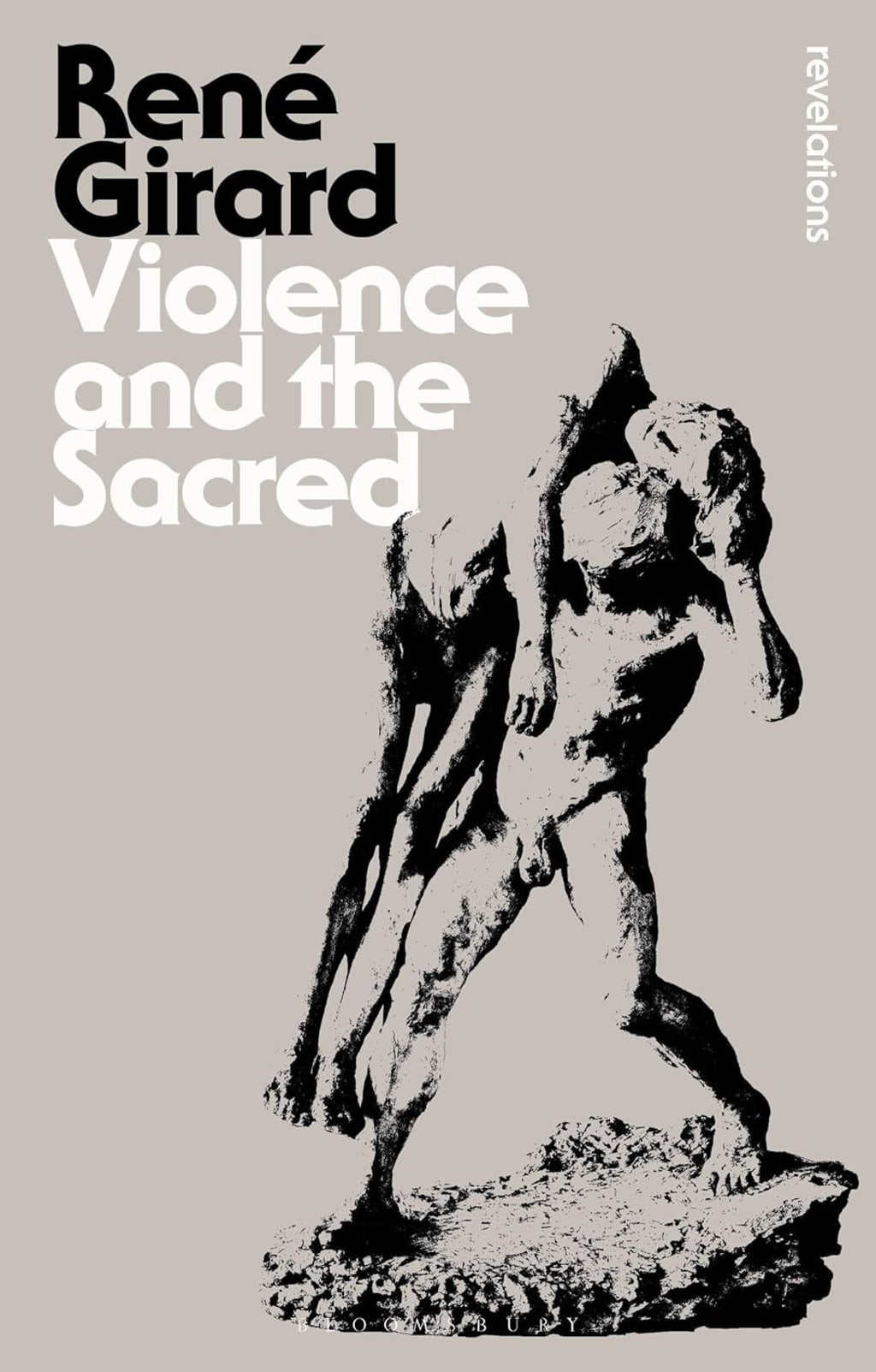
The claim that we desire things because others desire them is quite confidently the basis of many psychology books and many claims made about modern culture - especially concerning consumerism. Rather than wanting objects for their intrinsic value, humans imitate the desires of others, especially those they perceive as rivals or models. In his book All Desire is a Desire for Being, the author makes this bold claim backed up with ideas and facts to illustrate them. In my review of the book last year, I saw that Girard's maxims were anthologised as something called mimesis and that 'desire' was actually imitation. (I even depicted this through a clip from The Simpsons tagged in the review itself). But how does this then transfer to the idea of human sacrifice, religion and man's natural propensity for violence?
Girard's argument hinges on the idea that sacrifice seeks to rebuild or re-harmonise a community of people. Rivalry within the in-group can create tensions and in-fighting, but sacrifice is something that overarches and brings people back towards each other. An act of sacrifice is violent, and so acts as a kind of catharsis for the violence within the in-fights. But, sacrifice is also a common ground - a practice in which people are taught to act out of character, and thus given permission to be aggressive. Therefore something like desire, in his analysis, is never innocent or purely personal - it is social, imitative, and dangerous. It creates conflict and so, must be brought back to the most common, base of grounds. Unchecked mimetic rivalry causes these societies to descend. Everyone becomes both aggressor and victim.
Do I agree? No, not really. There's evidence that these societies descended for a whole host of reasons, but not all of them are through acts of extreme desire and in-fighting. But I do agree with the idea that sacrifice doesn't exactly solve the problem - instead it gives people permission and of course, over time, this want for permission erodes, but without an outlet, violence multiplies endlessly. The community, facing annihilation, unconsciously seeks a way to discharge this violence. This need gives rise to the scapegoat mechanism. Violence, paradoxically, becomes the means by which order will later be restored. I know, I was very concerned about this idea as well, but the more you think about it - the more it makes perfect sense. If you were to read this alongside some books by Christopher Hitchens, you would probably realise that there is a whole host of issues in religion concerning horrific acts of violence only there to restore order.

When crisis points are reached, Girard argues, the desire becomes to converge on a single victim. Individuals or singular groups are blamed for the issues within the community and thus, are scapegoated. This victim is often marginal, ambiguous, or vulnerable, making them a plausible target. By scapegoating this person/group and directing violence towards them, the community seeks to release its tensions again, as an act of catharsis rather than actually solving whatever problem they have through logic and reason. Girard states that the scapegoat is innocent of the crimes attributed to them; their guilt is a social construction - they either accept their fate (assimilation as a means of trying to fit in with the in-group) or they retaliate (causing the in-group to have a 'look, they really are guilty' moment). The scapegoat is interpreted as both guilty and powerful, a combination which makes it likely that they will 'strike again' and thus require to be ousted at the first given opportunity.
Various codes and laws of the in-group, Girard suggests, prohibit the escalation of mimetic desire's violences. When prohibitions fail, ritual sacrifice restores balance. Together, apparently prohibition and ritual form a system that keeps violence at bay. Therefore, "social rules" are not arbitrary; they are defensive structures. This reframes religion as a stabilising force rather than mere superstition. It also explains the actions of many of various in-groups on social media today. It is no mistake nor is it an accident, that these groups behave in a cult-like manner and anyone seen not adhering to the cult is cast out without a word. Girard moves on to the paradox of violence but does not leave out the fact that early societies understood the nature of mimetic desire and its intended violences long before they had a term for it.
The sacred is both violent and protective. That really is the paradox we're dealing with in this book. The sacred victim is terrifying because they embody the chaos that preceded their death and the peace that followed it. Therefore, according to Girard, the sacred does not represent moral goodness; it represents order born from violence. The first thing this does is challenge the more sentimental views many have of religion, the second thing it does is it helps us to understand why the social structures for religion existed in the first place. Girard's statement alluding to the fact that we are doomed to repeat these structures might be terrifying though they aren't completely unfounded. Again, we have witnessed this on social media over and over again. And in the coming years, I predict we will witness people take this to the streets - the chronically online hitting back in the real world.
To conclude, I am sure that there is something that we can all enjoy about this dark and prophetic tale. Girard's books themselves are always a philosophical delight to read and he makes some excellent points, though they do not come without their limitations. I believe that if you're looking for an explanation as to why these social structures keep on happening with us then definitely, read this book. But I'm not sure that it does the explanation as to how it happens all that well. For some reason, for me there is something very slight that is still missing. Like a puzzle not quite complete without one, single piece.
About the Creator
Annie Kapur
I am:
🙋🏽♀️ Annie
📚 Avid Reader
📝 Reviewer and Commentator
🎓 Post-Grad Millennial (M.A)
***
I have:
📖 280K+ reads on Vocal
🫶🏼 Love for reading & research
🦋/X @AnnieWithBooks
***
🏡 UK
Keep reading
More stories from Annie Kapur and writers in Geeks and other communities.
The Big Book Review: "Thinking, Fast and Slow" by Daniel Kahneman (Pt.1)
This book is split into parts but honestly, the parts themselves have so many ideas that I have no idea how I could fit everything I wanted to say into ONE review. I know I haven't done this since 'Reliable Essays' by Clive James, but I'd like to try that structure again. Sorry if it's not something you enjoy but I really wanted to share this...
By Annie Kapura day ago in Geeks
Lauren Sánchez Bezos Kicks Off Paris Couture Week in a Blood-Red Suit
Mrs. Bezos has brought her glamazon wardrobe to Paris for Haute Couture Week. Lauren Sánchez Bezos made a splash in blood red today as she arrived, hand in hand with husband Jeff Bezos, at Schiaparelli’s Spring or Summer 2026 runway show.
By Dena Falken Esq3 days ago in Geeks




Comments
There are no comments for this story
Be the first to respond and start the conversation.