
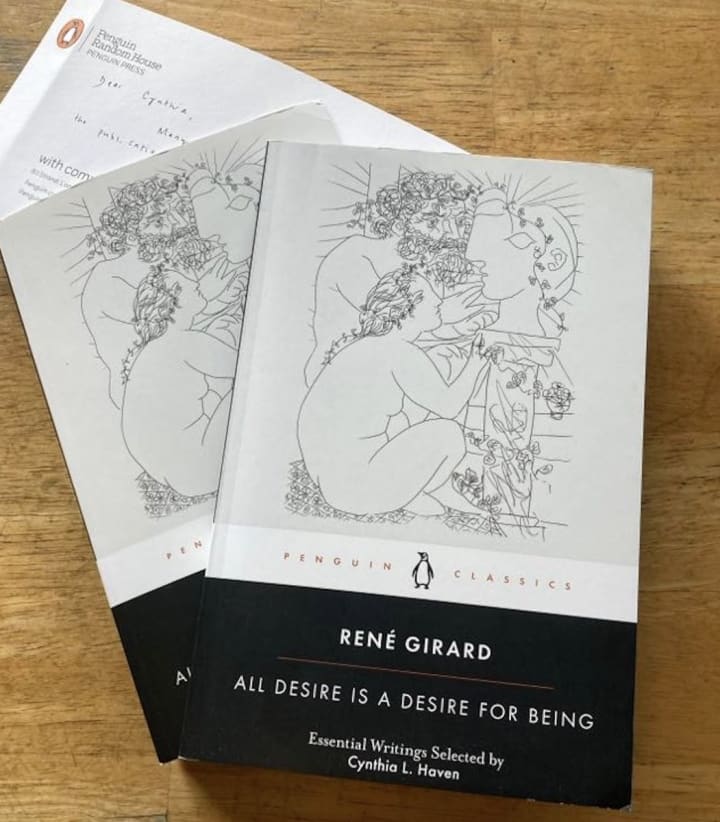
Book Review: "All Desire is a Desire for Being" by René Girard
5/5 - a readable slice of mimetic desire - I don't agree with it all, but it was a fun read...


I really don't want this to be a philosophy binge because that will hurt my brain, I know it. When I go down rabbit holes, I go far down. It's the middle of May 2025 and I've been reading a work I've never even heard of by a man I have heard of, but know very little about. All Desire is a Desire for Being is a strange philosophical text where the author looks at different human desires and how they are formed through imitation. He states near the beginning of the book: "We imitate the desires of those we admire. We want to 'become like them', to spirit away their very being." But he also goes on to clarify: "Desire is not mimetic only in mediocre individuals, those whom the existentialists, following Heidegger, branded as inauthentic, but in everybody without exception, even in those who appear the most authentic in our own eyes, namely ourselves." So, let's investigate!
"Within a highly mimetic world, the only objects we desire intensely are those that a rival prevents us from possessing. And the converse is also true: we quickly lose interest in objects that nobody wishes to take from us. This dual phenomenon frequently suffices to render our lives hellish."
Apart from being brilliantly illustrated by Lisa Simpson in Season 13, Episode 11 of The Simpsons, entitled 'The Bart Wants What it Wants' - this idea has spun yarn for centuries. I think it is safe to say that the whole luxury sector works on this very idea. Not only would the person buying the item be in competition with others. But knowingly or not, this renders the 'others' as the 'rivals' and therefore, the mundane (and possibly more valuable if we're not talking monetarily) is shoved aside for this new, expensive and, not forgetting, rare item which you are made to feel like rivals will take from you as it is so rare.
So the theory goes like this: we learn our desires through those we wish to imitate having the same or similar desires. The imitation leads to rivalries formed through in-groups and probably some cultish behaviour. It can also cause rivalries between people regarded as 'other' in the same group because now they are all going for the same object (see: Simpsons episode) and thus, these become 'rivals'. One of the things I loved about this book is the writers ability to find quite iconic and yet, unique examples of this happening in literature. For example: in the works of Dostoevsky, there is often a character that desires something based on other people's desires. This is sometimes an object, but a lot of the time it is status.
There are though two types of mediation for these desires. The first is external mediation which occurs when the model for imitation is distant. So for example, if someone is imitating the desires of celebrity or those of a fictional character. This means that there is no direct competition between the person and the model and this reduces the chance of there being 'rivalry'. The second is internal mediation which poses two people who are part of that same in-group opposite each other in direct conflict, as they vie for the same item or status. The idea of external mediation is presented best, I believe, through the authors analysis on the rules of the game as 'God is Dead' is repeated in the essay on Nietzsche and his works. But of course, it is the internal mediation that often leads to the worst outcomes.
Beyond mimetic desire lies metaphysical desire which is basically where the person doing the imitating longs to physically become the model. The author perhaps best shows this in his essay on A Midsummer Night's Dream where he shows how Helena quite literally would like to become Hermia as it is Hermia who has Demetrius follow her. Yet, in her proclamation of wanting to be Hermia - Demetrius isn't mentioned. He states:
"Helena would like to be translated, metamorphosed into Hermia, because Hermia enjoys the love of Demetrius. Demetrius, however, is hardly mentioned. The desire for him appears less pressing than the desire for Hermia's being."
That is of course true if we were to understand the dynamics of female power in the play in which Hermia has the vast majority of it, Titania perhaps has some but it is Hermia that Helena has seen to have this power. Of course, this is the power over the men. She abandons her father who takes her before Theseus and waves him off too, she takes off into the forest with her true love with Demetrius, the man Helena wants, following close behind. As Helena is the last one to enter the forest and therefore the one with the least power, there is no wonder as to why she would want to be Hermia.
The author also argues that scapegoating restores some sort of order to the chaos of these desires. As the rivalry tension grows, there is only one thing to do. A community projects these collective tensions on to an individual or group, blaming them for the chaos and expelling or destroying them. This appears to restore order and this act unites the community alongside establishing a new-found harmony. One of the ways the author depicts this is through his references to Oedipus, King of Thebes.
The author argues that Oedipus was, in fact, a scapegoat and asks us to consider what it would look like had Oedipus not been the son of Laius and Jocasta. Well, then he would just be a random guy who was wrongfully done-over by the people of the Theban kingdom. He also asks us to put aside the parentage box and focus on the fact that Oedipus was actually not from Thebes at all, in fact he had grown up and spent the majority of his life outside of Thebes. So, in fact, he was the perfect outsider to come into the city and use. The people then allowed him to walk into his future unknowingly.

There are many different authors Girard studies and analysis as a part of this book. One of them is Camus, another is Stendhal, then there's Proust and Cervantes as well. Of course, we get some ideas around Shakespeare, and through all of this, the author reveals how literature can often teach us about why humans behave the way that they do. There is that careful tip between free will, determinism and mimesis which Girard balances throughout his essays. But they still remain readable and not purposefully obtuse like a lot of philosophers are.
However, I have read some people who dislike Girard's theory that desire is mimetic as they state that humans can have authentic desires. And this is really the situation in which I had heard about the author before. Girard's theory doesn't really support the claim that humans have the autonomy to create desire and if you know how much I sit on the fence of free will and determinism then you'll know that I'm all up for reading more into it. I think Robert Sapolsky might get on well with Girard. They perhaps would not agree on exactly the same things, but they'd be able to shout to each other if they were standing 15 metres apart.
All in all, I quite enjoyed this book and I'm probably going to end it here and the review is getting a little bit long. I'm glad you had as much fun as I did (I'm only assuming) but I hope you'll give this book a go. I may not agree with everything it states but it is definitely very readable and the points are professed quite brilliantly.
About the Creator
Annie Kapur
I am:
🙋🏽♀️ Annie
📚 Avid Reader
📝 Reviewer and Commentator
🎓 Post-Grad Millennial (M.A)
***
I have:
📖 280K+ reads on Vocal
🫶🏼 Love for reading & research
🦋/X @AnnieWithBooks
***
🏡 UK
Keep reading
More stories from Annie Kapur and writers in Geeks and other communities.
Book Review: "Nausea" by Jean-Paul Sartre
I've read this book before but I have to admit, I lost my copy. I vaguely remember leaving it somewhere (like that time I left my copy of Algernon Blackwood's collected stories at a job interview once a while back - that really annoyed me because I was enjoying that). But I have definitely read it before and I can't really recall whether I enjoyed it, but I recall being conflicted from time to time. This memory was remembered through being conflicted again whilst I was reading it a second time. There were a couple of things I don't really like about this book, but they are weighted with the few things that are fairly enjoyable.
By Annie Kapur8 months ago in Geeks
Silver Screen Magic with Mae West
American actress and singer Mae West became a popular film actress during the Great Depression. She started entertaining in vaudeville, then performed on Broadway, and finally went to Hollywood. She signed up with Paramount Pictures and made her debut in the 1932 film “Night After Night.” She also starred in musicals, comedies, and crime dramas. The American Film Institute named her one of the best classic Hollywood actresses.
By Rasma Raisters9 days ago in Geeks
Jan-Willem Breure Joins the Joburg Film Festival Jury (JFF) - Septimius Awards Director becomes Judge at South Africa Oscar Qualifying Film Festival in Johannesburg
The golden horizon of South African cinema continues to expand, and the 2026 Joburg Film Festival marks a significant moment in this evolution with the appointment of Jan-Willem Breure (Director & Founder of the Septimius Awards) to its international jury. Breure, an acclaimed filmmaker and entrepreneur, brings a perspective forged through a life of global transitions. Born in Rwanda and later adopted by Dutch missionaries, his journey took him through the landscapes of Kenya and Namibia before he eventually settled in the Netherlands. This cross-continental upbringing gave him a rare understanding of the nuances inherent in African storytelling, a trait that has defined his professional career.
By postworldview2 days ago in Geeks
So You Decided To Become a Nurse Practitioner:
So you decided to become an "Advanced Practice" nurse. Congratulations!... is what I would say if this was a good idea. Grad school? In this economy? What were you thinking? Likely it was something along the lines of either 1) “I've seen these other chucklefucks do it— Why can't I?” or even 2) “I've got a nice career, I should shake it up. I miss feeling like I have no clue what I'm doing.”
By Sandor Szabo6 days ago in Fiction


Comments
There are no comments for this story
Be the first to respond and start the conversation.