
The Big Book Review: "Thinking, Fast and Slow" by Daniel Kahneman (Pt.1)
Chapters 1 to 9


This book is split into parts but honestly, the parts themselves have so many ideas that I have no idea how I could fit everything I wanted to say into ONE review. I know I haven't done this since 'Reliable Essays' by Clive James, but I'd like to try that structure again. Sorry if it's not something you enjoy but I really wanted to share this...
***
Thinking, Fast and Slow" by Daniel Kahneman (Pt.1)
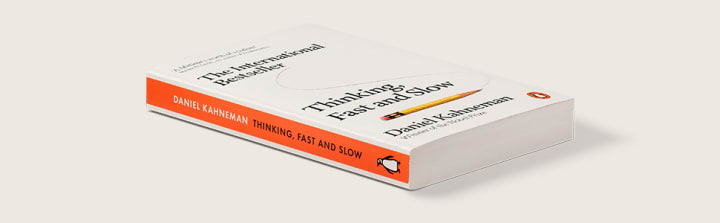
Part 1 of the book is entitled Two Systems in which we are introduced to the two main methods of thought. System 1 is the quick, low effort style of thought that I would say, often rattles around social media. System 2 on the other hand, is thought that can usually be considered more difficult or high-effort. This is normally employed when doing things like critical thinking or concentrating on a problem that needs to be solved. Kahneman makes a very clear distinction between the two of them by basically putting them into bullet points and giving us hypothetical situations to show us how they work. This use of hypothetical but often universal situations in order to illustrate a point is extremely helpful for someone who doesn't really read books about the psychology of thinking (i.e: myself).
He describes how these two systems work together, but also how they don't. We are basically constantly fighting against our impulsive brain in order to get our more attentive brain to kick in and vice versa. He states:
"Conflict between an automatic reaction and an intention to control it is common in our lives. We are all familiar with the experience of trying not to stare at the oddly dressed couple at the neighbouring table in a restaurant." (p.26)
He emphasises the fact that these systems are but fictional characters in the story of thinking but, are nonetheless massively important to our understanding of human thought and intention. I found this to be indicative of the way Kahneman himself thinks about fiction and his respect for the fact that possibly the fictional can help up understand the real, the difficult and the often incomprehensible. Yes, I might be a fiction-head but, you know, I can't help it.
Whilst doing a difficult task and employing the system 2 area of thought, Kahneman discusses how we can see effort on a person's face or in their being. For example: in these states, we can observe that the person's pupils will dilate as they begin to think (a similar thing that will happen in the 'flow state' which I am often guilty of myself. However, I have read in another book that someone in a 'flow state' can look like they are high). But he also admits that as the task depletes in difficulty, the effort required to do it also depletes. However, it also shows how people will often gravitate towards things that require the least amount of their effort, often either not building more difficult skills for the fear of not gaining the rewards necessary to make the effort 'worth it'. This is quite telling and I am probably guilty of this too:
"As you become skilled in a task, its demand for energy diminishes. Studies of the brain have shown that the pattern of activity associated with an action changes as skill increases, with fewer brain regions involved. Talent has similar effects. Highly intelligent individuals need less effort to solve the samel problems, as indicated by both pupil size and brain activity. A general 'law of least effort' applies to cognitive as well as physical exertion. The law asserts that if there are several ways of achieving the same goal, people will eventually gravitate to the least demanding course of action. In the economy of action, effort is a cost, and the acquisition of skill is driven by the balance of beneifts and costs. Laziness is built deep into our nature." (p.35)
Kahneman makes a distinction between different things within system 2 though, he states in the chapter on 'The Lazy Controller' that this second system has a 'natural speed' in which you expend mental energy on 'random thoughts and in monitoring what goes on around you even when your mind does nothing in particular' - noting that even nothing at all requires thought, effort and strain. (p.39) This combined with the fact that becoming 'skilled' at something means we spend less energy on it means that perhaps, our minds are producing random thoughts as a part of this 'skill'.
As we get into the book, we will find out that Kahneman also talks about the familiar and unfamiliar, the suppression of doubt and other things that our system 1 must do in order to kick our system 2 into action as well. From what I understand: these two systems cannot work completely independently and spend most of their time trying to control the other one or at least, guide it. Kahneman's representations of these in the real world tend to skew to the more 'simplistic' side but they are representative nonetheless. Once we as readers start to connect different ideas together we definitely realise that our own thinking is being shown here more than anything else. He will eventually show us our own biases as well.
One point I quite enjoyed in this book was the way Kahneman talks about 'flow state'. He states (by quotating a fellow psychologist) that people are sometimes able to expend energy and effort for long amounts of time if they are in a 'flow' state. This means "a state of effortless concentrations so deep that they lose their sense of time, of themselves, of their problems." And they are described as having the "optimal experience" (p.40). I have to admit that when I am reading in the depths of the night or early morning, I'm quite apt at hitting flow state. The only problem I have is getting out of it and realising what time it is. I have to admit that recently I committed this sin whilst reading the last half of The Rose Field (the final instalment in the series The Book of Dust, the follow on series from His Dark Materials - a favourite of single-digit aged me). I had been reading it for so long that the time changed from 11pm to 3am without my complete knowledge and by the time the book was over, I was thrown out of the joyful world of dust and back into this horrid, grey one. No wonder optimal joy is achieved in flow state.
Mental energy, I have learned, is actually a real thing as opposed to a distant euphemism or piece of figurative language for something else, as Kahneman states:
"...the idea of mental energy is more than a mere metaphor. The nervous system consumes more glucose than more other parts of the body and effortful mental activity appears to be especially expensive in the currency of glucose..." (p.43)
This definitely means that there is a biological reason we call something that takes a lot of effort as something that 'takes a lot of mental energy' - because, in fact, it actually does. I was quite surprised, I had no idea that thought used glucose to work and well, the way Kahneman describes it seems to suggest that it is a lot more glucose than what I was thinking whilst reading the first part of the paragraph. I love it when books give me random revelations I would have never have considered otherwise.
Apart from this, 'ideas' in this book are vast and though they take mental energy to form, they aren't without connection to other ideas. Association and associative memory is another topic that Kahneman tackles in the book - he looks at the way in which we associate ideas with other ideas and make inferences about what they might mean or suggest in particular contexts, using first and foremost the example of words like 'banana' and 'vomit' (p.51).
The idea of priming the memory to associate certain words with other words is learned, of course - but it is not, as Kahneman puts, limited to words and their associations with ideas. It can also be experiences. He states that actions and emotions can be primed by events that (the reader) may not have even been aware of (p.52-3). The power of the subconscious to store these associations is incredible. One part I found particularly poignant was the 'Lady Macbeth Effect' in which the feeling of shame causes people to buy more soap than other random items such as candy (p.56). It is a statistical oddity but honestly, through the 'priming of emotion' through experience, it makes perfect sense.
The fifth chapter of the book is titled 'Cognitive Ease' in which Kahneman discusses the way in which we distinguish between easy and strained thoughts. We are taught that when there is no threat and things are going well, our thoughts are put at 'ease'. Whereas, if things are not going well and we see a problem, we not only have an "increased mobilisation of system 2" but we also recognise the situation is going to be 'strained' (p.59). Honestly, this is simple to understand as one of the basics in psychology, but of course Kahneman takes us down the proverbial rabbit hole once again.
We are not only given the advantages of cognitive ease, but we are also given the disadvantages. Yes, it may "feel true" (p.60) but it also gives us an "illusion of truth" (p.61) to which we must admit that perhaps we are not as mechanically productive as we think we are. He opens us up to analysis by stating the following:
"Anything that makes it easier for the associative memory to run smoothly will also bias beliefs. A reliable way to make people believe in falsehoods is frequent repetition, because familiarity is not easily distinguished from the truth. Authoritarian marketers and institutions have always known this fact" (p.62).
Alongside the text and colour theory he then covers in the next paragraphs (p.63), he convinces the reader that there is definitely a likelihood as to why authoritarian belief systems tend to be carried with more sound and fury by those who refuse to employ the more critical side of the system 2 brain. I didn't suggest anything, you inferred it.
But he also states that there is a truth about this theory in testing as well, that those who score higher in tests tend to have test questions that are in fonts harder to read. Performance was often "better with bad font" (p.65) - which is why I will never understand the whole junk science around making everything as easy as physically possible (for example: the theory of easing the cognitive load) at schools when the only way to scientifically learn something is for it to be difficult to do. Only with initial difficulty is something learnt and eventually, comes ease towards that skill (see: quotation from page 35).
Thus, through this Kahneman then relates all of this back to his theories on associative memory, now quoting another psychologist who states that creativity is just "associative memory that works exceptionally well" (p.67), referencing the RAT (remote association test) study in order to do so. (Look it up, you won't be disappointed). He also gives his own analysis in which he suggests that mood can often change our access to our own intuition. I would affirm these suggestions that a bad mood often makes us less inclined to use intuition and therefore that is probably why people with chronic levels of depression stop doing things that are almost intuitive to everyone else (actions such as brushing one's teeth or regularly washing). These aren't to be looked down on, but understood as mood impacting intuition in a negative way, such so that the person in question has absolutely no idea what to do about it - and is often incapable of any plausible solution without medical intervention.
And so, we move on to 'norms' and what they are. Kahneman states in Chapter 6 of his book:
"The main function of system 1 is to maintain and update a model of your personal world, which represents what is normal in it." (p.71)
Basically you interpret and reinterpret the present, constantly adding to what is safe, normal and productive as well as molding these to suit an expectation of what is to come in the future. It is understandable enough with some context. This norm often works so well that because of it, we suspect no surprises in such sentences as "How many animals did Moses take on to the ark?" Even though, as Kahneman states, Moses did not take anything on to the ark as it was Noah who did it all. There's only slight surprise which is compromised by Moses and Noah having things like the same amount of syllables and being included in basically the same text (though in their own respective stories). It is striking how our systems will notice and often overlook something in small detail when we come to thinking of it without much strain (p.73).
During Chapter 7, Kahneman makes another judgement about us which is that we are prone to jumping to conclusions. This is useful, he states, if the conclusion is easy to come by and pretty obvious (p.79). It will save us time and effort, but anything above the obvious and we could be treading dangerous waters and misunderstandings. He speaks of experiments that were done and how it is easy to believe something when we think it is already true, but it is difficult to 'unbelieve' something we thought was initially true. It is also apparently difficult for us to believe something with think to be false and so, we are wrecked by our own confirmation biases (p.60). This brings me on to one of my favourite quotations of the chapter in which since our cognitive faculties are wound down, this would be obvious but is still clever nonetheless:
"Indeed, there is evidence that people are more likely to be influenced by empty persuasive messages, such as commercials, when they are tired and depleted" (p.81).
This brings us on to the 'Halo Effect' in which we think we like or dislike everything about someone or something even though we may not have all of the information (p.82). It is a form of confirmation bias, it is easier to conform to everything - even the things we may think are ambiguous - and so, no strained thinking is involved. We are lazy by nature. Confirmation bias is basically everywhere and unavoidable even to those who think they don't have it. But he does teach us how to deplete the impact of the 'Halo Effect' though we probably cannot be rid of it entirely:
"To derive the most useful information from multiple sources of evidence, your should always make these sources independent of each other. This rule is part of a good police procedure. When there are multiple witnesses to an event, they are not allowed to discuss it before giving their testimony" (p.84).
This is basically a great way of solving confirmation bias and of course, making sure that the 'Halo Effect' (in short: always believing you, or something you already believe, is always correct) does not take over your better judgement. This is why at work, you perhaps need to be careful of open discussion as well as Kahneman points out, it could lead to the loudest (but probably not correlated to the smartest) voices speaking first and thus, 'others line up behind them'. These others, are perhaps not as assertive in their opinions, but tend toward the more considerate on issues and thus are probably more perceptive (p.85).
This leads us on to the WYSIATI theory (what you see is all there is) in which the more overconfident individuals assert their stories and beliefs with dominance, thus telling a story of real quality - even though they may not have the information to back up that this is a universal truth (or even an acute truth). It is quite astonishing to see how people will 'die on hills' as it were, if it means affirming their own beliefs and becoming more overconfident in themselves, not able to perceive another person's point of view. This I would definitely is more viable in a man than a woman since women naturally hold more empathy (but I would not say this of all women or all men, the generalisation could kill us all). But Kahneman delights in the fact that we often have to tell ourselves these stories of quality to make ourselves believe them even more (p.87). Thus, we come to an overconfidence vicious cycle.
In Chapter 8 entitled 'How Judgements Happen', Kahneman leads us into a thought experiment about how we ourselves develop these judgements which will in turn lead to these confirmation biases. In the section 'Basic Assessments' I particularly enjoyed the way in which Kahneman developed ideas about facial theories in order to hold a mirror to our own judgements and how quickly they might happen. He states:
"The shape of a face provides the cues for assessing dominance: a "strong" square chin is one such cue. Facial expression...provides the cue for assessing the stranger's intentions. The combination of a square chin and a turned down mouth may spell trouble. The accuracy of a face reading is far from perfect: round chins are not a reliable indicator of meekness and smiles can...be faked. Still, an imperfect ability to assess strangers confers a survival advantage" (p.90).
Of course there is a biological advantage to making fast judgements and having some form of bias afterwards. It may not be 100% correct, but under most circumstances it can tell you of intention or validate your initial readings of the room. However, if we look at the neurodivergent people of our society, their faces do not always tell us of their social intentions, often they are masking or appropriating for the situation or even cannot provide us with a clear social intention altogether. I find this, therefore, to probably be an inaccurate reading on Kahneman's part. It may be a survival instinct but it definitely does not hold the complexities of our modern day within.
In a described experiment by another psychologist, Kahneman describes how people judged a politician's competence on the features of their faces and whether they exuded confidence whilst also admitting that there was no correlation between the two when it came to how the politician actually did in office. Following on from this, another group of psychologists built on the experiment by proving that voters who sought to 'automatic preferences' (such as: appearance) tended to watch more television than those who voted based on competance and policy. Also revealing that those who watched more television tended to be less informed than those who did not (p.91). Surprise, surprise.
In the section entitled 'The Mental Shotgun' within the same chapter, Kahneman admits that we often 'compute much more than we need' (p.95) when it comes to system 1 information. This is where the term 'mental shotgun' comes from - the excess of information computed that is then discarded, unused. In 'Speaking of Judgement' he reduces this back down to how we process quick information whether we like it or not:
"This was a clear instance of a mental shotgun. He was asked whether he thought the company was financially sound, but he couldn't forget that he likes their product." (p.96)
So, when we come on to Chapter 9, the final chapter of the first part of the book - we can understand that biases are very easily produced, often without or knowledge or consent. The mind definitely works in mysterious ways. One of the first statements in this chapter deals with the biases we have for or against people, whether we know them or not:
"You like or dislike people long before you know much about them; you trust or distrust strangers without knowing why; you feel that an enterprise is bound to succeed without fully analysing it. Whether you state them or not, you often have answers to questions you do not fully understand, relying on evidence that you can neither explain nor defend" (p.97).
There is something really strange about this statement. When I first read it, it felt like a warning about not taking my own biases so seriously. I tend to be naturally distrusting of other people and often think that they have worse intentions than they set out. But that, in itself, is me being biased about a situation without knowing about it - it is me judging people without knowing them. I confront it again, but I cannot get rid of it.
When we look at our biases, one thing that is often concluded (as it is in this book) is how much of a role emotion has to play in it is, in fact, far larger than we initially think. Kahneman talks about Paul Slovic's theory of the 'affect heuristic' (p.103) in which people let their likes and dislikes determine their biases and beliefs. This is probably not an ideal way to live your life, but in some cases cannot be helped, especially in our own disconnected world where people barely encounter each other in real situations anymore. Kahneman states as if he were talking directly to the reader who is learning from his wisdom:
"Your beliefs, and even your emotional attitude, may change...when you learn that the risk of an activity you disliked is smaller than you think" (p.103).
I think I can learn from this since I am so risk averse. However, carrying out a task that to me, is frightening, puts my entire mind into a state of freezing as if I were dropped into ice-cold water feet first.
Conclusion
I have come to the conclusion that there is a lot to learn about ourselves as people. I have often discussed these theories with others, online and in real life and many people seem to believe the exact same thing. It is either 'I am different and thus have fewer biases than normal' or 'I can recognise my biases before they become a problem, I am a critical thinker who can do something about them.' I think now, that both of these statements are farcical and if you honestly believe that about yourself, I have this book I want to tell you about that will destroy that farce for you.
Next Time on 'The Big Book Review' : "Thinking, Fast and Slow" by Daniel Kahneman (Pt.2)
About the Creator
Annie Kapur
I am:
🙋🏽♀️ Annie
📚 Avid Reader
📝 Reviewer and Commentator
🎓 Post-Grad Millennial (M.A)
***
I have:
📖 280K+ reads on Vocal
🫶🏼 Love for reading & research
🦋/X @AnnieWithBooks
***
🏡 UK
Keep reading
More stories from Annie Kapur and writers in Geeks and other communities.
Book Review: "The Haunted Library" ed. by Tanya Kirk
Full Title = The Haunted Library: Tales of Cursed Books and Forbidden Shelves edited by Tanya Kirk To be too impressionable is as much a source of weakness as to be hypersensitive: so many messages come flooding in upon one another that confusion is the result; the mind chokes, imagination grows congested. - The Whisperers by Algernon Blackwood
By Annie Kapura day ago in Geeks




Comments (1)
If there was ever one book that helped me make sense of the world it was this one. A very worthy Nobel winner in my opinion. I reference this work all the time, and see it reflected in so many places. An incredible work of logic.